
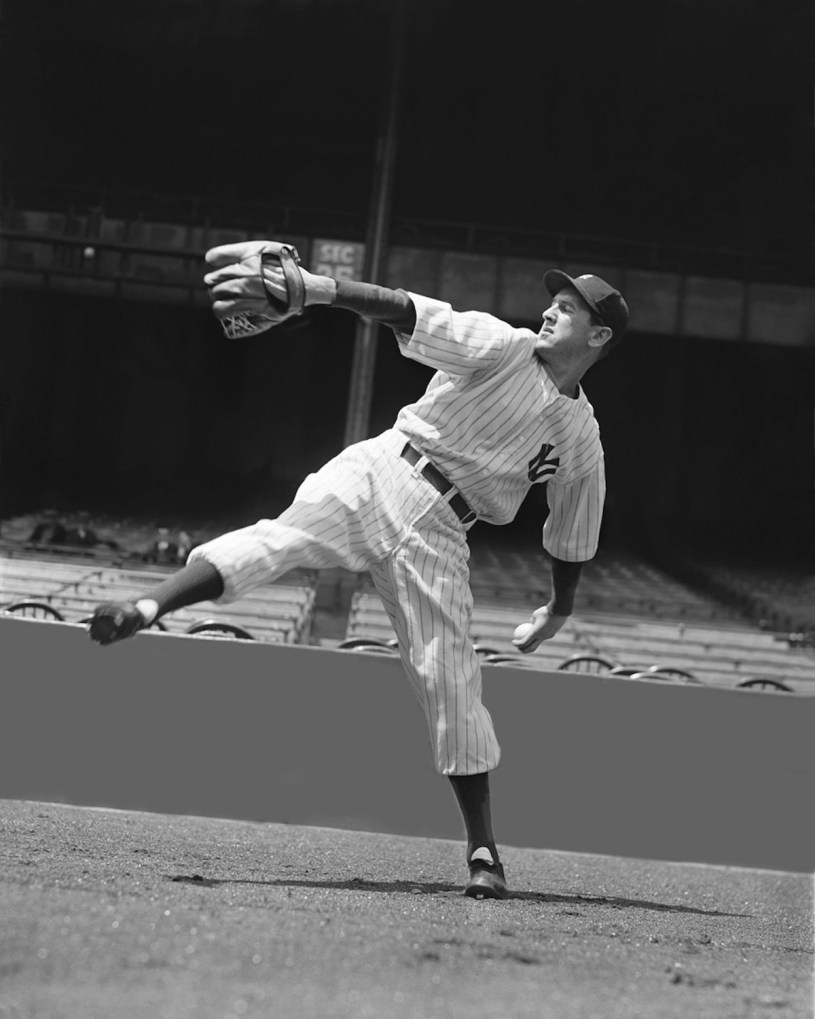
Welcome to our last Friday Funday for the month, as today we look at the career of Hall of Fame pitcher Lefty Gomez. He spent 14 seasons in MLB, including the first 13 with the New York Yankees, for which he is most known. He spent final professional baseball campaign with the first edition of the Washington Senators, actually making just a single start for that franchise. It’s a shame he didn’t just pack it in after the Yankees had used him up, because his 4 2/3 innings with the Senators just weren’t good.
But we digress: Gomez was a seven-time All Star, while winning six World Series and earning two pitching Triple Crowns as well. That certainly sounds like a Cooperstown resume, yet for all these achievements, Gomez compiled just 38.7 WAR in his MLB tenure, since he basically pitched and played for a team of All Stars at almost every position, thereby diminishing his actual value in a team-success context. Hence, the dilemmas over the sabermetric WAR valuation: was he truly great or just merely lucky?
There is no easy answer to that question.
His WAR mark puts him just 174th in MLB history as a starting pitcher, which doesn’t seem worthy of the Hall of Fame from our present-day perspective. He actually peaked on the balloting with 46.1 percent of the vote in 1956 before being admitted to Cooperstown in 1972 by the Veterans Committee. And therein lies the issue: he was a solid-if-not-spectacular contributor to a lot of championship teams, and perhaps he wasn’t appreciated by the early voting process, because there were “greater” individuals.
So, let’s assess for ourselves: we gave him two AL Cy Young awards (1934, 1937) which were the two years he won the Triple Crown. In those two seasons alone, he posted 17.6 WAR, and we have to clarify that his pitching WAR was 43.2 for his career with a minus-4.5 WAR for his hitting. Still, some pitchers can enhance their total WAR by being plate adequate, and Gomez was not one of those with his lifetime .353 OPS in 904 total ABs. This feels like a lot of disorganized informational context right now.
Starting at the beginning of his career, he was an age-21 rookie for the 1930 Yankees, as the team started to transition from the Babe Ruth era (1920-1934) to the Joe DiMaggio era (1936-1951). His 5.55 ERA in his first season, across just 15 appearances, doesn’t inspire at all, but Gomez established himself as a starter in 1931 at age 22: 21-9, 2.67 ERA, and a 1.198 WHIP. He would remain a fixture in the New York rotation through 1939, the last of his All-Star seasons, at age 30. And then his decline was sharp.
In his final three seasons with the Yankees (1940-1942), he pitched just 263 2/3 innings combined, and his collective ERA for those years was 4.20—well above his career mark (3.32). This caused the New York franchise to sell his contract to the Boston Braves in January 1943. But the Braves released him in May 1943 before the Senators took a brief chance on him. Thus, we really just have that nine-season stretch for Gomez where he was at his best: 163 of his 189 career victories were earned in that period.
He made seven straight All-Star teams from 1933-1939, and his postseason pitching was stellar, too: 6-0 in seven starts, with a 2.86 ERA and four complete games. We gave him the World Series MVP nod for 1937, as well. Gomez was on top of the world, pitching in five World Series championships (1932, 1936–1939). This equation is the result of being a pretty good pitcher while also working for the best team in the sport during prime production years. This is reflected in his WAR marks, year to year, too.
Only three times (1931, 1934, 1937) did he post 5.0-plus WAR, and his average value-added contribution for the nine-season stretch of effectiveness was 4.75 WAR. The yearly numbers dipped as low as just 1.5 WAR in 1936, too, so the consistency was a little murky, generally speaking. Yet even in that lowly age-27 campaign? Gomez still went 13-7 with a 4.39 ERA and a 1.622 WHIP. His lifetime WHIP (1.352) also reveals the weakness of his game: walking too many batters (3.9 per 9 IP). Stats don’t lie.
Thus, we see an inconsistent pitcher, even in his best stretches, who was capable of high-level greatness yet also prone to mediocrity overcome by his more-talented teammates at varying times, as well. In addition to the two Triple Crowns, Gomez also topped the AL in shutouts thrice (1934, 1937-1938). Yet only in 1934 did he top the league in WHIP. His ability to keep the ball in the park helped him tremendously, as he surrendered only 0.5 HR per 9 IP for his career; after his rookie year, he was stellar there.
Again, there was no actual Cy Young or World Series MVP award during his career, so we have granted those here in this space over the last handful of years. His actual lifetime rewards were the individual nods for the All-Star Game(s) and the team achievements in winning six World Series (even though he didn’t actually pitch in the 1941 Fall Classic)—and of course, the induction to Cooperstown in 1972. Gomez passed in 1989, so he got to enjoy that honor for close to two decades of his later life.
One final editorial note: Gomez was a local, in terms of our base operations here in the San Francisco Bay Area. He was born in Rodeo, north of Oakland, and he died in Greenbrae, across the waters in Marin County. He is buried in Mount Tamalpais Cemetery (San Rafael, also in Marin County). Vernon Louis Gomez, nicknamed Goofy as well as Lefty (since he was a southpaw), played for the San Francisco Seals as a youngster before the Yankees bought him in Summer 1929. A full biography can be enjoyed here.

