
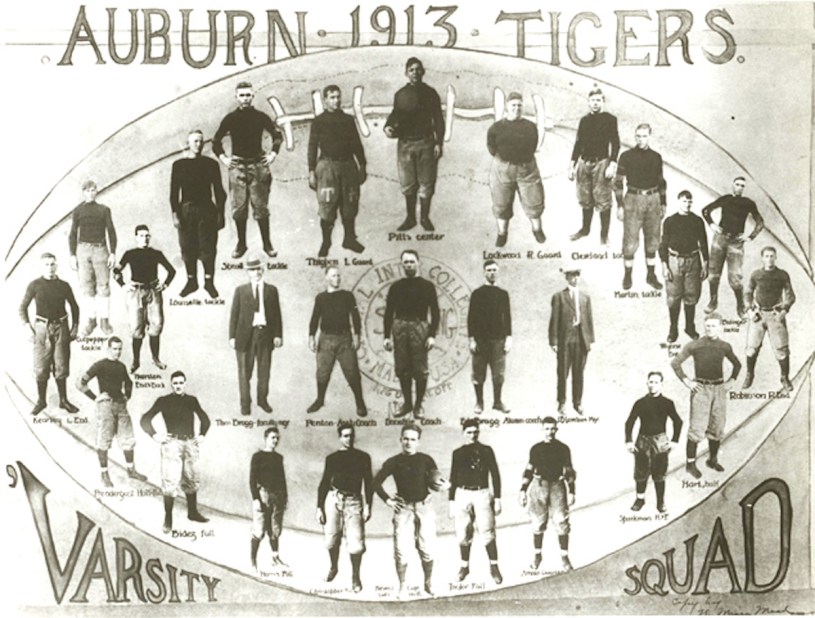
We are back on MNC Wednesday this week to look at the 1913 mythical national championship. We know the more distance we travel back in time, the less real interest there is in this sort of analysis. However, we like to finish what we start here, and it’s one lesson that always was drilled into us as Generation X seedlings in the 1970s: finish it. Thus, we continue to trudge on here until the 1901 season, when we will call it quits. We know we find this entertaining still, but we cannot speak for everyone out there.
The 1913 MNC: Harvard (Helms, NCF); Auburn (DMP)
The Crimson have been chosen retrospectively for this MNC, but as often is the case, modern sabermetrics have something to say about this, with Harvard (9-0) finishing No. 6 in the SRS with the No. 47 SOS (out of 76). It’s almost as if the experts just took the biggest “name” school of the time with the highest win total “sans loss” and just decided, “Hey, that’s our pick!” Four of the Crimson’s opponents were small schools, and Harvard only played one contest on the road the entire season. This will not do!
These are the other teams, prescreened, we are considering, in addition to the Crimson, and it’s a short list, and it is obvious why:
- Auburn (8-0): No. 1 SRS, No. 1 SOS
- Chicago (7-0): No. 2 SRS, No. 5 SOS
- Virginia (7-1): No. 3 SRS, No. 18 SOS
- Carlisle (10-1-1): No. 8 SRS, No. 29 SOS
That’s it, as all the other schools in the SRS Top 10 just didn’t have the numbers to match this small group. Already, we see that Harvard doesn’t stand a chance here in a mathematical sense. In fact, we probably do not need to go much beyond the Tigers and their top-line profile that cannot be beaten, literally. They played three road games, and all their opponents were big-time schools. Overall, Auburn outscored its schedule by a 224-13 margin. There is really no way to top this, mathematically, but we will go on.
In many years, the Maroons would be serious candidates, as all seven of their opponents were legit teams. They only played two road games, and that is a negative. Also, the math says Chicago would have been a 5.28-point underdog on a neutral field against the Tigers, and a serious gap of that nature between the top two sabermetric profiles is quite revealing. Still, props to the Maroons. Meanwhile, the Cavaliers’ one loss was to No. 45 Georgetown on the road by one point, and that hurts the overall profile a lot.
We included the Indians because we could: they played nine big-college teams, and a whopping nine matchups were played on the road. That’s crazy, but for this era and under the circumstances, we understand why. Carlisle’s loss came to No. 17 Pittsburgh on the road, and its tie came the following week against No. 35 Pennsylvania, also on the road. We suspect the Indians didn’t go back home between games, either. Overall, it’s a respectable mathematical profile, and we just wanted to expound upon it a bit here.
Therefore, we grant this MNC to the Auburn Tigers, only the second time we’ve done so in this long-standing exercise. That, in itself, may be an issue or a surprise for some. So be it: we make no apologies for our objective conclusions. As the site tagline notes, “often wrong, never in doubt …”—and we mean that! Either way, we do not want to detract from Auburn’s amazing 1913 season at all. Congratulations to the Tigers!
 Daily McPlay: (mostly) Historical Sports Analysis with TENACITY & VERVE