
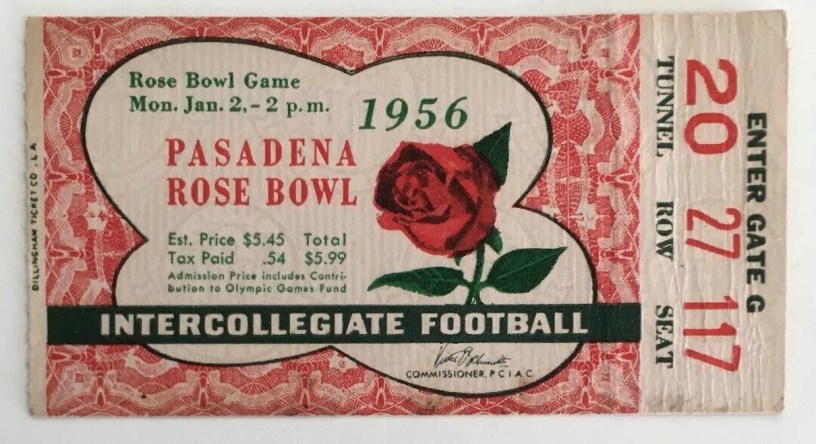
The Michigan State Spartans return to Rose Bowl Friday for the second time in three weeks, while we also celebrate the most dominant stretch of college football in the sport’s history. By our calculations and rumination, this was the fifth time in a six-season stretch (1950-1955) that the Spartans earned a mythical national championship. We know not everyone agrees, but our math and rationales are hard to contest.
Yet we digress: this was also a rematch from two years earlier when MSU defeated UCLA, as the Bruins returned to Pasadena themselves after being forced to sit out the Granddaddy of Them All in 1954 due to no-repeat rules. The Spartans were unranked into early October after second-game loss to then-No. 2 Michigan, but MSU rallied to win its final seven regular-season games and finish second in the conference.
Sparty beat ranked teams from Stanford and Notre Dame to rise to No. 6 in the Associated Press poll before the end of October, and then MSU ripped off four consecutive conference victories by a combined score of 117-21. After the Spartans beat Marquette, 33-0, in the season finale, they were ranked No. 2 in the poll—ahead of B1G champs Ohio State, ranked fifth. With the Buckeyes subject to the no-repeat rule, well …
MSU was back in the Rose Bowl, despite not winning the conference—although they never had a chance to play Ohio State, and the overall slate was higher for the Spartans due to SOS: MSU was No. 1 in the SRS and No. 14 in the SOS, while the Buckeyes were No. 12 in the SRS and No. 24 in the SOS. Sabermetrics mattered, even then … and even though the voters then didn’t even know what sabermetrics were, in practicality.
So the Spartans faced the Bruins: at 9-1, UCLA was ranked No. 4 in the AP, sat at No. 2 in the SRS, and No. 4 in the SOS. This looked to be a great matchup, as the Bruins’ only loss was a 7-0 defeat on the road in September against then-No. 5 Maryland. Eight straight victories later, and UCLA was ready to defend the Pasadena turf against Michigan State. Sparty was favored by seven points, but the Bruins were truly game.
UCLA took an early 7-0 lead, and MSU tied it before halftime. There was no scoring in the third quarter, but the fourth quarter was quite exciting: the Spartans scored on a long touchdown pass right away, before the Bruins came back to tie the game with about six minutes left. In the end, it was Michigan State kicking a field goal with seven seconds left to win the Rose Bowl by a 17-14 margin. Sparty emerged triumphant.
Overall, MSU had outgained UCLA by a 381-197 margin, but the Spartans committed three turnovers and ten penalties which hurt their ability to score points. While Michigan State could have dominated the game, the Bruins were able to keep the game close and only lost in the final seconds due to some penalties of their own. MSU certainly looked like a new power in the Rose Bowl now, although it did not turn out that way.
It would be ten more years before the Spartans returned to Pasadena, and after that, it would be another 22 seasons. UCLA made it back to the Rose Bowl within six years itself, however, before beating MSU in the January 1, 1966 game, keeping the Spartans from claiming an undisputed MNC. What was more profound, though, was that the B1G was 9-1 against the West Coast hosts of the Rose Bowl since the matchup started.
Ouch.

