
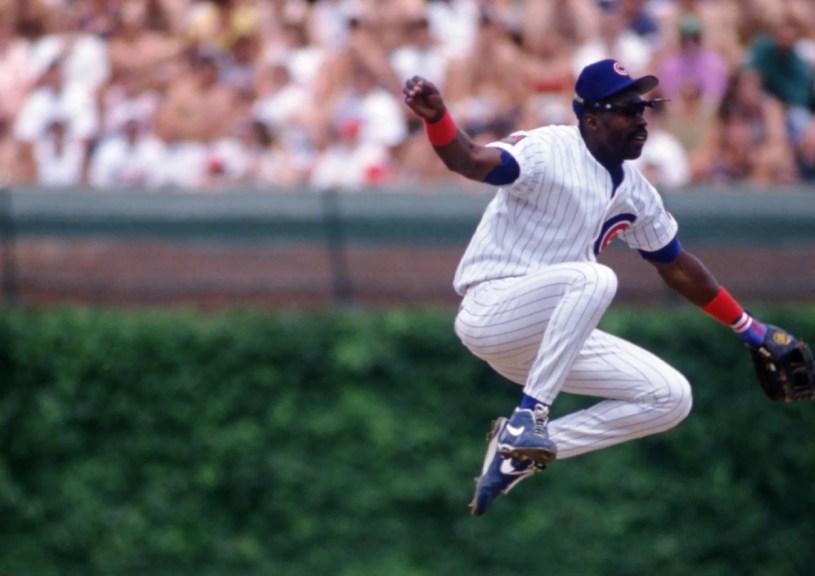
Back in October 1989, we were college freshmen, and while watching the National League Championship Series between the Chicago Cubs and the San Francisco Giants, we were simply amazed at how Cubs shortstop Shawon Dunston whipped the ball across the infield on routine grounders to his side of the infield diamond. First, it was on television for Games 1 and 2 at Wrigley Field, and then we were fortunate enough to go to Game 4 at Candlestick Park to watch it all unfold live. It was stunning, really.
What we remember most about that game in person was Giants third baseman Matt Williams hitting a two-run home run to put San Francisco ahead for good, the culmination of an insane, 12-pitch plate appearance for a young player who had not yet turned the corner, really, on his professional career. Alas, today’s MLB Monday analysis is about Dunston, though: a young All Star who hit .316 in that playoff matchup and continued to “wow” us with his arm. And we certainly were not the only ones to notice it all.
Dunston was actually the No. 1 overall pick in the 1982 MLB Draft out of Thomas Jefferson High School in Brooklyn, NY. To say his career 11.6 WAR mark was a disappointment is a slight understatement; while his career ended up being the fourth-best one of those drafted in the same round, based on sabermetric value, only one player picked in the first round finished their MLB career with more than 15 WAR—and that was Dwight Gooden, the No. 5 overall pick for the New York Mets, with 53.0 WAR overall.
By the time Gooden was winning the NL Cy Young vote in 1985, Dunston was barely making a splash in the Windy City: he debuted that same season, playing in just 74 games and logging a mere 1.5 WAR at age 22. His .698 OPS wasn’t very good, although teaming with future Cooperstown second baseman Ryne Sandberg at Wrigley Field certainly gave the fans something to cheer about after losing the NLCS in 1984, painfully, to the San Diego Padres: Dunston’s 0.5 dWAR was shiny enough to sparkle.
While he made it into 150 games the following year, his value dipped a bit, due to a .690 OPS and the fact he got caught stealing 11 times in 24 attempts. His 0.6 dWAR was steady enough, although his range wasn’t really there; so much of his defense was about that arm. He certainly had some speed on the basepaths, as his 212 career stolen bases reflect, but that wasn’t translating into as much value with the glove as one might suspect at his position. Then again with Sandberg at second, he didn’t need to do a lot.
Dunston never notched a 1.0-plus dWAR season, and his career dWAR mark (minus-1.8) certainly doesn’t impress us much. Thus, he never won a Gold Glove, and even though he made the NL All-Star teams in 1988 and 1990, Dunston really couldn’t break into the upper echelon of MLB shortstops, either offensively or defensively. In six full seasons as the Cubs’ starter at shortstop (1986-1991), he compiled just 7.3 WAR and only 1.8 dWAR. His reputation got him on to those All-Star rosters, for sure, we’re thinking.
Either way, the Chicago front office signed him to a four-year, $12M contract after the 1991 season rather than letting him test the free-agent waters, and it turned out to be a bad decision. A back injury before the 1992 season started limited him to just 25 games in two years, sadly. In the four years of that contract, the Cubs got a total of 0.7 WAR from Dunston in only 240 games, and they had no interest in extending his tenure on the North Side when he became a free agent after the 1995 season, for obvious reasons.
However, the Giants inked him to a one-year, $1.5M deal, and Dunston had a pretty decent campaign as a part-time player in San Francisco, hitting .300 even and posting 0.3 dWAR in 82 games. But that wasn’t enough for the Giants to retain his services, either, as he was going to entering his age-34 season in 1997. It’s clear the back injury not only stymied his decent career but also accelerated Father Time for him, as well. Alas, everyone loves a reunion, so Dunston returned to the Cubs on a one-year contract.
Starting at Wrigley again, Dunston did a passable job for 114 games before Chicago traded him to Pittsburgh right at the end of August, and there he played very well for the final 18 games of the season, hitting .394 with a 1.079 OPS. He earned 1.0 WAR for the Pirates in that “audition,” actually, breathing life back into his twilight MLB years, perhaps. He ended up signing with the Cleveland Indians, the defending American League champions, for the 1998 season, yet only for a $1M/one-year deal, oddly so.
Unfortunately, his age-35 season was not a good one (minus-0.9 WAR), split between Cleveland and San Francisco, where he was traded in July. The Giants would end up playing the Cubs in a one-game playoff at the end of the 1998 campaign to see which team got the NL wild card, but S.F. lost to Sammy Sosa and Co. Once again, Dunston was unemployed. His vagabond journey continued when the St. Louis Cardinals signed him, although they traded him to the Mets in July, a third trade in three seasons.
His WAR contributions in all these stints was negligible, of course, as one might surmise from that career mark above. But the Cardinals brought him back for the 2000 season at age 37, as by now, Dunston had become a decent utility man with a lot of wisdom to impart to his teammates. For St. Louis, he played every position but second base and catcher, and the Cards got 0.3 WAR out him in 98 games on their way to the postseason. There, he hit .429 in limited play as the Cards lost the NLCS to N.Y.
Now at 38, Dunston would play his final two seasons in a third stint with the Giants: however, the Giants had changed a bit, of course, at this point, not only playing in The House that Steroids Built—but also getting mixed up deeply with the BALCO scandal. And perhaps Dunston was not immune to that: he had his best season in a decade in San Francisco during that 2001 campaign, posting 1.5 WAR and an .800-plus OPS for his first-time ever in something resembling a “full season” (88 games).
Of course, the Giants had chosen to give a washed-up utility guy $2M for two years in his late 30s, and they expected something in return for their investment. Yet the “magic” didn’t last to 2002, which turned out to be Dunston’s final MLB season. Clearly, he didn’t like it in San Francisco that much, as his WAR cratered to minus-1.6 WAR at age 39, based on a .536 OPS. There’s no need to explain this here, but we’ve seen that happen a lot before in our prior analyses: something in Dunston just didn’t like the “water.”
Yet he had one last chance to win a World Series ring in October 2002, and despite his .750 OPS in eight games, the Giants lost Game 7 of the 2002 World Series to the Anaheim Angels. It was the only time Dunston reached the Fall Classic in an 18-year career with six different franchises, and he came up just short of the championship despite playing on a loaded team of PED users. Again, we suspect he dabbled in 2001 and didn’t like it, and then he hung around for his last payday, hoping for a ring. Oh well.
His minus-0.9 dWAR with the Giants in that last campaign pushed his career mark even deeper into negative territory, but we remember the arm from his youth; he also made close to $25M in his MLB lifetime as a player, so we appreciate that bonanza for him. Injuries can sap up even the best of talents in professional sports, and even though Dunston, in his prime, was just an above-average player, he probably could have done a lot more in his time if the back had not given out on him at such a young age.

