
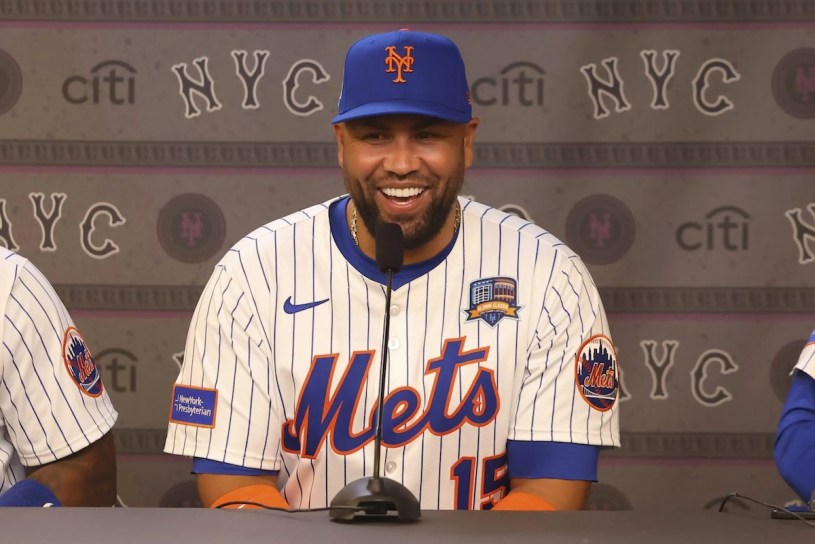
We return to MLB Monday today with our take on longtime outfielder and Cooperstown inhabitant Carlos Beltrán. A controversial figure in the sport for many reasons (which you can read about here), he was just inducted into the Hall of Fame this past summer. He compiled 70.0 WAR in his 20-year career, playing from 1998-2017 for seven different major-league franchises, while hitting .279 overall, delivering 435 home runs, 312 stolen bases, and an .837 OPS augmented by a combined 1.9 dWAR.
Along the way, he won the 1999 American League Rookie of the Year vote (which we did not agree with in our analysis), three Gold Gloves, and nine All-Star nods. Ironically, he was deprived of a World Series title in 2013 when his team had to face the Fenway Frauds, and then a few years later, he was perhaps the leader of the 2017 World Series champions, the Houston Trashstros. We were fine with his entrance to Cooperstown as discussed, in brief, a few years ago, which is not something we deeply analyzed.
Now we can … better late than never, right?
On with the show: Beltrán was drafted in the second round of the 1995 Draft by the Kansas City Royals out of Puerto Rico, and he made his MLB debut at age 21 in the final month of the 1998 campaign. His debut was brief (14 games) and solid enough (0.3 WAR); the Royals made him their starting center fielder in 1999, when he went on to win that aforementioned 1999 AL ROTY nod. The 4.7 WAR mark was impressive, too, with 22 HRs, 27 SBs, and 108 RBI on his stat line—not to mentioned 2.3 dWAR.
Although Beltrán was generally a pretty good player during his K.C. tenure, he never topped the league in anything significant, despite posting 16.7 WAR combined from 2001-2003. Still, the Royals were not going to be able to retain his services, financially, so they traded him in late June 2004 to the Houston Astros, where he proceeded to tear up the National League with 23 HRs and 28 SBs—without getting caught once—in 90 games, helping his new team climb from fifth place to an improbable playoff berth.
(Interestingly enough, he earned his first All-Star nod for the NL, despite just joining the senior circuit a few weeks before the roster was finalized.)
His combined 6.8 WAR between Kansas City and Houston was his career high at that point, and then his 2004 postseason efforts in helping the Astros reach an amazing NL Championship Series against the St. Louis Cardinals put him on the edge of superstardom—both financially and popularly. At age 27, Beltrán just had begun his prime-years stretch, and he ended up signing a seven-year, $119M deal with the New York Mets. That actually seems tame by today’s pay scale for talent, but it was big then.
Over six-plus seasons with the Mets, he provided mixed results (31.1 WAR): just 2.9 WAR in 2005, but a whopping 8.2 WAR in 2006, followed by 5.4 WAR in 2007, and 7.0 WAR in 2008. At age 32 in 2009, he dropped down to 3.6 WAR (in only 81 games) before cratering in 2010 with 0.7 WAR in 64 games. Knee injuries had sapped him of his speed on the base paths, and from 2010 onward, he stole just 26 bases in his final eight years combined. This was a definite demarcation line in his career capabilities, too.
Beltrán recovered enough overall to start 2011 off pretty well, earning 3.4 WAR in 98 games with the Mets before they traded him, in the final season of that big contract, to the San Francisco Giants. But he only managed to get into 44 games with his new team, which went from three games up in first place to a 26-32 finish on the year and no postseason berth. His .920 OPS with the Giants was impressive at age 34, but the San Francisco organization chose not to pony up the desired cash at the end of the year. Ho hum.
(Interestingly enough, the Giants traded pitching prospect Zack Wheeler for him—who just notched 6.0 WAR for the Philadelphia Phillies in 2026 at age 36. Wheeler himself has compiled 46.6 WAR in his career with the Mets and the Phillies. Bad trade?)
He ended up signing a two-year, $26M deal with the Cards, and 6.2 WAR later, he’d helped them teach the 2013 World Series: he drove in 15 runs over 17 postseason games, but St. Louis came up short of winning a championship. But it was enough to get the New York Yankees to ink him to a three-year deal, this time worth $45M, even at age 37. This reflected more the market changes than Beltrán’s actual worth, of course, as his age was really catching up to him now: he posted 2.8 WAR combined in pinstripes.
In fact, the Yankees all but dumped him in 2016 on the Texas Rangers for the final 52 games, although his OPS in 2016 was quite respectable (.850). Yet he really did drop off with the Rangers in the end (.776). Entering his age-40 campaign, it was surprising to see the budding Astros offer him a $16M, one-year deal. His .666 OPS (no joke) in 129 games certainly was not worth that money, nor was his negative-1.1 dWAR, even though Beltrán was mostly a designated hitter at this point. But we all know how this ends.
The Trashstros, with Beltrán reportedly leading the way in the clubhouse, won their first-ever World Series. The sign-stealing scheme was his greatest contribution, sadly, as he managed just a .440 OPS in 10 playoff games—clearly the cheating wasn’t helping this old man at the plate, even if it did wonders for his teammates in the Houston lineup. Either way, this was the final season of his long career, and as noted, generally we’re fine with him in the Hall of Fame, despite the negatives of this episode.
Why? Well, it was one season; it didn’t help him, specifically; and we can see why he did it after feeling screwed perhaps by 2013 and realizing it was his last shot at a title. That doesn’t make any of it right, obviously, and it’s not as bad as doing PEDs, really. Beltrán ranks as a Top 10 center fielder, historically, in terms of overall WAR, even if he played his last handful of seasons (2011-2017) in right field and DH. Again, his cheating didn’t directly benefit his own statistics, so we’re not going to fuss over it here.
And that is that: he made around $222M in the sport, achieved some incredible things, and won a World Series in the end. Beltrán also paid the price for his transgressions by losing his managerial gig with the Mets, who hired him after the 2019 season to be their manager—but fired him before he managed a game for them, due to the sign-stealing revelations that came out publicly. Thus, consequences were served, even if temporarily. That is enough for us, in this case, as the punishment fit the crime. Amen.

