
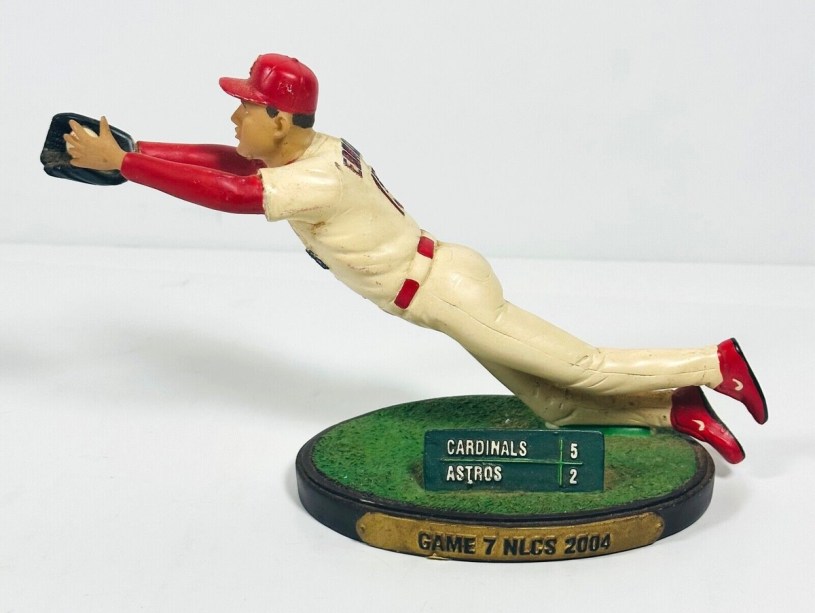
Continuing with our fun exploration of the past today on MLB Monday, it is time to look at the major-league career of centerfielder Jim Edmonds, four-time All Star and eight-time Gold Glover. In a 17-season journey, he compiled an impressive 60.4 WAR, placing him 15th in history, currently, among players at his primary position. This begs the question: why is he not in the Hall of Fame? He somehow only received 2.5 percent of the vote in his only year on the ballot (2016), and that was that. Hmm.
Let’s explore this conundrum, shall we?
Drafted by the California Angels in the seventh round of the 1988 Draft directly out of high school, he made his MLB debut with the team in in 1993 at the age of 23. In only 18 games, he didn’t do much to impress on the statistics page, yet the Angels saw enough in him to let Edmonds earn the left field starting spot during the course of the strike-aborted 1994 campaign. In 94 games, he posted a .720 OPS while also contributing 0.3 dWAR, demonstrating a decent level of production for his inexperience. Next?
Edmonds exploded onto the scene with a stellar 1995 season where he posted 5.6 WAR, an .888 OPS, and 1.6 dWAR while sliding over to the Angels starting CF slot. He was named to his first All-Star team and finished 14th in the American League MVP voting. No doubt he might have finished higher if not for the team’s 24-34 slump over the final two months of the season that cost California the AL West Division crown. The Angels actually lost a one-game playoff to the Seattle Mariners, getting drubbed 9-1.
Either way, the baseball world knew Edmonds now: he followed up that breakout year with another impressive effort in 1996 at age 26, putting up 5.0 WAR in only 114 games, delivering a .946 OPS, and defending centerfielder to the tune of 1.2 dWAR. Alas, he earned no accolades for his efforts, although his salary for 1997 jumped more than 300 percent as a result via arbitration: he made over $2M in 1997, when his OPS dropped (.868)—although he did win a Gold Glove for the first time, perhaps overdue.
Another raise in 1998, this time to almost $3.2M for his age-28 year, resulted in a consistent presence at the plate (.874 OPS) and in the field (his second Gold Glove, although he was getting by on reputation at this point). The Angels still had not reached the postseason since the 1982 campaign, but Edmonds was a fan favorite at this point, and another raise in 1999 brought his annual salary over $3.5M. When he managed to play in only 55 games at age 29, the team’s front office decided not to pony up anymore.
The Anaheim organization traded their star CF to the St. Louis Cardinals before the 2000 season, in exchange for veteran pitcher Kent Bottenfield and rookie infielder Adam Kennedy (two scraps, basically). The former would be out of baseball after 2001 and the latter posted 20.9 WAR in a 14-year career, although Kennedy did win the AL Championship Series MVP vote in 2002 as the Angels went on to somehow win the World Series for the first—and only time—in franchise history. Still, it was not a good trade.
Now at age 30 and making $4.5M, Edmonds was about to embark on the best stretch of his career: from 2000-2004, he totaled 32.3 WAR and won five straight Gold Gloves in the National League (with a combined 3.7 dWAR). In the process, he also saw his compensation skyrocket to over $12M in 2006, when the Cardinals miraculously won their own World Series after losing one to the cheating Boston Red Sox in 2004. Edmonds finished Top 5 in the NL MVP voting twice (2000, 2004) in an era of PED users.
His .947 OPS over eight years in St. Louis stands out, however, while his .890 OPS in October also is quite impressive while with the Cardinals (61 playoff games). One could argue he certainly deserved those salaries, although we also have to point out he was playing next to Mark McGwire for his first few seasons with the club—although there is no suggestion that Edmonds was dipping his toes into the PED pool. His peak noted above came from age 30 to age 34 seasons, which is still comprehendible in all context.
Edmonds certainly had something to prove after the Angels dumped him, so we cannot underestimate his motivational drive. And, of course, at age 35, he did begin a noticeable decline, even before the Cards won the Fall Classic in 2006. In his final four seasons (2006-2008, 2010), he only managed a relatively minuscule 3.5 WAR, and most of that came in his final campaign (2010) after he took the entire 2009 season off, ostensibly to heal/rest. Overall, his general career arc fits within acceptable parameters, overall.
That being said, he finished his MLB career with a .903 OPS, a 132 OPS+ mark, and 6.4 dWAR, to go along with 393 home runs. Edmonds made over $85M in his career, won a World Series title, and collected plenty of other accolades on his journey through professional baseball. So, why isn’t he in the Hall of Fame? Good question. We haven’t been able to find an answer why he is not, and we feel those ballots in 2016 shortchanged him a lot consider these incredible career numbers, both counting and sabermetric.
One thought: Edmonds never led the AL or the NL in any categories, and maybe that hurt him. Of course, again, he was playing in a PED era, so in comparison, perhaps that’s why he never led the league in anything. There are 21 centerfielders in the Hall, and he is the 15th-best one at the position all time, based on sabermetric profiling. Thus, there are six guys in Cooperstown at his position with inferior sabermetric careers. Maybe the pollsters just didn’t like Edmonds, which would be garbage rationale for sinking him.
We assume this error will be fixed in time, but it’s a shame it had to happen in the first place, right? Maybe it was the four teams he played for in his final two seasons (San Diego Padres, Chicago Cubs, Milwaukee Brewers, Cincinnati Reds), giving some impression that he hung on too long. Yet he contributed 1.1 WAR in 85 games to the Cubs’ cause in 2008 and 2.0 WAR in 73 games to the Brew Crew in 2010. He was inconsistent after his peak, but that happens to a lot of guys in their late 30s, generally.
There’s just no reason he should not be in Cooperstown, at least none we can discern. If anyone knows of one, please enlighten us.
 Daily McPlay: (mostly) Historical Sports Analysis with TENACITY & VERVE