
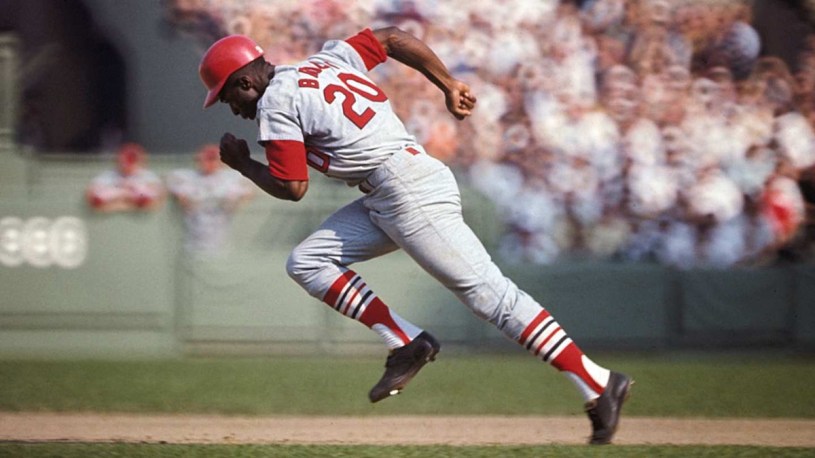
The MLB Monday column returns this week to examine the statistical career of a guy we learned all about in the early 1980s, growing up in the San Francisco Bay Area: Lou Brock. With nicknames like “The Franchise” and “The Rocket”, it’s easy to see how he captured our little baseball imaginations as we watched Rickey Henderson play for the Oakland Athletics in that time period. As Henderson closed in on the single-season stolen base record, Brock loomed large. Truly.
From 1961-1979, he stole 938 bases in the majors, and we are proud to say that we were at the A’s game in 1991 when Henderson stole Number 939. Since Henderson broke into MLB during the 1979 season, there had been some symbolic passing of the torch, even though Brock—playing for the St. Louis Cardinals at age 40—didn’t set foot on the same diamond(s) at the same time as Henderson, playing for Oakland. There was no interleague play back then, of course.
But we digress: Brock played from 1961-1964 for the Chicago Cubs, before they traded him to St. Louis just in time for him to spark the Cardinals to the National League pennant and the World Series championship. With the Cubbies, Brock hit .257 in 325 games across parts of those four seasons, posting a .689 OPS in the process—not that special. He only stole 50 bases with Chicago, too, so it’s clearly the Cubs did not realize what his strengths were at the time, nor did the sport itself.
Stolen bases weren’t all that valued in the early 1960s; remember, this was the era of expansion and a lot of home runs, although the base paths themselves had not been all that popularized before expansion, either. Brock’s best full season with Chicago (1963) still only featured 24 SBs in 36 attempts, which is interesting looking at that ratio now. Clearly, the Cubs manager—Bob Kennedy—didn’t really know how to maximize the talent Brock brought to the table. However …
Brock’s overall career stolen base rate is right about where one might expect it to be (75.3 percent). Due to the high volume of attempts in his career, though, he actually “led” the league in getting caught seven times in his MLB tenure. For comparison’s sake, Henderson only topped the league in caught stealing five times in 25 seasons while posting an 80.8-percent rate of success. We’re not here to argue which player was better, as they each clearly dominated their own eras.
Once he joined the Cardinals organization, though, in mid June 1964, Brock seemed to be a different player: he hit .348 for St. Louis with a .915 OPS in 103 games. That was worlds better than any numbers he had posted with the Cubs, and maybe the Cards superior lineup/roster had something to do with sparking Brock in his age-25 season. Maybe it was the coaching staff in St. Louis; we know it wasn’t steroids, that’s for sure, although this kind of turnaround today … yeah.
Brock would never again be that good in his career, as in 16 seasons with the Cardinals, he hit a combined .297 with a .761 OPS for overall career marks of a .293 BA and a .753 OPS. In three World Series with St. Louis, he hit .391 overall with a 1.079 OPS to go with 14 SBs in 16 attempts. He clearly shone on the brightest stage, and while the Cards went his final 11 seasons (1969-1979) without making the postseason again, Brock led the NL in steals five more times, including 1974.
That was the year he stole a record 118 bases in 151 attempts, at age 35, no less. He hit .306 and posted a .749 OPS that year, too, to accrue 4.0 oWAR. His defense had never been great, and he ended up with minus-16.8 dWAR overall, which is pretty ugly for any outfielder. However, in 10 different seasons with St. Louis, he earned MVP votes, peaking in 1974 when he finished second in the vote. His best sabermetric year, though, was 1964 when he finished with 5.9 WAR overall.
Career-wise, his 45.3 WAR total is low due to the poor defense. A six-time All Star, Brock is in the Hall of Fame, appearing on 79.7 percent of ballots in his first year of eligibility (1985). We have no issue with that, although his WAR number places him just 38th overall among MLB leftfielders in history. That’s not stellar, but then again, only one of those other guys stole as many bases as he did, right? Fair enough: we do not quibble with this at all. He changed the game.
Literally.
Without Brock, there is no 1976 A’s team running wild; there is no Henderson; there is no Vince Coleman, et al. You can read more about the man here, of course, but remember his peak years (1966-1974): he topped the NL in steals eight times in that stretch, from age 27-35. In a lot of ways, that fits a lot of analysis for what a player’s best seasons of production are in the sport. Yes, Brock did pretty well into his mid-30s, for sure, so like many greats, he is an anomaly: understood, yo.
In his final seasons (1975-1979), he still hit over .300 three times, even though his SB totals declined a lot (185 combined in though five seasons). His SB success rate in his late 30s? Still a respectable 70.9 percent through those later years when most guys don’t even dream of attempting a single steal. Brock was still running the NL off the base paths, inspiring a generation of speedsters who would help many teams win a lot of games in the 1980s and the 1990s—not just Henderson.
That is his legacy, and we applaud it.

