
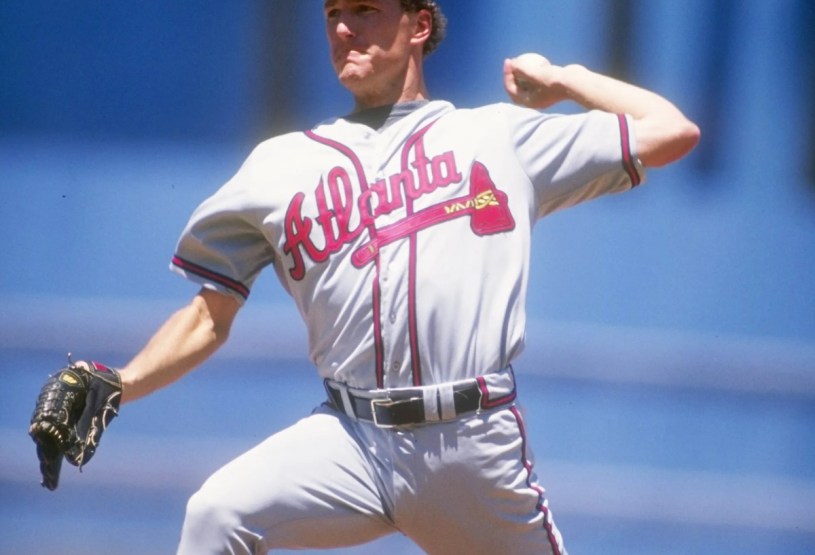
It’s been three weeks since our last Friday Funday column, and we move forward in 2026 with another entertaining piece on a random MLB player from the past: Charlie Leibrandt. His career 33.4 WAR mark places him 234th among all starting pitchers in baseball history, not too far behind such overrated luminaries as Madison Bumgarner (37.2 WAR, 204th). Of course, neither player is in Cooperstown, right?
Indeed.
We only bring up MadBum since there’s this mythos around him thanks to some unreal performances that defy logic, both on the mound and at the plate. But we digress: this is about Leibrandt. Sadly, our enduring memory of him is giving up the walk-off home run in Game Six of the 1991 World Series. The image of his slumped-shoulder walk from the mound remains in our minds as one of the saddest things we ever saw.
His Atlanta Braves would go on to lose Game Seven, of course, in extra innings, too. Leibrandt was a key contributor to the franchise’s first pennant in decades, posting a 15-win season with a 3.49 ERA for the Braves, but his 0-2, 5.06 ERA in the postseason hurt the team in October, of course. Yet Atlanta never would have been there without him, and he came back in 1992 at age 35 to post an even better season. Good on him.
The story of his career, however, is much more than that pitch to Kirby Puckett in Game Six. He broke into the majors in 1979 with the Cincinnati Reds, pitching in three games before moving into the team’s 1980 rotation at age 23. He won 10 games with a 4.25 ERA, but Leibrandt didn’t really distinguish himself for a club that won 89 games to finish third in the National League West: he was mostly in the minors for 1981.
Overall, he struggled to a 16-17 record from 1979-1982 with Cincinnati across 315 2/3 innings, posting a 4.45 ERA. He didn’t pitch at all in the majors in 1983, as the Reds traded him in June to the Kansas City Royals. There, over the next six seasons, though, Leibrandt established himself as a reliable major-league starting pitcher and thrived to the tune of 76 victories, a 3.60 ERA, and 10 complete-game shutouts. Shame on Cincy.
He earned Cy Young votes for the only time in his career after the 1985 season, when he posted 6.6 WAR for the eventual World Series champions. He shone again in 1987 at age 30 by putting up 6.0 WAR. But by 1989 at age 32, he was starting to fade a bit, as he failed to toss 200-plus innings for the first time since 1984. His 5.14 ERA was unsightly, too, and after earning $2.5M combined in 1988 and 1989, the Royals let him go.
Enter the rebuilding Braves.
Atlanta gave him a four-year, $7.8M deal to basically be a mentor to a trio of up-and-coming starting pitchers: Steve Avery, Tom Glavine, and John Smoltz. You may have heard of them?! And under the tutelage of a fantastic pitching coach—Leo Mazzone—both Leibrandt and the youthful arms thrived enough to win the 1991 and 1992 NL West and league pennants, unfortunately losing both World Series.
But again, Leibrandt was never better in his career than he was with the Braves: 39 wins, a 3.35 ERA, and a 1.197 WHIP in three seasons (1990-1992) across 585 regular-season innings. At his age, he probably just was tired come the playoffs both Octobers, as he failed to win a game in either postseason while putting up a mediocre 4.67 ERA. However, no one ever accused Leibrandt of failing the franchise: mission accomplished.
By 1993, though, the Braves felt they needed a younger back end to their rotation, and they traded Leibrandt to the Texas Rangers in what amounted to a bit of a salary cleansing ($2.8M). At age 36, it would be his final MLB campaign, and the heat in Dallas didn’t agree with his aging body. His 4.55 ERA across 26 starts and 150-plus innings signaled the end of his distinguished career, and Leibrandt never pitched again in MLB.
Overall, the southpaw finished with 140 victories while posting just 4.4 Ks per 9 IP over the course of his career. He got guys out with guile, location, and moxie, really, one of the last of the lefty junkers, as we used to call them in the late 1980s and early 1990s. He kept the ball down, ironically, giving up just 0.7 home runs per 9 IP through his time in MLB, and he let his defense do their work behind him when the ball was in play.
A guy like Leibrandt would not get a second look today, that’s for sure. We love what he did with his talents, though, in winning a World Series with the Royals and helping revitalize the Braves organization in Atlanta. Never an All Star, he was nonetheless a very important cog in three pennant-winning teams in his career, and that’s probably the highest praise any grinder like Leibrandt can hope to achieve in sports today.
 Daily McPlay: (mostly) Historical Sports Analysis with TENACITY & VERVE