
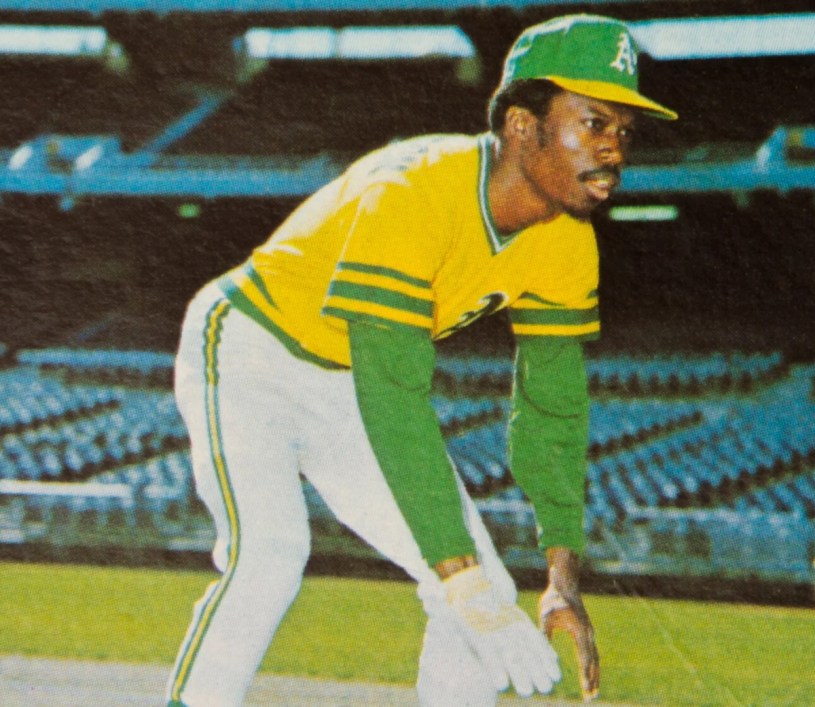
Our last MLB Monday of the year explores the interesting season for the 1976 Oakland Athletics, a team that finished second in the American League West with an 87-74 record after winning the five prior division titles from 1971–1975. The Kansas City Royals posted a 90-72 mark to advance to October while the Swingin’ A’s dynasty came to an official end. But the Oakland organization did not go down without a fight in ’76.
Despite roster decimation brought about by the start of free agency, the A’s retooled the roster the best they could under a new manager (Chuck Tanner) who would win the World Series in 1979 with the Pittsburgh Pirates. Under the leadership of an eccentric owner/general manager (Charlie Finley), the team’s farm director (Syd Thrift) would go on to be the GM of both the Pirates (1985-1988) and the Baltimore Orioles.
So, basically, the Oakland front office still had chops even after losing many of the great players that helped the franchise win three consecutive World Series from 1972–1974. What stars remained? Well, the “lesser” ones on offense (first baseman Gene Tenace, shortstop Bert Campaneris, third baseman Sal Bando, and left fielder Joe Rudi) and only a few on the pitching staff (starter Vida Blue and closer Rollie Fingers).
All of these position players definitely had their moments for the A’s over the years, but they were mostly complementary parts. Yet the team also featured some newer players who would go on to have notable careers, players like Don Baylor and Claudell Washington. But the rotation really only had two legitimate starters (Blue and Mike Torrez), and the offense ended up being driven by a surprising, record-setting idea.
Steal like it’s your job.
Only five teams since 1903 have stolen more 300 bases in a season, and the 1976 A’s hold the AL record still with 341 steals. They also got thrown out 123 times, but that came with the territory: Oakland tried to run its opponents off the diamond, and it sort of worked—while it also did not. The team’s Pythagorean projection (91-70) shows than Tanner may have mismanaged the team a little bit, but he was doing what he could do.
The team only hit 113 home runs, so the power was missing from the aging lineup. Only Bando (27) and Tenace (22) delivered more than 15 HRs, individually, while eight players stole at least 20 bases, giving the team a strange formula for success: run, run, run. While five players earned Top 20 MVP votes (Rudi, Bando, Tenace, Fingers, and Blue), this team is notable for the fact it stole so many bases to set an AL record.
Blue topped the team in WAR (7.3), finishing sixth in the Cy Young balloting, after he’d won the award in 1971. Bando was the leader for position players (5.8 WAR), so there were stellar seasons in the bunch. Yet it was center fielder Bill North who topped the majors with both 75 SBs and 29 CS. In his age-34 season, Campaneris stole 54 bags, while Baylor—at age 27—stole 42 bases himself. Yes, that Don Baylor … crazy.
The team also had two designated runners, really: forget Herb Washington. Both Larry Lintz (31 steals) and Matt Alexander (20) were part of the SB Brigade in Oakland, combining for just 34 plate appearances together in 129 games. Officially, Lintz—who hit .232 with Montréal and St. Louis prior to joining the A’s—went 0-for-1 on the season at the plate, while Alexander posted a 1-for-30 batting line with Oakland. Doh!
Overall, it’s an interesting roster to dissect, with the strengths being the base stealing, the two dominant starters, and the established closer. It’s not a bad recipe for an undertalented team to employ, in truth, if the specific horses are present: Blue and Torrez combined for a whopping 76 starts, giving the team 34 victories between them with a 2.42 ERA in almost 565 innings combined, while Fingers added 20 saves and 13 wins.
Those three pitchers along shouldered much of the load for this staff, but other relievers piled on Fingers’ 134 2/3 IP as well: Stan Bahnsen (who won the 1968 AL ROTY vote) and Paul Lindblad combined for 14 victories and five saves in 277 2/3 IP themselves, which is pretty incredible for a team to have three relievers posting over 100-plus IP each. Bahnsen actually started 14 games, too, which helped, but still? Workhorses.
No one jacks a relief staff like that these days, of course. These five pitchers tossed 957 innings out of a team total of 1,459 1/3 IP overall. The A’s team ERA (3.26) was built on the arms of these guys, and combined with base stealing, the Oakland franchise found a unique way to stay competitive in a new era of economics in the sport that robbed the roster of its star power. No one can ever say Finley wasn’t an interesting genius, eh?
 Daily McPlay: (mostly) Historical Sports Analysis with TENACITY & VERVE