
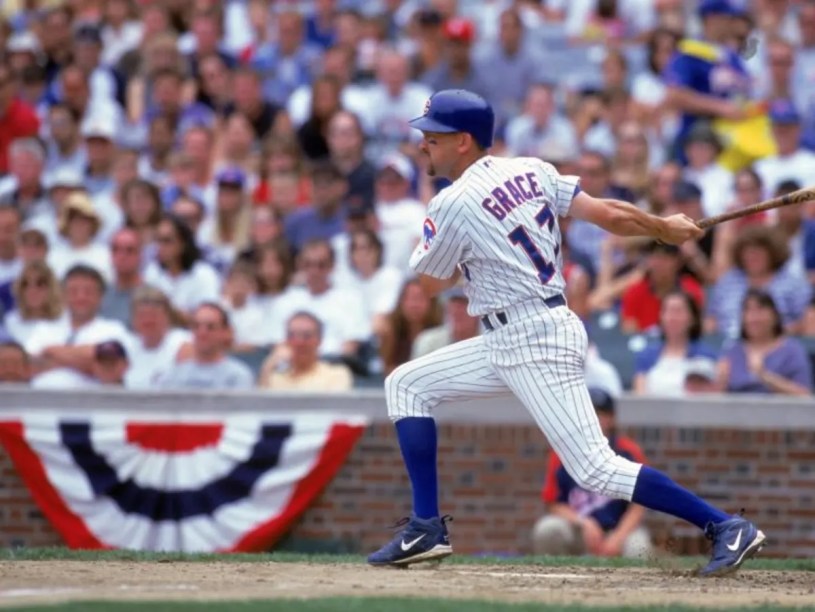
We are back on MLB Monday with another look at a historical player from the past: this time, it’s Mark Grace. He once dated television darling Janine Turner, showing just how much he was “liked” in the early 1990s. But we digress: while the moms we grew up with in our small Northern California town may have liked his butt, we as baseball fans preferred to examine his on-field abilities—and they were a mixed bag.
Grace hit .303 across his 16-year MLB career, yet he’s not in the Hall of Fame despite winning four Gold Gloves (compiling a total of 0.1 dWAR in those four seasons, though) and posted a 119 OPS+ mark. His 46.4 career WAR falls short of Cooperstown standards, of course, as he rates out as just the 43rd-best first baseman in MLB history. He falls into the very-good-but-not-great category of players ever to take the field.
He was a three-time All Star (1993, 1995, 1997) and a World Series champion in 2001 with the Arizona Diamondbacks after spending the first 13 years of his career with the Chicago Cubs. He also hit .329 in 25 postseason games with both franchises combined. In the 1989 National League Championship Series, he hit .647 with 8 RBI even though his team lost in five games to the San Francisco Giants. That was his “arrival” …
Grace broke into the majors with Chicago in 1988, finishing second in the NL ROTY vote, despite just 1.0 WAR. But he hit .296 with a 119 OPS+ mark, setting the tone for his career at the plate. It was his defense that was atrocious early on, though, as he compiled minus-3.3 dWAR in his first two seasons combined. In 1989, he still posted 4.0 WAR, hitting much better in the process (.314 BA, 139 OPS+) to earn MVP votes.
Sadly, though, the Cubs would not make the playoffs again until 1998, so Grace’s prime seasons—through 1997—were somewhat wasted. He compiled 33.6 WAR from 1989 to 1997, while the Chicago franchise mostly floundered. He was then in his age-34 season when teammate Sammy Sosa carried the Cubs to the 1998 playoffs. After making over $38M playing in Wrigley Field, he signed with the Diamondbacks at age 37.
His numbers with Chicago—44.2 WAR, .308 BA, .832 OPS, and 122 OPS+ in 13 years—were pretty good, but Grace really only had one good season (2001) in Arizona while making another $7.75M with the D’backs through 2003 and retirement. He didn’t have a lot of power (173 career HRs), and he didn’t run the bases particularly well (70 career SBs in 118 attempts). His defense ended up below average (minus-5.0 dWAR), too.
But like many of the players we profile here, he could hit as the batting average indicates, and that’s become a bit underrated in recent years. He averaged 37 doubles every 162 games played, so he did have a good line-drive stroke that held his game up high for many years. Grace also had tremendous plate discipline (no surprise there), drawing close to 1,100 walks while striking out just 642 times overall (thus, a .383 OBP). Nice.
Still, we can’t shake the pretty-boy image we had of him in our late teens and early 20s when he was in his prime and dating “Maggie” from Northern Exposure. Our female friends who liked baseball in our youth fawned all over him, too, in addition to the moms we knew at the time as well. We remember being in the “luxury suites” at Candlestick Park a few times with our friends’ moms commenting aplenty on his tushy.
Yes, we are repeating ourselves, but again, we always saw him for the qualities he brought to the Cubs and later the expansion Diamondbacks in their World Series upset of the New York Yankees. And that? Forever endeared him to us, since it stopped the Bronx Bombers from a four-peat dynasty. Considering he played until he was in his age-39 season, Grace had some staying power in the game, and we always respect that.
 Daily McPlay: (mostly) Historical Sports Analysis with TENACITY & VERVE