
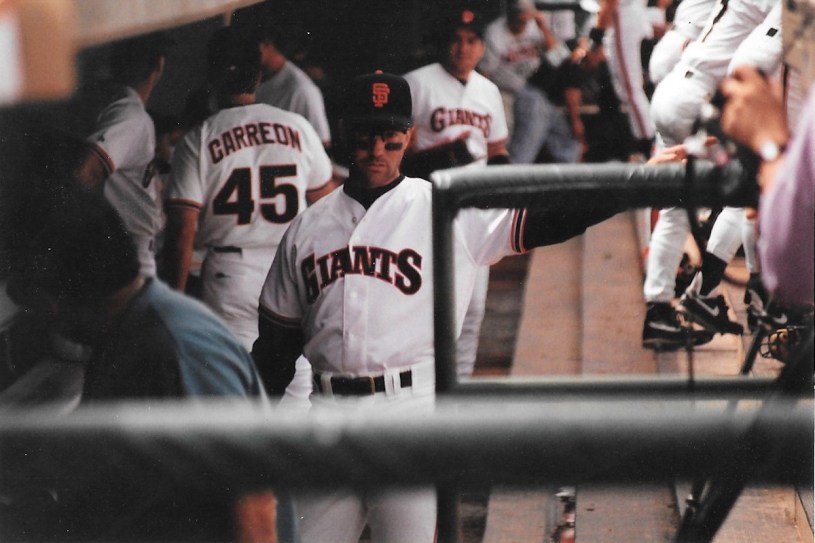
Our Friday Funday piece focuses on former MLB first baseman Will Clark: one of our all-time favorite players. A six-time All Star, Clark came up with the San Francisco Giants in 1986 and immediately proceeded to hit a home run on the first pitch he saw in the major leagues—off Nolan Ryan. It doesn’t get much better than that, as Clark would go on to hit .303 over a 15-season career with four teams overall.
We write about him today in a nostalgic sense, as Clark’s career is full of achievements we saw so many of in our childhood and college-aged years. In addition to the All-Star appearances (1988-1992, 1994), he also was a two-time Silver Slugger winner (1989, 1991), a Gold Glove vote winner (see our analysis elsewhere), and our pick for the 1989 National League MVP, as he led the Giants to their first World Series in 27 years.
That’s quite the career, really. Did we mention his career batting average? Yes, we did. He also won the 1989 NLCS MVP vote, which we did confirm, as well. He finished fifth in the 1986 NL ROTY vote, as he played in only 111 games for a third-place team. However, Clark established himself well enough in 1987 as he helped San Francisco reach the postseason for the first time since 1971 during that exciting campaign. He was dope.
His Giants career lasted until 1993, when the team decided not to re-sign him after he became a free agent. This was incredibly disappointing to the local fans, although at age 29 then, he did have his “worst” full season in the majors, with just a .799 OPS for the team. That was enough, evidently, for the front office to consider him not worth the long-term investment after they’d broken the bank for one Barry Bonds prior.
So Clark went and signed with the Texas Rangers for almost $27M over five years. After hitting a collective .299 with the Giants over eight seasons, he hit .308 with the Rangers across those five seasons (1994-1998), making one last All-Star team in his first season playing for Texas. His power dropped off, but his OPS increased slightly playing for the Rangers, and the team reached the playoffs twice with him (1996, 1998).
In fact, those were the first two October appearances in franchise history, dating back to the team origins in 1961 as the second version of the Washington Senators. What is most interesting about his time in Texas was that he had at least three teammates who were PED users, including his former adversary in the Bay Area, José Canseco. It’s probable Clark resisted temptations, however, as he aged gracefully into his 30s.
He was consistent in his time with the Rangers, but when he hit free agency again, this time ahead of his age-35 season, the Texas front office decided it was time to move on. Clark then signed with the Baltimore Orioles for two years and $10.9M; with his new team, he only managed 77 games during the 1999 season, but he still hit .303 with an .877 OPS in limited play. As it turned out, too, the 2000 season would be his last.
Clark played well enough for 79 games with Baltimore—.301 average, .886 OPS—that he was traded to the St. Louis Cardinals for the 2000 summer pennant race. He thrived in his return to the senior circuit, hitting .345 with a 1.081 OPS in 51 games, helping the Cards reach the NLCS that October. In the postseason, he raked it as well: .345 BA, 1.062 OPS. But St. Louis lost to the New York Mets in five, sadly enough, however.
Just like that, too, he hung ’em up, despite posting 4.0 WAR in his final campaign at age 36. In 31 playoff games over five Octobers, though, Clark proved to be one of the best in crunch time: .333 BA, .956 OPS. His career OPS (.880) and OPS+ (137) marks are pretty stellar, in truth, and his career WAR (56.5) places him 28th among first basemen in MLB history: maybe not quite Cooperstown, but definitely “next-best” tier.
His negative-10.1 dWAR holds him back a bit, although we never remembered reading that he was a “bad” first baseman with the glove; he just wasn’t very good, either. Clark did win that singular Gold Glove, but we analyzed that earlier this year as being a problematic piece of hardware. Either way, the Giants fans still love him, as he spent most of his career in San Francisco and still is involved with the franchise these days.
More than a decade ago, we went to Will Clark Night at the new ballpark in San Francisco (you know, the House that Steroids Built), and we witnessed an exchange between some fans near us that made us cringe: One of the bandwagon Giants fans asked, “Who is Will Clark?”—and their companion next to them said, “I don’t know. I think he’s one of the pitchers.” We just had to shake our heads in bewilderment and let it go.
Editor’s Note: We took the above picture at Spring Training in 1993 when we were covering baseball for our college campus newspaper. We never published that photo, and it remained in our possession all these years. It is fully copyrighted and not available for distribution at this time. Thank you.
 Daily McPlay: (mostly) Historical Sports Analysis with TENACITY & VERVE