
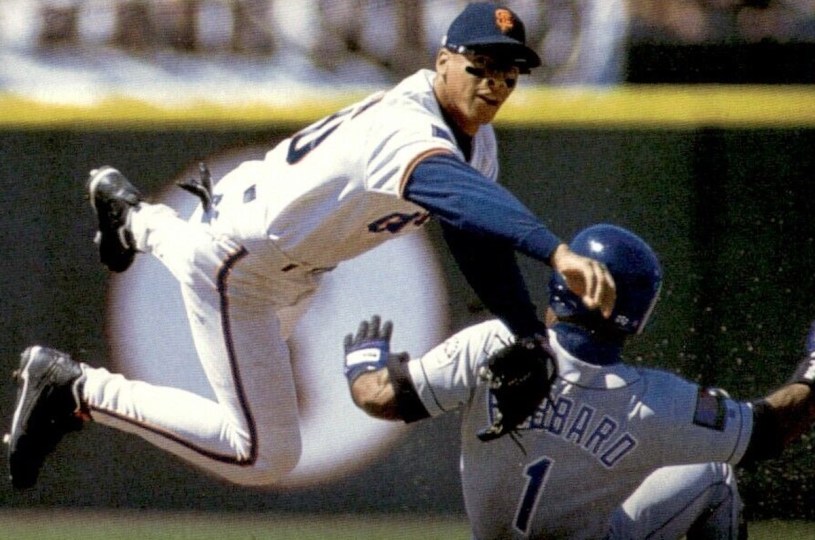
Our Gold Glove analysis on MLB Monday marches on to the 1990s now, with a look at all the players who deserved to win the defensive hardware—but did not, for whatever reason. Sometimes it was because there was a better player at the same position in a specific season, but quite often it was a bad decision by many voters, collectively, to give the trophy to the wrong dudes. Alas, this is why we exist in the present day, yo.
Editor’s Note: We only include those who never won a GG vote at any time in their respective careers, not individual seasons from those who won a Gold Glove at some point in their MLB lives.
Lenny Dykstra, CF: In 1990, he posted 8.9 WAR overall and only finished ninth in the NL MVP vote. What’s crazier is that his 3.2 dWAR was the top mark in the National League by a whopping 0.7 dWAR—and he didn’t win the GG vote. He also topped the league in hits and OBP, which usually gets the attention of voters, too, for anyone with a decent glove. The voters really messed this one up in real time, regardless.
Roberto Kelly, CF: In a similar goof, he posted 2.6 dWAR in 1990, certainly better than any other American Leaguer at his position, but he didn’t win a Gold Glove, despite a very good offensive year. The dWAR mark was a bit of an anomaly in his career, and the New York Yankees team he played for was terrible, finishing with just 67 wins as the last-place team in the AL East. That was probably the primary reason for vote fail.
Lance Johnson, CF: With 2.2 dWAR in 1991, he didn’t get a Gold Glove. He finished with 10.5 dWAR for his career, with a combined 6.2 dWAR from 1991-1993. He also added 1.9 dWAR in 1996 as well, without winning a GG vote. Even with offensively explosive seasons in 1993 and 1996, he was unable to permeate the voters’ minds. We understand why in the American League (some guy named Junior in Seattle), but … come on.
Spike Owen, SS: In his age-31 season (1991), he put up 2.1 dWAR for Montréal, in a very packed shortstop field. So, we understand why he didn’t win the vote, although his mark was the best among NL SS candidates. But, the voters were lazy and just made some assumptions, perhaps without looking at any data, which was probably thin at the time. But again, this is why we are here, to restore honor where missed.
Darrin Jackson, CF: In 1991, he earned 2.0 dWAR without winning a GG vote, and he bettered that in 1992 with an NL-best 3.9 dWAR—and still didn’t win a Gold Glove. We don’t even know how that is possible, to be so good on defense and not be noticed for it, properly. For the rest of his career as a whole, he only managed to compile 2.0 dWAR total. But in these two seasons, no one was better in roaming centerfields than this guy.
Mike Devereaux, CF: In a crowded AL centerfield mix, he posted 2.0 dWAR to finish behind Johnson above. Both of them were deserving of the GG vote win, and of course, neither of them won. Devereaux did post a then-high 3.2 oWAR, too, which should have helped his candidacy. But no. It’s hard to play a position where a generation talent exists elsewhere and overcome supposition. Nevertheless, he was worthy of it.
Manuel Lee, SS: From 1990-1993, he totaled 5.8 dWAR in the American League while also playing on a World Series champion in 1992 and putting up his best oWAR ever that season as well. His 2.1 dWAR in 1992 was ninth best overall in the majors, for example—but it was just fourth best at his position in the AL … which is pretty insane. Not much you can do about that, but playing on a division winner should have mattered.
Gary Disarcina, SS: He was the fifth-best defensive shortstop in the AL during the 1992 campaign despite finishing tenth overall in MLB with 2.0 dWAR. When you got it rough, you got it rough, right? His 12.8 dWAR total for his career is quite impressive, even though he was never much with the bat (5.2 oWAR total) in his career. That, as we know, has hurt a lot of GG candidates in their careers, trying to break through.
John Valentin, SS: Twice, he topped MLB in dWAR (1993, 1995) without winning a Gold Glove, which has to be one of the worst crimes in this whole miniseries—if not the worst ever. We, at least, awarded him our 1995 AL MVP nod, and today they have that “Platinum Glove” designation for the fielder who wins the dWAR crown. But back in the 1990s, they did not have it. Why not retroactively award it? Good question.
Mike Gallego, SS: As a regular middle infielder for both Oakland and New York (AL), he compiled 10.1 dWAR from 1988-1994 without winning a Gold Glove. His 2.4 dWAR in 1993 was fifth best in the majors, as well. He also put up a career-high 2.7 oWAR that year, but alas, there was no GG vote win in his career. A look at this list, and we know why … such a competitive position in such a competitive time, for shame.
Rick Wilkins, C: We usually see more catchers than this in our defensive explorations, so it’s a surprise that it’s taken so long to get to one here. In 1993, his 2.3 dWAR was sixth best overall in the majors—he also posted 5.0 oWAR that year, but no one noticed. He didn’t garner a single MVP vote, for example. Yes, it was the peak of his career at age 26, and it’s a shame that no one gave him any hardware for it. That is bad luck.
Mark Lemke, 2B: With 2.3 dWAR in 1993, the man they called Lemmer finished seventh overall in the majors. Were there any NL second basemen higher? No. Somehow, he was always underrated playing in Atlanta, surrounded by a lot of All Stars. He finished with 10.1 dWAR in his career, along with a lot of postseason street cred for his October efforts. His light bat always hurt his broader appeal, but we know.
Royce Clayton, SS: In 1994, he was the top dWAR earner in the majors (2.5), and he would follow that up with 2.6 dWAR in 1995 to be the NL’s top defensive performer. Alas, he never won a GG vote for either effort. With 16.3 dWAR for his career, he certainly distinguished himself, readily. His weaker bat may have hurt him, or the fact that in both 1994-1995 he was overshadowed on his own team by the big head in left field.
Terry Steinbach, C: Speaking of being overshadowed, he was never the primary focus of his successful teams in Oakland, despite winning the All-Star MVP nod in 1988. Yet from 1992-1996, he put up 5.8 dWAR behind the plate. He peaked with 1.5 dWAR in the strike-shortened season of 1994, the highest mark of any catcher in the majors that year. Alas, no Gold Glove for him! He finished with 9.3 dWAR for his career, total.
 Daily McPlay: (mostly) Historical Sports Analysis with TENACITY & VERVE