
Last week on MLB Monday, we explained our process for determining who should have won Gold Gloves in the 1950s. Now we move on to the 1960s, taking one league at a time like we did with our never-should-have-won-a-Gold-Glove features, previously. These players are presented in chronological order, and we do our best to explain why they should have won the Gold Glove vote—some more deserving than others.
Editor’s Note: We only include those who never won a GG vote at any time in their respective careers, not individual seasons from those who won a Gold Glove at some point in their MLB lives.
Marv Breeding, 2B: In 1960, he posted 2.2 dWAR, which was good enough for third best in the league. Alas, he did not win a Gold Glove and was out of the majors by 1964. However, in his four seasons, he compiled 4.3 dWAR for Baltimore, Washington, and Los Angeles (NL). He hit .250, overall, as well. However, from 1964-1968, he was stuck back in the minors at the Triple-A level. Think what a GG could have done.
Tony Kubek, SS: We listed him in our ’50s column for this segment, and in the 1960s, he posted individual seasons of 2.2, 2.3, 1.9, and 2.4 dWAR without once winning the Gold Glove vote. Seems a bit rough, but his mediocre bat probably hurt him, as he never posted an OPS+ mark over 100 in any full season. Seems he was good enough to be an All Star multiple times … but never a GG winner. Think about who votes for what.
Chuck Schilling, 2B: Seems to be a theme here at second base, and that can happen when more-famous players dominate a decade’s worth of defensive awards. But he posted 1.9 dWAR in 1961, which was good enough to rank eighth overall in MLB. It was his rookie season and his best offensively, too; after this, it was all downhill at the plate, and he finished with 3.6 dWAR across five seasons in the majors, overall.
Ron Hansen, SS: This was highway robbery, as from 1960-1968, he topped the majors twice in dWAR (1963, 1964) while compiling 16.6 dWAR across those nine seasons—and 16.3 dWAR for his full 15-season career. Why did he never get the vote win, even in those two seasons leading everyone? Good question. He was a mediocre hitter, but in 1964, for example, he posted 7.7 WAR overall and should have earned the nod.
Jerry Kindall, 2B: He only finished his career with 2.6 dWAR overall, but in 1962, he was third overall in MLB with 2.3 dWAR. His negative oWAR that season certainly hurt his chances in the GG vote, and somehow he made it nine seasons in the majors while “compiling” minus-3.0 WAR in total. We might consider him a “one-glove wonder” for this singular season of note, so we can overlook the oversight.
Eddie Bressoud, SS: A journeyman who played 12 seasons with four different MLB teams, the 1962 season was his moment in the sun with 2.5 dWAR—the second best in the majors and the top shortstop mark. Oddly, he posted his best offensive season to date in the same season and didn’t win the GG vote. His 4.8 WAR that season was his career best, too; thus it was a missed opportunity for the voters to reward him.
Wayne Causey, SS: He cracked the MLB Top 10 for dWAR in 1963 with a 2.0 mark, which was (by far) his career best in an 11-year stay in the majors which totaled just 2.6 dWAR. Another one-glove wonder on defense, the season also happened to be his best-at-the-time offensive effort. Alas, playing for the terrible Kansas City Athletics, there was little chance of him winning any recognition for his efforts.
Pete Ward, 3B: In 1964, he posted 2.3 dWAR to finish seventh overall in MLB, but of course, his pathway to a GG vote win was blocked by a legend in Baltimore who won 16 consecutive Gold Gloves from 1960-1975. He followed up this great season with 1.3 dWAR the following year, but his career overall totaled just 2.7 dWAR across nine campaigns. He also managed 9.7 oWAR in 1963-1964, but he declined sharply after.
Jerry Adair, 2B: From 1964-1967, he put up a combined 7.3 dWAR without winning a GG vote. In 1965, he finished sixth overall in the majors with a 2.3 dWAR effort. Alas, it was not good enough. His weak bat may have something to do with it, however; even his own team traded him in 1966 and then went on to win the World Series without him. Maybe that says something about the rest of the team’s defensive prowess?!
Don Buford, 2B: With a career-best 2.8 dWAR in 1965, he failed to win a Gold Glove. He also posted a then-high 4.7 oWAR as well, so what happened here? A certain New York Yankee is what happened, winning five straight GG votes at the position. Enough said, really, when you’re toiling for the Chicago White Sox, eh?
Rico Petrocelli, SS: Over his career, he compiled 14.4 dWAR without ever winning a GG vote. This, despite three individual seasons over 2.0 dWAR—including 1966, when he finished fourth overall in MLB (2.2). He never posted a negative dWAR mark in a full season in his 13-year career at short and third, all in Boston.
Ken McMullen, 3B: His 2.3 dWAR in 1967 may have given him a Top 6 MLB finish, but he was 1.9 dWAR behind the leader at his position (see above). Timing is everything, eh? He finished a 16-season career with 10.8 dWAR, overall, and he compiled six seasons of at least 1.0 dWAR along the way, playing primarily third and first. He was good enough with the bat, but again, he just played the wrong position at the wrong time.
Roy Oyler, SS: A six-year MLB career produced 5.3 dWAR, but in 1967, his 2.7 dWAR was third best in the majors—and deserving of a GG vote win, for sure. Interestingly, though, he posted just 0.2 oWAR—the highest of his career, as it was also his only positive oWAR mark ever. That’s probably why he didn’t win.
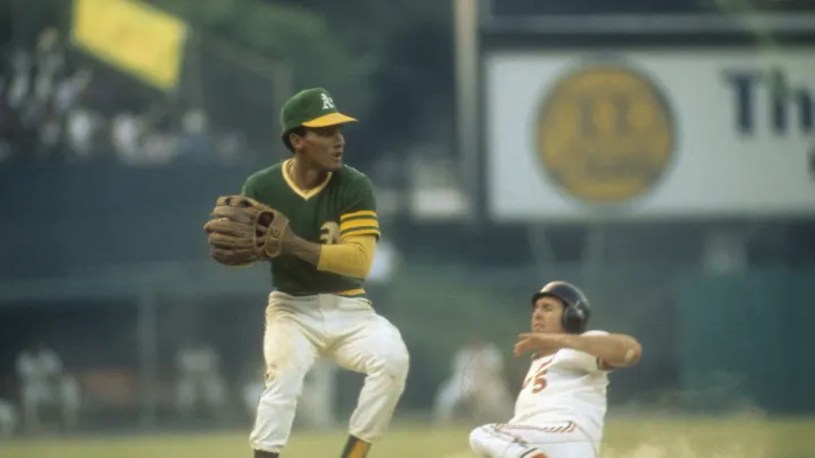
Bert Campaneris, SS: Here is a guy who is known for playing all nine defensive positions in the same game (1965), and he posted 21.1 dWAR for his entire career—including nine individual seasons over 1.8 dWAR. Yet he never won a GG vote, for whatever reason. In 1968, at shortstop, he posted his first season of 1.8-plus dWAR (2.1), and he put up the highest oWAR mark of his career, too (5.8). Yet somehow he was overlooked.
 Daily McPlay: (mostly) Historical Sports Analysis with TENACITY & VERVE