
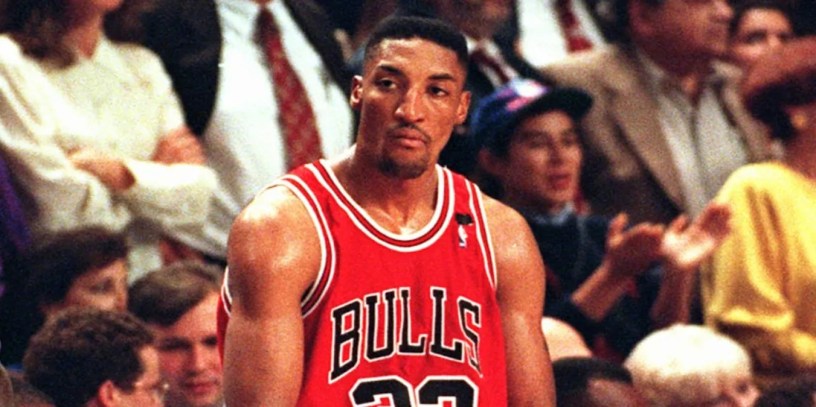
Our Sunday Surmising column returns today with a detailed take on NBA Hall of Fame small forward Scottie Pippen, who had the good fortune of playing next to Michael Jordan for the majority of his career. We referenced this a few weeks ago when discussing the issue of sidekicks for current Golden State Warriors legend Stephen Curry; now it’s time to really see if perceptions of Pippen are accurate … or not?
Admittedly, one of the most damaging singular moments in our sports memory for Pippen’s case as an “all-time great” came in the 1994 NBA playoffs, when he pouted and took himself out of a game at the end because the potential game-winning play was not drawn up for him. Why Head Coach Phil Jackson ever tolerated this is another question for another day, but it always had us thinking from then on about Pippen.
He had to be a lousy teammate to take himself out on a whim, out of petty jealousy or whatever that was. Just a brief Google and/or YouTube search for his name brings up a lot of interesting Internet commentary, to which maybe this will be added someday soon. But since we try to deal in sabermetrics here alone, removing emotion from the equation as much as possible, we’re going to go a different route and look deep.
The best data we have is the 1993-1994 and 1994-1995 seasons, when Jordan played just 17 games at the tail end of the latter season. Pippen was the de facto leader of the Chicago Bulls in the former season, for sure, as the team was the three-time defending champions. We also have the seasons before and after this two-year, mostly Jordan-free window of Pippen’s prime. We will discuss his later years elsewhere down below.
So, how did Pippen fare in that season, specifically, when compared to 1992-1993 with Jordan at his prime, 1994-1995 with Jordan partially on the court, and 1995-1996 with the 72-win Chicago team that won another NBA title? Look at the sabermetric measurements for the four seasons in question:
- 1992-1993: .132 WS/48, 19.2 PER, .510 True Shooting Percentage, 23.9% Usage Rate
- 1993-1994: .194 WS/48, 23.2 PER, .544 TSP, 27.1% Usage
- 1994-1995: .188 WS/48, 22.6 PER, .559 TSP, 26.3% Usage
- 1995-1996: .209 WS/48, 21.0 PER, .551 TSP, 24.4% Usage
What we see is that Pippen actually had a pretty poor 1992-1993 season, as his WS/48 mark dropped from .192 the prior year even though he played in 81 games and played just 41 fewer minutes overall. He was in his age-27 season, the start of the “prime” years of an athlete’s career, in theory. His 1993-1994 numbers bounced back without Jordan, however, due to a sharp rise in usage rate. Was Jordan stifling his potential?
That’s possible, but we also know MJ wasn’t going to be giving the rock to someone else on the team unless he had full confidence in them, and by the end of the 1992-1993 season, it’s clear Jordan didn’t trust Pippen at all. Maybe that .510 TSP had something to do with it, as that number ranked just eighth on the Bulls roster of regular rotation guys that year. Jordan knew Pippen wasn’t producing, and that is reflected in data.
So, without Jordan at his side for all of 1993-1994 and most of 1994-1995, we see Pippen’s numbers all rise. How do those 1993-1994 marks rank overall in his career line? The PER mark was a career high, so Pippen could play at his “best” without Jordan—and that career-high PER number for Pippen ranked fourth in the NBA, overall, about 7.5 points behind league leader David Robinson. What does this tell us? A lot, actually.
The number itself is not elite, but it was still good enough for fourth place in a league that was experiencing a talent drop off of sorts, in an era of defensive basketball, too. Pippen actually posted 6.0 Defensive Win Shares that season, which was the best of his career to that point—and seventh in the league overall. Meanwhile, he was 23rd overall in OWS (5.2). His overall 11.2 WS were higher than the 8.6 WS in 1992-93.
However, his career high at that point (12.7) had been in 1991-1992. It’s clear his 1992-1993 numbers reflect a poor season, overall, as from 1991-1997, that was the only season he was below 11.2 WS overall. We have to balance out that usage rate with the overall WS mark, so the WS/48 minutes help somewhat, and again, the 1993-1994 season was his best to that point in WS/48 and in usage. Looking at WS/48 tells us a lot here.
His 1991-1992, 1993-1994, 1994-1995, and 1997-1998 WS/48 marks are all very closely bunched. His best two WS/48 marks came in 1995-1996 and 1996-1997, when Jordan was playing at a high level next to him. We’re not sure we can draw any conclusions here from this data: he was both more and less without Jordan, really, which is to be expected when you have your own great talent but are no longer played alongside elite talent.
And that’s kind of we can discern here: Pippen was a “great” player but never an elite one. The singular time he led the NBA in anything? Steals during the 1994-1995 season, when he posted 6.7 DWS to tie Robinson for the league lead there. His 2.9 spg were a league high, as was his 4.0 steals percentage. But that’s it: that is the only he was the “best” in the NBA at anything in comparison to his peers. Does that warrant the Hall?
We’re not so sure. The fact he never made an All-Star team after his age-31 season says a lot to us; he was injured during the 1998 title-winning season that ended Jordan’s career the second time. Never again after that did he top .137 WS/48, even when playing in Portland on some talented teams. That injury in his age-32 season seems to have ended his “dominant” run, and that just happens to coincide with the end of MJ’s role.
Where does Pippen rank in all-time lists of sabermetric prowess? He is 148th in all-time PER (18.2); he is 47th all time in Win Shares (125.1); and he is 145th all time in WS/48 (.1462). Those ranks really don’t suggest Hall of Fame quality to us, especially when considering he benefitted from about nine full seasons of Jordan playing next to him, clearing out space, providing him with elite-level assists and opportunities, etc.
The counting stat of WS in total reflects quantity more so than quality (PER, WS/48). So Pippen did play 17 years in the league, so those seasons add up, of course. However, we’re inclined to look at the PER and WS/48 marks as the best summation of Pippen’s quality: is being Top 150 in history warrant “greatness”? It’s borderline to us, in truth. And again, without Jordan, he probably would be outside the Top 200/250, too.
One thing we will point out is Pippen’s rank in all-time DWS (20th): that is elite. He is ahead of Jordan in that category, although he played in 100 or so more regular-season games than MJ did. Jordan himself was an elite defender, so it makes it easier to play elite defense when you have a teammate doing a lot of dirty work themselves. Still, Pippen was playing good defense as late as his age-34 season in Portland (1999-00).
So, what can we derive here from all this? We’re not going to budge on the lousy-teammate part, because that one act against the New York Knicks in the 1994 playoffs cements it. But we can firmly declare was never elite at anything but playing defense (mostly) next to Jordan, himself an elite defender. He remains firmly overrated in NBA annals, as a sidekick to the arguably best player in the game ever: simple as that.
 Daily McPlay: (mostly) Historical Sports Analysis with TENACITY & VERVE
I completely and totally disagree about Scottie. I’m a 50 year old Chicagoan, a huge Bulls fan since 1984. I was there for all of Pippen’s career. I watched him grow and learn as a skinny rookie in 1987, gaining strength and using his length to clearly become one of the best defensive players in basketball history. He was the perfect sidekick to the greatest player of all time.
Scottie was a definite Hall of Famer. In fact, he’s a top 50 player of all time. All time!!!! He won 6 titles, and even though he never won without Jordan, neither did Jordan ever win without him.
Therefore, I clearly disagree with your analysis. Thanks for the column!
Reid
LikeLiked by 1 person
Sometimes, it can be just a matter of perspective. We lean hard on the data, of course, but we also watched it all unfold on television from afar, too, when we were in college and graduate school. We place MJ very high on the mantle, of course, so … perhaps it’s just always been hard for us to overlook Pippen’s self-benching incident in the playoffs in 1994.
LikeLiked by 1 person