
This Wednesday Wizengamot space is dedicated to the ongoing integrity of both college baseball and college hockey, since college basketball and college football have bent the knee to their professional brethren. While MLB and the NHL are doing things right, and have been for decades in giving high schoolers the chance to go pro right away, the NBA and the NFL have basically screwed over everyone.
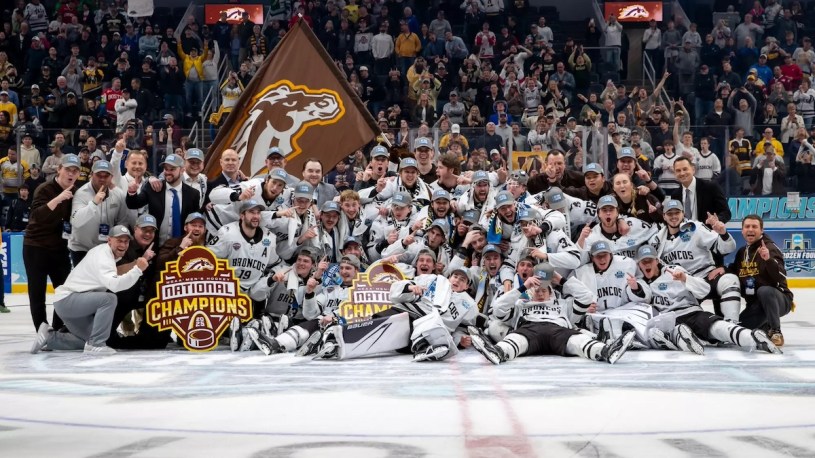
Western Michigan just won the NCAA title in hockey, which is a fantastic moment for sports fans, when the “little guy” can still win the big prize. This doesn’t happen in basketball, as we once again saw the NCAA shaft the Gonzaga Bulldogs; this doesn’t happen in football, although the move to a 12-team playoff is better and more equitable than anything the sport has given us in the past. It does happen in baseball, too.
In the last 20 years, we’ve seen College World Series champions from what we might consider “small schools”—including Fresno State in 2008 and Coastal Carolina in 2016. Sure, the $EC has bought 10 of the last 15 titles (including the last five in a row since Covid canceled the 2020 event), but the little guys do get to sneak in every so often to snare a title. That’s all we ask, really: equity and fairness. You know how it is.
Those used to be hallmarks of collegiate sports; the ideals are even enshrined in the NCAA mission statements, although we have seen the organization choke on its own words too often when it comes revenue generation for basketball and football. But baseball and hockey still represent the best of what college sports really should be about: student athletes trying to better themselves, ethically and morally.
As former college athletes and coaches, we really have lost interest in the present-day shenanigans of college basketball and football. The NIL nonsense has turned the sport into a professional endeavor, where the term “student” is now a bad joke, even if it already had been for quite some time. Let’s be honest: ever since the Dream Team, kids weren’t going to college to learn a trade. They were using colleges, completely.
And when their dreams didn’t come true, they got mad at the colleges for using them. Ironic, eh? But no one forced them to go to college (except the NBA and the NFL, with their restrictions on draft eligibility, which need to be challenged in court), and when they never graduated, they felt left behind—through no fault but their own. Getting a free education was tremendous compensation, but they just didn’t value it enough at all.
Now, through entitlement and greed, the college sports model is all but ruined in basketball and football. We continue to enjoy reviewing the past in both sports, but the present is becoming something we have little-to-no interest in supporting through journalistic engagement. We feel like we’ve said this before, and our emotional ties to the past have brought us back into the fold repeatedly, but we’re closer than ever now.
Baseball and hockey are where our NCAA futures reside.
Don’t get us wrong: we always felt that student athletes on scholarship deserved pocket-money stipends since they were denied the chance to work for spending money that other students often had. Giving every student athlete who maintains an eligible GPA about $1,000/month makes sense, so they can buy a PlayStation, get a cell phone, and order a pizza, etc. But there is no equity in the NIL garbage, whatsoever.
Again, if any high schooler wants to go pro in any industry, they can—except for footballers. They need to sue the NFL, while the basketballers need to go to Europe or sign with the NBA’s G League, etc. Even a computer programmer can “go pro” by skipping college and getting a job right away with some tech company. If and when the NFL is brought to its knees, then and only then will we return to watching college football.
The NBA should do the smart thing and go back to letting high schoolers declare for the draft, while also building a minor-league system like MLB has been using for decades. Until then? We won’t be watching college basketball. Our missing support won’t be noticed, of course, but the more fans themselves come to their senses and realize how much they’re being scalped for to keep the inequity going, these sports are dead.
 Daily McPlay: (mostly) Historical Sports Analysis with TENACITY & VERVE