
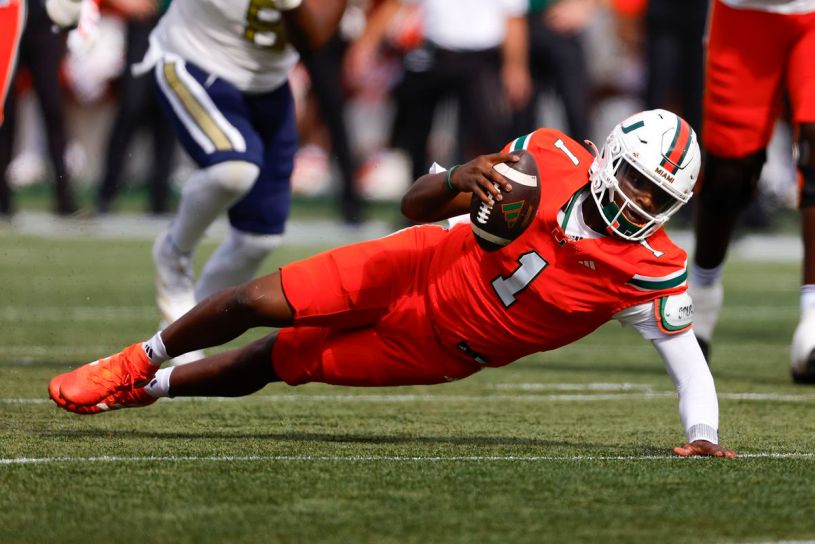
The NFL Draft is approaching, and today on NFL Thursday, we’re going to tackle the subject of college quarterback Cam Ward, the projected No. 1 overall pick by many experts. We included a throwaway (no pun intended) comment a few weeks ago in this same space about him, and it’s time to revisit to expand on the sentiment now: “Cam Ward (who only could win when surrounded by high-end talent)” … we mean it.
We saw Ward play repeatedly for two seasons at Washington State University, where he was heralded as the next greatest thing on the Palouse. It didn’t turn out that way: his record as a starter was just 12-13; he did nothing to elevate the play of his teammates; and he couldn’t even carry the team to a bowl game in 2023. Those are a lot of red flags. The fact he “thrived” at Miami-FL in his final year on shows us one thing.
He’s only as good as the talent around him, somewhat like our assessment of Brock Purdy—who we like and respect as a person. With the Hurricanes, Ward had high-priced NIL talent around him, unlike the recruits he played with at Washington State. He was supposed to be a leader for the Cougars; he was not. With the Hurricanes, the team had several high-profile stars, so naturally Ward’s numbers look a lot better.
But do they, really?
Ward’s completion percentage barely rose in transition between the two opposite ends of the nation: his 65.5-percent rate at WSU was pretty solid, but he only increased that to 67.2 percent in South Florida—despite an allegedly serious improvement in coaching and teammate talent. Let’s remember he joined a team that went 7-6 in 2023, so that was clearly a better squad than the 5-7 WSU team he bailed on there.
Another thing we want to point out is how bad that WSU team actually was: it started out 4-0 and ended up 5-7. With bowl eligibility on the line in the last game of the season, Ward tossed two interceptions against the University of Washington in a game the Cougars lost by three points. That’s not stepping up and leading at all. So, all he could manage was a minuscule 1.7-percent increase in completion rate while powering up?
That’s downright mediocre.
Ironically, Ward’s INT rate was worse at Miami than it was at WSU in 2023, too, so he didn’t improve there. What increased what his TD percentage and his yardage statistics, which reflects the higher level of overall talent on his offensive unit. He may have led the FBS in QB rating, but he owes that to his teammates—as his INT rate actually went up. And let’s look at how Ward choked down the stretch with the Hurricanes, too.
[Just like he did at Washington State in both 2022 and 2023, going a combined 5-12 after September.]
The then-No. 4 ranked Miami squad (9-0) went on the road to play a 5-4 Georgia Tech team on November 9, 2024: Ward’s numbers were all worse than his seasonal marks, even though he did toss three TDs in a 28-23 loss. But where was that ability to win a trap game on the road with the season on the line? Nowhere. In fact, his legs also couldn’t save him as he had just minus-five yards rushing on five attempts. He’s not agile.
We saw this at WSU repeatedly, too: he had 13 rushing TDs for the Cougars over two seasons, but he averaged less than a yard per carry, taking bad sacks behind an undersized offensive line and showing no elusiveness against good defenses. His YPC mark improved at Miami to 3.4 YPC, but he also was sacked less and didn’t have to carry the ball as much, running for his life. Yet still, the best mobile QBs do much better.
So, he’s not mobile, and he’s not a leader. His accuracy isn’t that stellar. And we didn’t even get to second late-season loss on the road last year for the Hurricanes, did we? With a 10-1 record, Miami traveled to play 8-3 Syracuse in the regular-season finale—and lost, 42-38. Again, Ward did not play poorly, but he again was not able to elevate his teammates play to win a road game that the team absolutely needed to win. Ouch.
The two road losses to unranked opponents in November cost the Hurricanes a shot at the ACC Championship Game, and it demonstrated Ward is not a superlative QB who is a winner. He compiled his fat stats against the No. 60 SOS last year, out of 134 teams. And he couldn’t even beat the Yellowjackets or the Orange on the road in November to clinch a spot in the ACC title tilt. We’d call that a soft QB, folks.
Sure, no one is comparing him to Patrick Mahomes, but this guy isn’t even DeShaun Watson. He’s honestly not even as good as Purdy was in college: Purdy’s aggregate college QB rating was 151.1 in four years at Iowa State, and Ward’s mark is 148.8 in two years at WSU and one at Miami-FL. Purdy started 10 more games than Ward did at the FBS level, and his completion percentage was 1.7 points higher.
Throw in the running ability (Purdy had 1,177 rushing yards in four years, while Ward had 406 yards in three years), and it’s clear how overrated Ward is when Purdy was the last pick of the seventh round. Why is Ward being pimped at the No. 1 overall spot? We have no idea. The two most telling signs of a college QB’s future success in the NFL is number of starts and completion percentage. Purdy tops Ward in both, readily.
We will issue our standard DMP guarantee: if Ward ends up having a successful NFL career, we will print this column up on paper and eat it on livestream socials. He will be a bust in the pros, maybe not to the level of say Ryan Leaf, but he will be barely be as good as Jameis Winston, for comparison’s sake. And that’s not all that good, really. Ward is totally overrated, and we’re committing the perspective to posterity, right here.
 Daily McPlay: (mostly) Historical Sports Analysis with TENACITY & VERVE
I disagree. I indeed believe Cam Ward will be successful. Now, is he overrated? Perhaps. Was it his fault that both Wazzu and Miami lost games? No way. You dogged him for his team failures, yet you didn’t give him much praise for his teams’ victories. Miami improved from 7-6 to 10-3 (including the bowl game loss 42-41 in which Ward only played half of the game I believe). He threw for 4313 yards, 39 TD, only 7 INTs, and yes, 67.2% which was his highest in his five year career. So, I see that he showed improvement. He was clearly a team leader. He made Miami better. Was it his fault that the Miami defense was overrated and gave up 42 points in two of those three losses? I mean, c’mon man. You are being very nitpicky in my opinion.
I love reading your columns, but I need to comment when I disagree. I definitely disagree with you about Ward. I do agree that he has some issues with holding onto the ball too long in the pocket. He’s very casual with the ball. He needs to improve ball security. However, his 172.2 QB rating this past season was outstanding (4th in the NCAA behind Jaxson Dart, Kurtis Rourke, and Will Howard). His passing yards was 2nd behind Kyle McCord. He improved Miami from 7-6 to 10-2 (not including that bowl game).
I don’t see why you’re so down on him.
Thanks for letting me retort.
Reid “Dutch Lion”
LikeLiked by 1 person
Always just my two cents … I suspect time will tell if I am right or I am wrong. We can check back in five years and see what has happened. The Internet is permanent?!
LikeLiked by 1 person
Agreed. I too have made many predictions, and it’s fun to look back years down the road. I’m way off sometimes and it makes me wonder, what was I thinking!?! LOL
Thanks,
Reid
LikeLiked by 1 person