
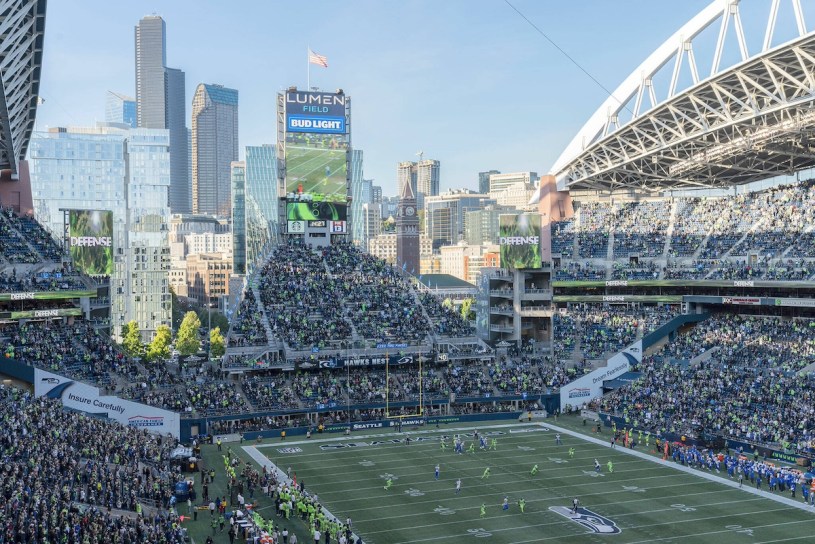
Okay, so we were wrong about quarterback Sam Darnold on last week’s NFL Thursday column: he ended up signing with the Seattle Seahawks, who traded their own QB—our one-time pick for NFL MVP, Geno Smith—to the Las Vegas Raiders. There, Smith is reunited with his old Seahawks coach, Pete Carroll. If we’d known that was happening, then we probably would have guessed Seattle would reload with Darnold.
But this whole episode, and the ongoing musical-chairs dynamic of the NFL QB circle jerk, reminds of us a strategy we developed a long time ago in our imaginary world of being a professional football team’s general manager: draft a quarterback every year and develop a pipeline, so you never have to overpay for the starter, especially since most QBs are not good enough to make the players around them better. Voila!
We’re serious: there are seven rounds in the NFL Draft every year, and it’s “easy” to acquire extra picks by trading away overvalued assets on your roster. Even if you net just an extra seventh rounder, that can be enough to land a competent starting QB at a very cheap price—which is quite often the way teams win Super Bowls. Because once the quarterback becomes a “star”? The salary demands ruin cap management.
This happens all the time, and we’re going to use Carroll’s tenure with the Seahawks as an example: Russell Wilson was on a rookie contract when the team made two consecutive Super Bowls in 2013 and 2014, and then they never returned, largely in part to Wilson’s increased salary. While his play generally stayed at a high level—we gave him our NFL MVP nods in 2018 and 2019, for example—the Seattle cap was overcooked.
And then when his play dropped in quality, the team was stuck with a salary boondoggle. It’s hard to predict when a QB will drop off (barring a cheater like Tom Brady, of course), so it’s best to cycle through QBs while they’re young and cap friendly. This requires investing in good offensive coaches, of course, but that’s a much cheaper route than overpaying for a QB who may just nosedive next year overnight without notice.
It may seem obvious to keep a team young at the skill positions, but it’s also not obvious to many that only a few elite QBs are worth keeping at high prices: guys like Patrick Mahomes don’t come along that often. Joe Montana was one of those QBs who made the players around him better, while his successor Steve Young was not. Most fans can’t tell the difference, since they don’t understand sabermetric valuations. But we do.
There are a lot of college quarterbacks available in every draft: smart GMs will invest in one every year, even if the roster seemed “settled” at that position. Not all of them will pan out, of course, and that is to be expected. But even if you “hit” on just half the prospects, you’re going to have a continuous pipeline of cheap talent at the position which will allow you to spend wisely on the rest of the roster, in order to win.
Darnold got too much money from the Seahawks, and while they salary dumped elsewhere, Darnold is not the kind of QB who makes those around him better. He has one great wide receiver now in Seattle (Jaxon Smith-Njigba) and two solid running backs (Zach Charbinnet and Kenneth Walker III). The Seahawks have a lot of draft picks in the upcoming draft, and they can add some younger talent to improve. However?
That QB contract is going to hurt them long term; they’d be smart to draft Darnold’s replacement in this upcoming draft, perhaps in the later rounds, grabbing a “sleeper” pick and developing him in-house. Forget an overrated guy like Cam Ward (who only could win when surrounded by high-end talent) and overpriced guys like Shedeur Sanders. The Seahawks should target truly underrated guys like Kurtis Rourke, really.
That’s the smart play, every draft.
 Daily McPlay: (mostly) Historical Sports Analysis with TENACITY & VERVE