
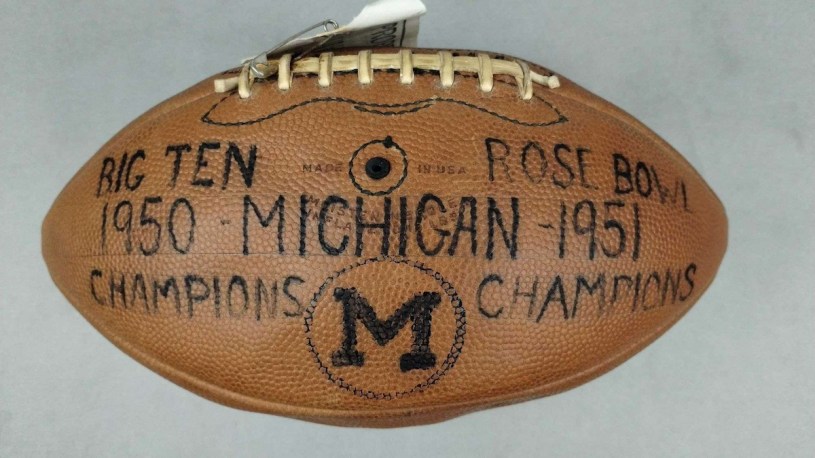
On Rose Bowl Friday this last day of February 2025, we take on a matchup of two teams wearing blue and gold, of some shade/tint. This was the fifth year of the Western and Pacific Coast conferences taking each other on in the Granddaddy of Them All, and so far, the future B1G was 4-0 against the future Pac-X. Would the culmination of the 1950 regular season be any different? We shall see, but it was an interesting time.
The official mythical national championship went to the University of Oklahoma, but our analysis shows it probably should have gone to Michigan State, a school that would join the Western/B1G Conference very soon. The Midwest was where the true power resided in the sport, even if the Associated Press pollsters didn’t want to admit it. Alas, no legit contender for the MNC participated in this Rose Bowl, sadly enough.
The California Golden Bears were making their third straight appearance in the Granddaddy, after losing the prior two. Cal entered the game with a 9-0-1 record, the only blemish a tie in the Big Game against Stanford in the regular-season finale. Ranked fifth in the AP poll, the Golden Bears were No. 7 in the SRS after playing the No. 22 SOS. The defense had only given up 76 points in 10 games, so that was the power.
On the other side were the seemingly lame Michigan Wolverines: unranked, they had been 2-3-1 in the first week of November before winning three straight to end the regular season and claim the conference title with a road victory over then-No. 8 Ohio State. Thus, with just a 5-3-1 record, the Wolverines still had a No. 12 SRS ranking after playing the No. 1 SOS in the nation. Perhaps this is why Cal was barely favored to win.
Things were bad from the start for the Bears: they had a 77-yard touchdown run called back on the second play of the game due to an illegal-motion penalty, and from then on, the game was somewhat of a rock fight. Cal did score another TD in the second quarter, but the extra point was botched. The score remained 6-0 until the fourth quarter when the Wolverines, despite travel fatigue, scored twice to win the game, 14-6.
With three consecutive losses, Cal started a unique club that today only has a few members (bonus points if you know what other team[s] have lost three straight Rose Bowls). The Golden Bears only have made one additional Granddaddy appearance since this game, while Michigan went on to have a bit of success in the game (until the 1970s, really). At this point, though, the Wolverines were 3-0 in Pasadena (1901, 1947, 1950).
Cal’s misfortunes contributed to the PCC adopting the same “no-repeat” rule that the Western Conference had in place, although by the 1960s, the conference reversed course. Meanwhile, the future B1G kept that rule until the mid-1970s, when Ohio State became the first league team to make consecutive appearances in the Rose Bowl. By then, too, the tidal wave of power had shifted to the West Coast, and the B1G was weaker.
 Daily McPlay: (mostly) Historical Sports Analysis with TENACITY & VERVE