
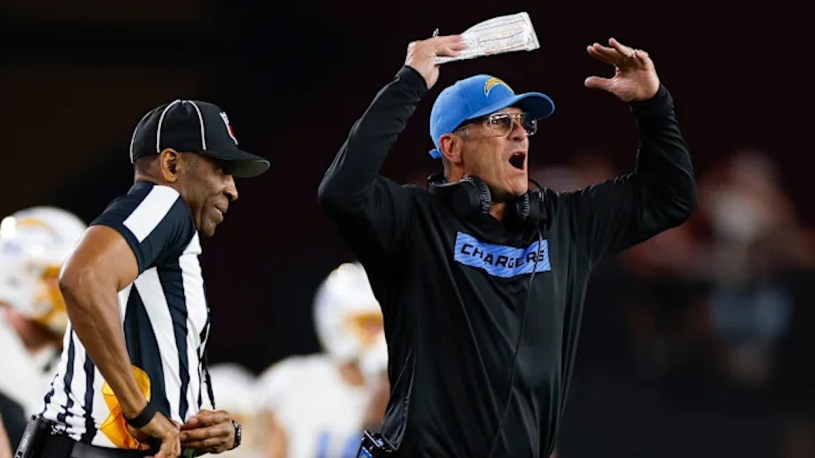
As we did with Nick Saban previously, it’s time to assess the myths enveloping American football coach Jim Harbaugh, who has coached at Stanford (2007-2010) and Michigan (2015-2023) in the college world, as well as in the NFL with San Francisco (2011-2014) and the Los Angeles Chargers (2024). Before we start, we label Harbaugh factually as a liar and a cheater, as the NCAA has confirmed in its assessment(s).
[We stay honest and transparent here to provide context for what follows; any sports mediot outlet that does not do so is lying to its audience. Just as Donald Trump always will be a convicted felon, confirmed fraudsters like Barry Bonds, Tom Brady, and Harbaugh, et al, need to be identified as such. Facts matter here; if you don’t like that? Please leave; don’t let your laptop laugh at you on the way out. Seriously.]
Now, on with the discussion: Is Harbaugh overrated? Probably. His success at Stanford was built on the back of a single recruit; his legacy with the 49ers was set up by the prior head coach and general manager; his “achievements” at Michigan are forever tainted by his NCAA scandals; and we’re too early in his Chargers tenure to know much yet, other than he did inherit a playoff-worthy roster in his first year (see below).
Today, we take on his return to the NFL after being banned from college coaching as a result of his Michigan cheating and lying: the 2024 season of the Los Angeles Chargers, which seems successful on the surface as the team improved from a losing record the year prior to make the postseason. Yet context matters here, the Chargers franchise has been up and down for a long time: team made the playoffs in 2022, for example.
Overall, in the last decade of play in both San Diego and L.A., the team has posted a combined 77-87 record with three postseason berths. There are five winning seasons in there, total, so again, the team has been inconsistent without being truly horrible for the last decade, through four different head coaches in that time. Generally, the team is seen as an underachieving one, no matter who is on the sideline. Remember it.
So, the Chargers posted a 10-7 record in 2022 under Head Coach Brandon Staley, and they then lost in the postseason—mostly due to the Trevor Lawrence Agenda, which was short lived. Then, the team got off to a 5-9 start in 2023 and fired Staley before finishing 0-3 under an interim coach. But a closer look at that 5-9 start shows that L.A. lost five games in that stretch by a combined 14 points. It was probably just bad luck.
The clincher for Staley was when the team got torched by 42 points against the Las Vegas Raiders on the Thursday Night Football stage. However, as the team lost its final three games? Those three losses came by a combined 10 points. So, overall, that 5-12 record was the result of losing eight games by a combined 24 points. Clearly, this was a talented team that just came up short way too often, perhaps, in key situations. Marked.
And the Chargers did that under two different head coaches in the same season. That’s not so much a coaching problem as just bad luck—which data has shown reverses itself quite often on a season-to-season basis. Thus in 2024, the natural rebound to the mean should have been expected, no matter who the coach was: And L.A. posted a 4-4 record last season under Harbaugh in games decided by one score or less. See that?
What was different about the roster? Not much. There was some turnover as is the case, but the team’s talent level remained roughly the same, led by quarterback Justin Herbert—who missed four games in 2023 but was healthy all year in 2024. He had his best season since his rookie year (2020), even though he tossed a full-season, career-low 23 touchdowns. The team did shift to a more run-oriented offense, however.
And that may have been the one big adjustment Harbaugh made, as he tried to replicate his “success” with the Wolverines from 2021-2023: more running. There was a 500-yard shift, really, in the direction of the running game, as the offense threw for 300 or so fewer yards while running for 200 or so more yards. There also was a significant improvement on defense, too—not an area people generally connect to Harbaugh.
The Chargers cut their points allowed by 97 points from 2023 to 2024: the new defensive coordinator would generally get credit for that in a sane world, but we’re guessing most people don’t even know who the L.A. defensive coordinator is right now (or the name of the one in charge in 2023, either). The impact of a more game-controlling offense also has to be factored into the defensive improvement, as we explore below.
Los Angeles’ defense actually had fewer sacks in 2024, for example, but the offense held the ball for more time per drive, on average. That kept the defense fresher, in theory, and able to perform at a higher level. In fact, the Chargers defense went from 24th in points allowed and 28th in yards allowed in 2023 to tops in points allowed and 11th in yards allowed in 2024. How much of that credit should go to Harbaugh, really?
He’s a former QB himself and an alleged QB whisperer (although that is based on one Stanford recruit alone, as we have shown). His brother is better known for his defensive acumen, so while Harbaugh can get some credit for the hiring of a new DC, he’s not going to sticking his head into all the defensive meetings and plans all season. He’s also not going to be having a lot of say in the drafting of defensive players, either.
The Chargers drafted four defensive players in rounds three through five in the 2024 Draft, including one of Harbaugh’s cheaters from Michigan. How did those rookies fare? Here are their Approximate Value (AV) results from the past season: linebacker Junior Colson (1); defensive lineman Justin Eboigbe (0); cornerback Tarheeb Still (6); and CB Cam Hart (3). The two fifth rounders did the best, clearly. Coaching!
But unless Harbaugh was also the defensive secondary coach? The credit is not his for those players’ success. His prize third rounder from Michigan didn’t do squat, for example. The defensive improvements really should go to the credit of DC Jesse Minter, who did come from the Wolverines with Harbaugh—but he received his NFL training with the Baltimore Ravens (and John Harbaugh, from 2017 to 2020). Noted!
To recap, the Chargers had plenty of talent on the roster, but they’d had some bad luck and injuries (an 0-4 record without Herbert in 2023) before Harbaugh showed up. The biggest reasons L.A. improved by six wins comes down to better luck in close games and better defense as a result of changed game philosophies and strategies on both sides of the ball. Harbaugh gets no credit for the first and only partial credit for the latter.
In the end, though, the result was the same: a first-round playoff loss. In fact, in 2022, the team lost a close playoff game on bad luck, while the 2024 team got blown out as the betting favorite, losing by 20 points on the road: Herbert had an uncharacteristically bad game, to be sure. With the 49ers, we saw Harbaugh’s teams get progressively worse, so we will see in the next few seasons if he’s learned anything over time.
If the Chargers can fight their way through the AFC West Division to another postseason berth in 2025, that will be a good indicator that perhaps Harbaugh is having a positive influence on the team’s outlook. The franchise last made consecutive postseasons from 2006-2009, under Head Coach Norv Turner. Turning that corner would be a big step for the team, but it could come down to some more luck, really.
 Daily McPlay: (mostly) Historical Sports Analysis with TENACITY & VERVE