
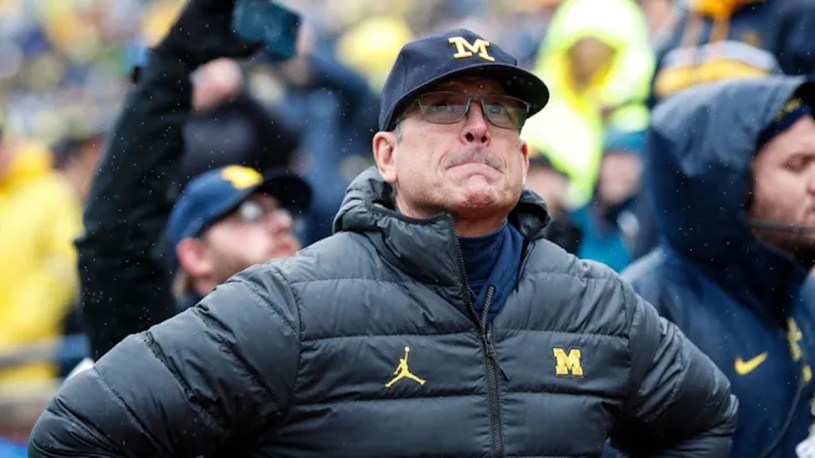
As we did with Nick Saban previously, it’s time to tackle the myths enveloping American football coach Jim Harbaugh, who has coached at Stanford (2007-2010) and Michigan (2015-2023) at the college level, as well as in the NFL with San Francisco (2011-2014) and the Los Angeles Chargers (2024). Before we start, we label Harbaugh factually as a liar and a cheater, as the NCAA has confirmed in its assessment(s).
We stay honest and transparent here to provide context for what follows; any sports mediot outlet that does not do so is lying to its audience. Just as Donald Trump always will be a convicted felon, confirmed fraudsters like Barry Bonds, Tom Brady, and Harbaugh, et al, need to be labeled as such. Facts matter here; if you don’t like that? Please leave; don’t let your laptop laugh at you on the way out. Seriously.
Now, on with the analysis: Is Harbaugh overrated? Probably. His success at Stanford was built on the back of a single recruit; his legacy with the 49ers was set up by the prior head coach and general manager; his achievements at Michigan are forever tainted by his NCAA scandals; and we’re too early in his Chargers tenure to know much yet, other than he did inherit a playoff-worthy roster in his first year. Time will tell.
Today, we take on his time at Michigan (2015-2023), which can be divided into two distinct parts: the first six seasons showed the typical Harbaugh we’d come to know and expect from his time at Stanford and San Francisco, and the second part was something else altogether—and we now all know how Harbaugh “found” his inner child to finally “achieve” some “success” that he felt he was due, for whatever ego reasons.
In Harbaugh’s first six years with the Wolverines, he lost at least three games every season, for a total of 22 defeats. In his final three seasons while employing an illegal sign-stealing operation, his Michigan teams lost a total of three games combined. After 13 seasons of being a head coach at Stanford, the 49ers, and Michigan, Harbaugh didn’t suddenly discover the secret to life on the gridiron: he cheated, as confirmed.
Let’s be clear that his first five years at Michigan were certainly good ones: 47-18 record overall, with five bowl invitations to the Citrus (2015, 2019), Orange (2016), Outback (2017), and Peach (2018). Sure, he only won one of those bowl games, but other than not winning a B1G title or beating Ohio State, Harbaugh was doing well at a program that had fallen on hard times from 2008-2014 in the years before he arrived.
In those prior seven seasons under the head coaching of Rich Rodriguez (2008-2010) and Brady Hoke (2011-2014), the Wolverines went a collective 46-42, overall—not up to their internal standards. Of course, there were no B1G titles in there, either, and only one win against Ohio State (2011). In-state rival Michigan State was dominating Michigan, too, winning six of seven in that stretch against the wobbly Wolverines.
So, again, Harbaugh’s first five years were a big improvement, but without beating Ohio State or winning a B1G title (something Michigan had not done since 2004), it wasn’t enough. And then the Covid year came, and the Wolverines had their worst season since the 1960s, going 2-4 and actually stooping so low as to cancel their regular-season finale with the Buckeyes, under the guise of Covid, yet just in fear of another L.
Can anyone offer a legitimate explanation for how Harbaugh turned that mess around overnight into a behemoth that went 40-3 over the next three seasons (2021-2023)? There is no rationale for the impossible, literally. First, Harbaugh was caught skirting recruiting rules and then lying about it; subsequently, the whole sign-stealing scandal was exposed and revealed. Now we had all answers to the myriad of questions.
And there you have it: the secret to Harbaugh’s eventual “success” at Michigan was the same secret the Houston Astros hid in finally winning a World Series after 55 years—and ironically, the same sauce that fueled the New England Patriots to their first league championship after 40-plus years without one. It’s no coincidence that Harbaugh loves former Patriots confirmed cheater and head coach Bill Belichick. Sheez.
The bottom line of this part of his career is that Harbaugh couldn’t reach the mountaintop honestly, just as he failed to do so in San Francisco, and he decided to cheat to get there, knowing the consequences would be minimal even if he did get caught. Well, he got caught; now the whole world knows he’s a liar and cheater—whether they want to acknowledge it or not. The public record and historical archive will always reveal it.
 Daily McPlay: (mostly) Historical Sports Analysis with TENACITY & VERVE
Overall, I disagree with your assessment of Harbaugh. The “sudden” success of Michigan from ’21 to ’23 to me was finally going back to his strategic roots, the running game, physicality, etc. For many years they tried to run the modern spread offense, which always made me wonder what he was thinking. His coordinator hires tried to be modern, even though I figured he was more inclined to use that old school Stanford offense, the pro set with the downhill running game of Toby Gerhart, etc. I’ve seen interviews with Jim and John and their dad, who was famously a coach also. Dad loved “fullbacks and tight ends”. So finally Jim went back to using fullbacks and tight ends and it worked, including out “physical-ing” Ohio State. Now Michigan has gotten into OSU’s heads too, as we saw in November. Anyway, great columns with loads of analysis. However, we can agree to disagree about Harbaugh. He’s a really good coach in my opinion. He wins everywhere.
LikeLiked by 1 person
Why did the NCAA suspend him then? Twice? And ban him from coaching for four years, even though he fled to the NFL? Doesn’t add up.
LikeLiked by 1 person