
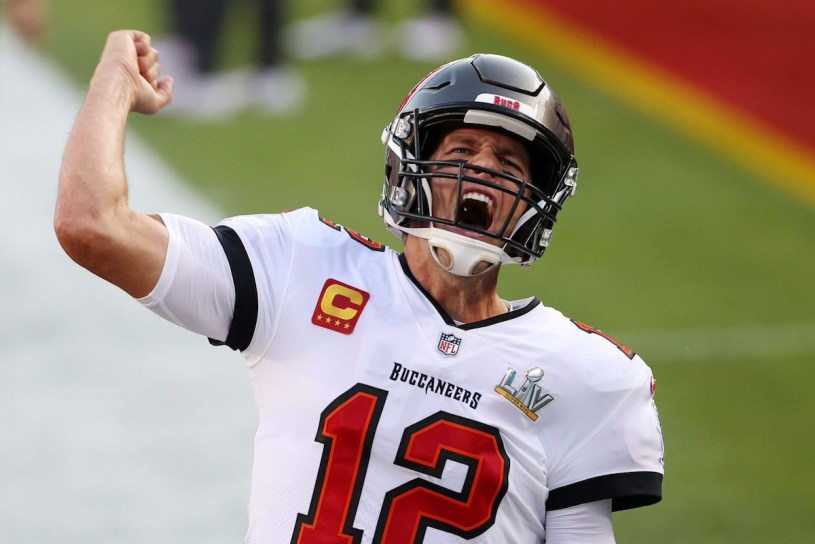
Here on NFL Thursday we like to explore ideas, some of which may seem fringe to some sports fans. Yet we get questions a lot about what we think after covering the league for a handful years on CBS web sites. One we hear a lot is whether or not we think the NFL contrived the result of Super Bowl LV for the Tampa Bay Buccaneers to win it on their home field, similar to what we’ve argued happened in college football (2019).
That postseason was fishy, of course, just as it was in 2005 for the Pittsburgh Steelers, 2007 for the New York Giants, 2011 for the Giants again, etc. Sometimes we think that the NFL never wanted Tom Brady to win again after the SpyGate controversy in 2007, but the Seattle Seahawks screwed up in 2014 just as the Atlanta Falcons messed it up in 2016. And then by 2018, the league seemed to favor Brady once again. Why?
Perhaps they realized it was more financially lucrative to simply let him keep being Brady: the same reason MLB never suspended Barry Bonds, or the same reason the NCAA let Michigan cheat its way to a title last year. The biggest takeaway from the twentieth century remains a guiding principle for the twenty-first century: follow the fuckin’ money, folks. We know how the NFL makes its money, and we know the fans, too.
So, what happened with Tampa Bay in 2020? Well, the team was 7-5 when it hit a late bye week, and then the Bucs won their last four games by an average of 18.3 points per game to make the postseason as the No. 6 in the NFC—facing an uphill battle of needing to win, potentially, three straight road games to be the first team ever to play the Super Bowl on its home field. This franchise had not won a playoff game since 2002.
And the team had an age-43 quarterback who didn’t seem to age, thanks to his personal trainer’s controversial methods. What were the odds? Minimal, really. But it was a low-risk, high-reward situation for the league, and conveniently, Tampa Bay got to play its first road playoff game against the Washington Football Team, a squad that qualified for the postseason with a 7-9 record. Still, it was a pretty close game.
Leading just 18-16 in the third quarter, the Bucs suddenly got hot: they scored on three consecutive drives in the fourth quarter to hold off a team quarterbacked by someone named Taylor Heinicke. Tampa Bay was lucky to be a low seed and play a losing team on the road to start the playoffs, for sure. Heinicke is 13-16-1 as a starter in the NFL, as somehow he still had a job in 2024, as the backup for the Los Angeles Chargers.
After beating the WFT by a 31-23 score, the Bucs earned a rematch with the New Orleans Saints, a team that had beaten Tampa Bay twice already this season, in Week One and Week Nine by a combined 72-26 score. Yet, somehow? The Bucs beat the Saints this time around: New Orleans held a seven-point lead late in the third period, but somehow the fifth-best offense stalled while the fifth-best defense choked. That’s right.
How did it happen? We didn’t know then, and we still don’t know now. Tampa Bay scored 17 unanswered points to close the game out with a 30-20 victory. One of the best QBs ever tossed two interceptions in the fourth quarter to bury the Saints’ hope of victory. In the end, New Orleans coughed up the ball four times and lost by 10 points, so it’s not hard to connect the dots here. But the timing of the Saints’ implosion …
Very peculiar, just as the Green Bay Packers’ loss at home in the NFC Championship Game was odd, too. The Southern swamprats from Tampa went into the Frozen Tundra and beat the Pack, 31-26. How? We really don’t know. The Packers had the ball for nine more minutes of game time and committed one fewer turnover, but the Bucs were penalized for just eight total yards in the game, and that was all she wrote.
Tampa Bay had beaten Green Bay easily during the regular season, so maybe it wasn’t such a surprise. But it felt like one to see the Bucs beat the Saints and the Packers on the road in back-to-back weeks. In the Super Bowl, it was time for another rematch, this time against the Kansas City Chiefs—the defending champions who had beaten Tampa Bay in Week 12. But the Chiefs were battered and bruised by this point, and … yeah.
Without any real controversies here, it’s more like the Bucs just got on a roll at the right time, faced the right opponents at the right time, and won eight straight games to win the NFL title after looking like anything but a champion after 12 weeks of play. This kind of thing happens often in sports: team just get on a roll and cannot be stopped by anything. We see it all the time, in truth, and some times like this, it’s legit.
Brady & Co. fixed what ailed them in a bye week and went on a historic bender which featured a lot of good fortune. There was nothing irregular about it, other than Brady himself playing at such a high level of football despite his advanced age: his 102.2 QB rating in the regular season was the seventh-best mark of his career, as his 12 best seasons all came after he entered his 30s. That’s not natural, folks; it’s incredulous.
And that’s the only real issue we have here: at an age where most QBs are playing golf, Brady was playing at a high level that used to only be for twenty-something quarterbacks. Connecting the dots isn’t hard here, but to say the NFL itself did us all a dirty by getting Tampa Bay to its pinnacle here? That’s just not honest or right. Brady may have been cheating, as usual, but the Bucs earned their second Super Bowl championship.
 Daily McPlay: (mostly) Historical Sports Analysis with TENACITY & VERVE