
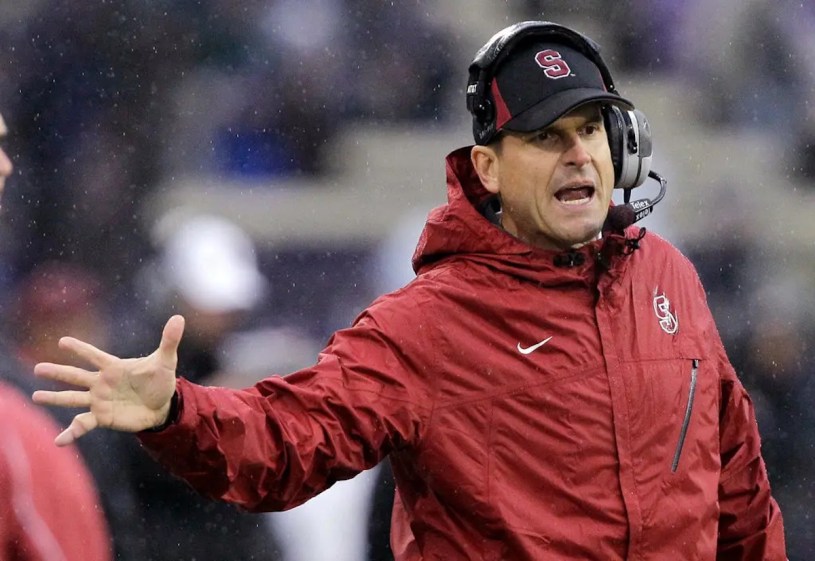
Just as we did with Nick Saban previously, it’s time to tackle the myths surrounding American football coach Jim Harbaugh, who has coached at Stanford (2007-2010) and Michigan (2015-2023) at the college level, as well as in the NFL with San Francisco (2011-2014) and Los Angeles (2024). Before we start, we will label Harbaugh factually as a liar and a cheater, as the NCAA has confirmed in its assessment of his actions.
This has to be done honestly and transparently in order to provide context for what follows; any sports mediot outlet that does not do so is lying to audience and acting as if those transgressions against his peers and his sport do not matter—and they do matter, always. Just as Donald Trump always will be a convicted felon, confirmed fraudsters like Barry Bonds, Tom Brady, and Harbaugh, et al, need to be labeled as such.
[Facts matter here; if you don’t like that? Please leave; don’t let your laptop laugh at you on the way out.]
Now, on with the show: Is Harbaugh overrated as a coach, considering all context in his career? Possibly. His success at Stanford was built on the back of a single recruit; his legacy with the 49ers was set up by the prior coach; his achievements at Michigan are forever tainted by his NCAA scandals; and we’re too early in his Chargers tenure to know much yet, other than he did inherit a playoff-worthy roster in his first year.
Today, we will take on the Stanford years: in essence, Harbaugh went 9-15 in his first two years, until he recruited Andrew Luck. After that, the Cardinal posted an 8-5 record in 2009 while losing the Sun Bowl before leaping to 12-1 in 2010 with an Orange Bowl victory. Harbaugh had inherited a 1-11 team, pulled off one big upset in 2007, and ended up leaving the program in a lot better shape than the one he found it.
Breaking this down, season by season, it’s easy to see that some of the pieces were there when he arrived; we’d never argue Harbaugh isn’t a “good” coach, either. We respected him as a player in the NFL, and his kind of profile—i.e., high football IQ—falls right in line with the kind of former athletes who do well on the sidelines themselves. However, he got a lot of mileage out of two circumstantials: the USC upset and Luck.
However, that 2007 Stanford roster included future NFL stars Doug Baldwin and Richard Sherman, not to mention the deserved Heisman winner for 2009, Toby Gerhart. Harbaugh did not recruit Sherman or Gerhart, but they would play big roles in the rise of the Cardinal from doormats to winners. We certainly can give Harbaugh credit for developing these guys and turning them into rock stars; it’s impressive.
Yet the mythos about that USC upset is that it was a 1-11 team that beat the mighty Trojans, etc. That wasn’t the case; it was a young, hungry, and talented team taking on a lazy, entitled, and unprepared USC team that obviously didn’t take Stanford seriously in that moment. And more honesty? The officials had a lot to do with it, too. It was a combination of several factors that somehow Harbaugh got all the credit for later.
We also know then-USC Head Coach Pete Carroll has a penchant for blowing some obvious in-game decisions, as we saw him do that in the 2005 BCS Championship Game against Texas, not to mention the 2014 Super Bowl—two of the biggest blunders in this century of football. So, this upset was honestly just as much Carroll blowing it as it was Harbaugh “winning” it; after all, Stanford still went 2-5 the rest of the way.
Onto 2008: the Cardinal went from a 4-8 record in Harbaugh’s first year to just 5-7 in his second year. There was no great improvement overnight after that big upset. Hot quarterbacks didn’t come to Stanford begging Harbaugh for guidance, as mythos might have people believe. The Cardinal still stunk, really, and Coby Fleener was really the only major talent addition to the roster who would have a huge impact later in time.
In the rematch against USC, this time at home in Palo Alto, Stanford got blown out by 22 points. Three of the Cardinal victories came by eight points or less, so the team really wasn’t any better in Year Two of the Harbaugh Era. The myth that he built a behemoth overnight at Stanford is not legitimate; many coaches in college football have completed better turnarounds overnight in this era than Harbaugh did with this team.
[Look at Urban Meyer, for example: that guy was an overnight miracle worker everywhere he went.]
Enter Luck in 2009, which turned Harbaugh’s reputation fully around as some sort of “QB Whisperer”—which the rest of his coaching career has proven patently false. The addition of a quality QB, however, enabled Gerhart to have a Heisman-worthy season, as the Cardinal won eight games, despite losing to five-win Wake Forest and dropping the Big Game to California even while ranked 14th in the nation. That hurt.
Yeah, Year Three of the Harbaugh Regime was an improvement, but it also ended with a loss in the Sun Bowl to unranked Oklahoma, when Stanford was still ranked 19th overall. Other than Luck, there was no major talent infusion to the roster, either, as a result of recruiting prowess; Harbaugh later commented that the admission standards at Stanford were too high, actually, which didn’t seem to hurt in subsequent years.
In fact, in the four seasons after he left (2012-2015), Harbaugh’s successor at Stanford won 40 games, so the recruiting pipeline didn’t seem to affect David Shaw too much. Regardless, Harbaugh was still under .500 after his first three years with the Cardinal (17-20). And now, despite losing Gerhart, the team peaked in 2010 with a 12-1 record and an Orange Bowl victory that certainly shows Harbaugh and his staff were good.
Luck finished second in the Heisman voting, and Harbaugh got a lot of credit for that. Why? Luck was the son of an NFL QB, just like Peyton and Eli Manning were. How much credit did those players get, instead of their coaches, when they were in college? Ponder that for a moment. The argument is more probable here that Luck made Harbaugh rather than Harbaugh making Luck—by far. Without this QB?! Hmmm.
Zach Ertz was the only major addition to the 2010 roster, really, and that’s not why the Cardinal made the leap from merely good to certifiably great. Yes, Harbaugh and his staff—including Shaw—should get a lot of credit for developing the players on The Farm the way they did over this four-year period. Stanford eked out two wins (against Arizona State and USC) by just six combined points, but good teams do that. Right on.
The Cardinal may have been the best team in college football, in truth. But a 21-point blowout loss to Oregon on the road cost them a shot at the national championship, and that’s an ugly loss to overlook. Either way, the Stanford rise to greatness under Harbaugh was all about Luck, really—which is a bit of luck in itself (see what we did there?). Harbaugh got credit for something that Phil Fulmer did not, for example.
Why? Good question: Harbaugh, a former NFL QB himself, gets credit for recruiting and developing the son of a former NFL QB. Without Luck in the fold, Harbaugh might have remained a sub-.500 coach at Stanford and never left the school for the San Francisco 49ers job in 2011. We know what Luck went on to be in the NFL, and the mythos of Harbaugh’s success at Stanford is pretty much tied directly to Luck and luck.
 Daily McPlay: (mostly) Historical Sports Analysis with TENACITY & VERVE