
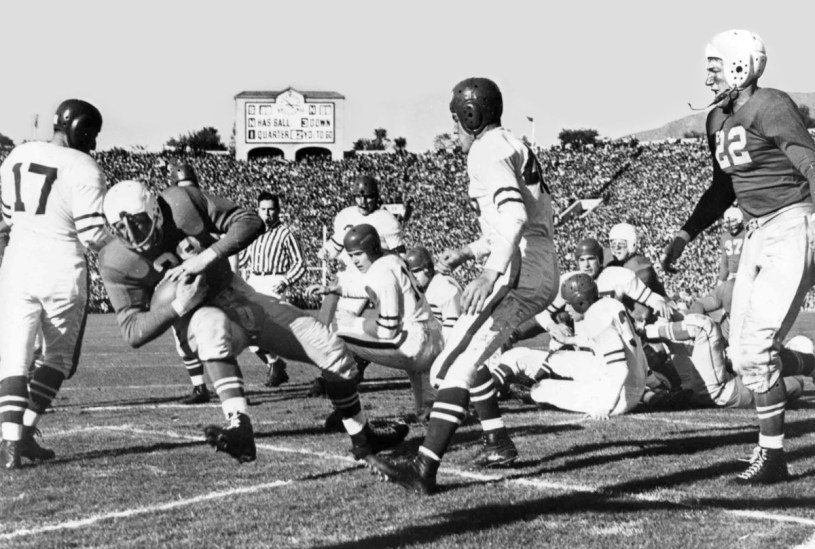
Our Rose Bowl Friday miniseries continues with a look at the culmination of the 1940 regular season. And this time, the “Champion of the East” actually just was from the Midwest: Nebraska, to be exact. The matchup featured No. 2-ranked Stanford (9-0) against the No. 7-ranked Cornhuskers from Lincoln (8-1). It wasn’t a marquee matchup, by any stretch of the imagination, but it was still the Granddaddy of Them All.
The Indians had played the No. 13 schedule in the country, defeating nine major-college opponents, outscoring them by a 196-85 margin overall. Stanford beat four ranked teams along the way, and the team did not have to travel very far for this matchup. This was the school’s first Rose Bowl appearance in five seasons, after the Indians had played in three straight Pasadena games from 1933-1935, winning the finale.
As for Nebraska, the Huskers lost their opening game on the road to the eventual mythical national champion, Minnesota, but then they ran the table in the Big 6 to get the invitation to Pasadena. However, the schedule was light: no other ranked teams despite the No. 18-ranked SOS. Nebraska did play some other “Big 10” teams along the way, too, but realistically, the schedule was much weaker than Stanford’s schedule.
This was the Cornhuskers’ first-ever bowl game, as well; the Indians had played in seven prior Rose Bowls. And while the train ride from Nebraska certainly wasn’t as rough as one from the East Coast, it still was longer than the one the Stanford players had to take from Northern California. The Indians also had a secret weapon: Head Coach Clark Shaughnessy, who turned a nearly winless 1939 team into champions.
He basically invented the T Formation, and Stanford brought that offense to the Rose Bowl for the Cornhuskers to counter. And Nebraska, despite holding two leads in this game, struggled to defend the T: the Indians rolled up 375 total yards in this game, while Nebraska managed just 128 yards overall. However, after exchanging touchdowns in both the first and second quarters, Stanford led just 14-13 in the third.
And then Indians halfback Pete Kmetovic returned a punt 39 yards for the clinching score; this video shows him starting to his left and reversing field to his right before scampering down the sideline to he end zone. This truly dazzling play came after Nebraska completed a goal-line stand against the Stanford offense to preserve the one-point margin—but then decided to punt on first down from its own one-yard line. Doh!
Future NFL quarterback Frankie Albert was the Stanford signal caller; he would play for the next-door San Francisco 49ers from 1946-1952 in the team’s original seasons in the AAFC and beyond. Shaughnessy had been coaching at the University of Chicago until 1939, when the school terminated its football program due to fear of corruption and other ethical/moral complications. Ironic how that changed the sport, eh? Indeed.
Either way, the Huskers would not return to the Rose Bowl until they (very) undeservedly were invited back after the 2001 regular season to compete in the Bowl Championship Series “title” game … despite not even playing in their conference title game. It would be 11 more seasons for the Indians returned to Pasadena, signifying a shift in the game’s evolution and popularity across the nation—not to mention World War II.
 Daily McPlay: (mostly) Historical Sports Analysis with TENACITY & VERVE