
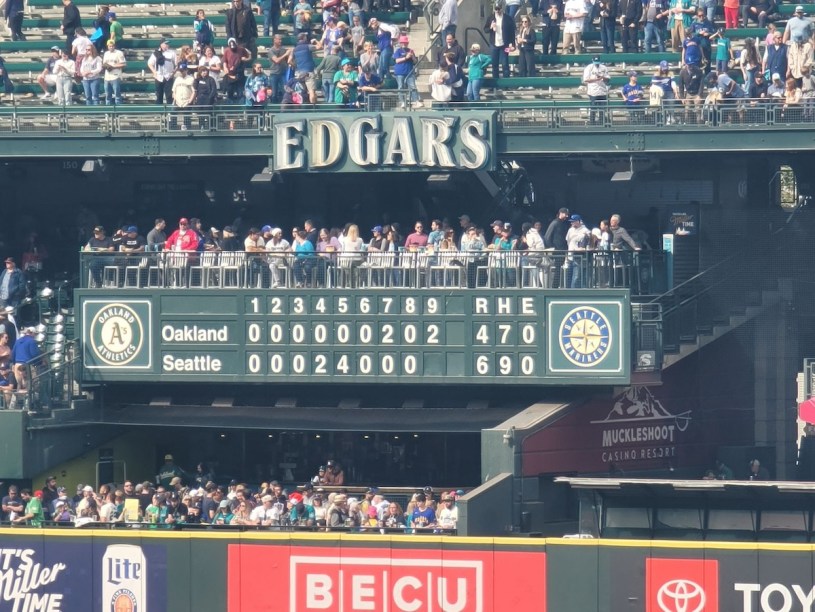
Despite winning four World Series, six American League pennants, 17 AL West Division titles, and 21 postseason berths in the 57 seasons by the Bay—numbers that most MLB franchises can’t come close to matching in the years since 1968—the Oakland Athletics played their final game a week ago today in Seattle, losing 6-4, to finish the 2024 season with a 69-93 record … a 19-win improvement over 2023.
The team will play its 2025 games in Sacramento, and the plan still is to arrive in Las Vegas with a new stadium by 2028. The reasons for this development are two-fold, documented in full view, and obvious: the socioeconomic decline of Oakland since the Civil Rights Movement of the 1960s and MLB’s desire to place the team in a more lucrative market, financially. The two trajectories have been intertwined since 1992.
The emotional narratives are not factual, as is usually the case when people who don’t understand change want to look for a scapegoat. Oakland lost an ABA team in the 1960s, an NHL team in the 1970s, an NFL team in 1980s, the same NFL team in the 2010s (after it returned in the mid-1990s by stealing money from the city, basically), an NBA team in the 2010s, and now an MLB team in the 2020s. Whose gets the blame?
It’s all Oakland’s “fault” although if you want to place responsibility at a city’s feet for not being held hostage by greedy business owners, feel free to do so. But America runs on money: we know this. And Oakland doesn’t have a lot of it, for a variety of socioeconomic reasons (read the book American Babylon by Robert O. Self; it will explain a lot to the uninformed about Oakland’s challenges since the mid-1960s).
When Bud Selig hijacked the MLB Commissioner’s Office in September 1992—another subject worthy of some needed education for clueless critics—the San Francisco Giants were headed out of town as an abject failure: just four playoff appearances and only two National League pennants in 35 seasons by the Bay. They’d been sold, in principle, to a Florida ownership group that would move the team to St. Petersburg.
The A’s were coming off four postseason appearances in the prior five seasons (1988-1992) and had the highest payroll in baseball as a result. But Selig never cared: he remembered the Oakland Oaks leaving after winning the ABA championship. He remembered the California Golden Seals leaving after never posting a winning season. He remembered the Oakland Raiders leaving town despite winning two Super Bowls.
Selig decided that Oakland was a losing proposition, and he decided to give the Bay Area baseball market to the Giants in November 1992 by rejecting the sale to the Florida ownership group (whom he then repaid with an expansion team in 1998)—a team that didn’t deserve it but had more potential to make more money in the greater San Francisco Bay Area alone than the A’s did. Selig’s pattern of actions since then prove this.
Even since getting Selig’s silent enablement to do whatever necessary to make money and succeed, the Giants have only made the postseason nine times in the 32 seasons since they were allowed to stay in town. In those same 32 seasons, the A’s have made the playoffs 11 times despite significantly less financial resources, because Selig factually stopped them from improving their local viability at every turn possible.
We know how the Giants finally found success by the Bay, even if sporadic: they cheated, first with Barry Bonds and BALCO, and then via other nefarious methodologies—just as the Boston Red Sox did, etc., under similar circumstances after decades of not winning anything and fans becoming disinterested in their big market team(s). People didn’t care about the documented cheating; they just wanted a winner.
Now, the San Francisco franchise has made just one postseason since 2016, but it makes money anyway based on a run of successful fueled by PEDs that will last decades as the “fans” bask in the glory of finally winning something. Since 2016, the A’s and their “worst owner ever” have made three postseasons while spending a fraction of the payroll: Oakland always fielded better baseball teams, but it wasn’t enough.
The A’s cycle of building, winning, rebuilding, and winning again has been in place since the franchise arrived in Oakland. Despite the lowest payroll in the sport this season, Oakland improved 19 wins, and the team probably will come close to finishing around .500 in 2025. We doubt MLB will let them make the playoffs until they reach Vegas, for financial reasons, but when they do, the A’s will be winners again.
And Oakland will have nothing left but tears to wipe away, even if half the blame lies with its own chosen pathways forward through time since the 1960s. We noted the sad irony of the final Oakland A’s game being played in Seattle, where that city lost its beloved NBA team through no fault of its own, thanks to similar greed. Follow the money, and the truth shall set you free, sports fans: trust us on this one. You’ll feel better.
 Daily McPlay: (mostly) Historical Sports Analysis with TENACITY & VERVE