
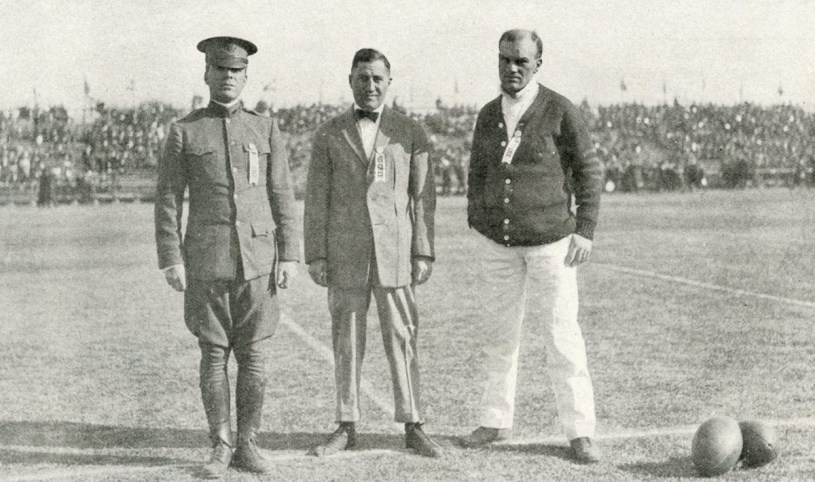
For the second year in a row, World War I impacted college football and the Granddaddy of Them All in Pasadena. So, today on Rose Bowl Friday, we look at the fifth “Rose Bowl” and the first one with a repeat contender: the Mare Island Marines, who won the game the prior year. The opponent this time? The Navy, instead of the Army, in the form of the Great Lakes Bluejackets, as more travel was possible this season.
Both squads are considering major-level competition in the NCAA annals, and neither team had lost entering the Rose Bowl. The Marines were 10-0 and the “defending” Rose Bowl champions, but they didn’t play a major-level team all season. The Bluejackets came into the game with a 5-0-2 record, playing a full schedule of major competition from Midwest colleges, including four future B1G schools and Notre Dame.
Thus, the game was somewhat of a mismatch as the final score indicates: Great Lakes won the game, 17-0, with future Chicago Bears legend George Halas being named the MVP for his two-way play. He scored on a 32-yard pass reception in the third quarter and also returned an interception 77 yards coming up just short of another touchdown there. The difference in the strength of schedule definitely showed itself here.
Since the war still had been in effect during the regular season for the most part, teams played regional schedules. Even though Mare Island played 10 games against non-major competition, its schedule managed to be 52nd best out of 72 teams. On the contrary, Great Lakes played the toughest schedule in the country: Iowa, Illinois, Northwestern, Notre Dame, Rutgers, Navy (the academy), and Purdue. There was power there.
As we saw in our MNC analyses from a few years ago, the B1G really was the elite conference in the nation until the late 1960s. This trend started early, since the schools in the Midwest also started playing the sport earlier than a lot of other regions in the country. While the Great Lakes team wasn’t necessarily a B1G school, it benefitted from its location in Illinois, drawing athletes from all over the Midwest during the war.
The Rose Bowl had survived World War I, as a result, and in the upcoming years, it would earn its nickname with marquee matchups, usually in the tradition of “East versus West”—even though the conference matchup we all came to know and love eventually didn’t really start officially for another three decades or so. Nonetheless, the sport would grow into one of the most popular, money-making spectacles out there.
 Daily McPlay: (mostly) Historical Sports Analysis with TENACITY & VERVE