
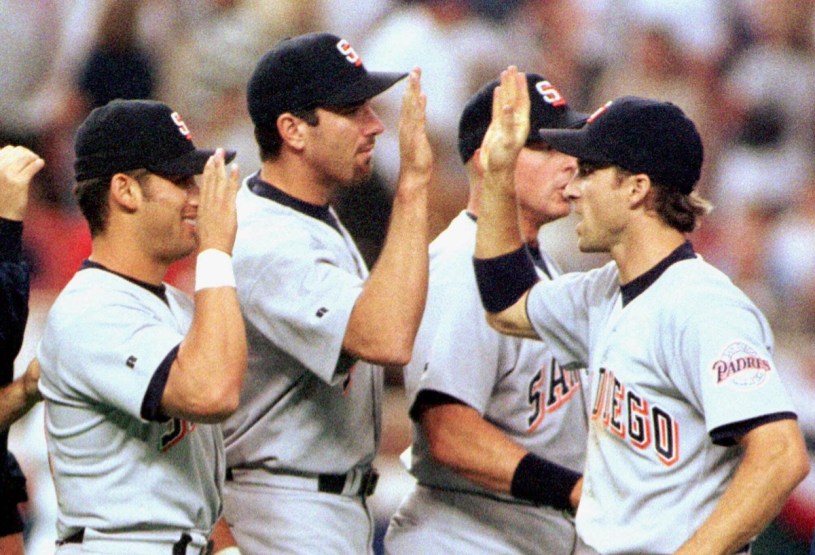
Welcome to the second edition of Random MLB Player Analysis, a series where we explore the careers of oddball players that we stumble across while doing various sports history research for future publication. First time out, we looked at Phil Nevin, and today we take on some players from the 1998 San Diego Padres: centerfielder Steve Finley and starting pitcher Sterling Hitchcock—Nevin joined the franchise in 1999.
We still start with Finley, as this was his last season with the Padres after being traded from the Houston Astros along with Ken Caminiti prior to the 1995 season. With the Astros in 4 seasons through his age-29 year, Finley posted a .737 OPS across 557 games. In his 4 seasons with the Padres, from age 30-33, he boosted that up to a .792 OPS in 602 games. Yet we have to break down these numbers in a few myriad ways.
With the Astros, Finley was glove-strong player, hitting just 32 home runs while stealing 110 bases. That style continued with his first season in San Diego (10 HRs, 36 SBs), although his defense went off a cliff (minus-1.8 dWAR). In his second year with the Padres, which coincided with Caminiti’s suspect MVP season, suddenly Finley mutated into a different hitter: 30 HRs, 22 SBs, and a career-high .298 average.
Where did those 30 dingers come from? His SLG at age 31 (.885) was a career high by almost 100 points, topping his previous high (.786) from the year before—which had been his career best at that moment, too. It’s odd for a hitter with so much speed to suddenly develop power at age 30 … unless, of course, your manager is Bruce Bochy. This issue has come up repeatedly with the overrated manager who cheats.
Finley is no exception to the Bochy pattern we also saw with Caminiti’s arrival from Houston. He proceeded to make his first All-Star team in 1997, while hitting another 28 HRs with a .788 OPS at age 32. So, as Finley should have exiting his prime, he was posting 60 HRs in 2 seasons combined after hitting just 42 HRs in the prior 7 seasons overall. When he dropped back down to 14 HRs and a .702 OPS in 1998, it looked plausible.
Exit the San Diego franchise, and enter the expansion Arizona franchise—which decided, for some reason, to give a declining player a 6-year contract at age 34, while also giving him a $2M raise from that lousy 1998 season. Finley either found a Fountain of Youth in the Phoenix desert or he knew he had to do something drastic to justify the contract … and overcome the pressure that must have come with it to win immediately.
Either way, he hit 69 HRs in the next 2 years combined, making the All-Star team again in 2000 while posting a new career high in OPS (.904) at age 35. We have seen this same narrative before, repeatedly so, in our House that Steroids Built miniseries on the cheatenous San Francisco Giants under Manager Dusty Baker and then Bochy. No one playing naturally sets a career high OPS at age 35, not even Babe Ruth.
Later in his career, Finley also hit a career-best 36 HRs in 2004 at age 39. Overall, in 849 games with the Diamondbacks on that fat contract he didn’t deserve after the 1998 season, he managed an .851 OPS from ages 34-39. Finley clearly learned enough in his first 2 seasons with Bochy, Caminiti, and the Padres to figure out just how to use … something … to his advantage and extend his relatively plain career.
Financially, his Arizona deal paid him $32.8M, and he also went on to get $6M from the Los Angeles Angels in 2005 at age 40 and another $7M from the Giants in 2006 at age 41. The S.F. deal is funny, since by that point, Finley was clearly washed up (6 HRs, .714 OPS). The team must have had different, ahem, assumptions about what Finley would do for them. But Finley had posted just a .645 OPS in 2006, so …
You never know what is “unspoken” in free-agent negotiations, do you?
As for Hitchcock, he spent his first 4 MLB seasons with the New York Yankees, and he wasn’t good: 16-15 record with a 4.79 ERA in 261 2/3 innings. With that statistical line, he wasn’t viewed as a “keeper” by the 1995-1996 offseason, so the organization traded him to the Seattle Mariners in exchange for a key piece of the championship puzzle that would result in 6 pennants and 4 World Series titles between 1996 and 2003.
The fact that a team on the cusp of historical greatness didn’t want him says a lot, so when Hitchcock found his way to the Padres by his age-27 season (after a 5.35 ERA in 1996), it was make-or-break time, really. And he responded with a career-best ERA (3.93) for a full season in 1998. His WHIP (1.231) was also a career high. How Bochy did not reward him for this with an All-Star nod in 1999 is still a mystery to us today, indeed.
Nonetheless, Hitchcock’s 4.47 ERA with the Padres across 6 seasons under Bochy remains the “high point” of his statistical profile, by far, not including a 38-inning stint with St. Louis in 2003. The 4.80 ERA that defines his career as a whole is not good, and again, the fact the Yankees found him expendable at the time says a lot. His peak years—age 26 to age 30—all came with San Diego, and he was never dominant at all.
The statistical profile here suggests he did not succumb to temptation, perhaps: that peak season of 1998 at age 27 was never repeated, and Hitchcock struggled to stay in the majors until 2004—getting one last shot (21-plus IP and a 6.33 ERA) with Bochy and the Padres. He failed, so perhaps he overcame temptation multiple times in San Diego to accept his fate gracefully, dignity intact. There’s just one suspicious catch:
$26.5M
After Hitchcock’s peak year in 1998, his sixth in the majors, he got a $1.25M raise from the Padres for 1999 and went on to earn almost $27M more in salary after that “career” season. Even though his next-best season would only produce a 4.11 ERA in 1999, those 2 seasons combined basically extended and propelled his career to a much greater financial height than his original stint with the Yankees would have produced.
It’s possible, although we are not fully convinced, that Hitchcock used … something … in 1998 and 1999 after his first year with the Padres (1997) resulting in a 5.20 ERA in 161 IP. Entering a do-or-die career crisis, he needed 1998 to happen for him or else his MLB existence would definitely be over. When we throw in his teammates on that 1998 team, and his manager … well, we see the possibility of something suspect, for sure.
Yet, in fairness, the statistical profile also first a guy who found his peak—albeit a low one, comparatively speaking—very briefly and then was able to parlay that potential with sucker front offices for another $26.5M. Although, the catch with this is clear: it was the Padres who gave him the first $15.6M from 1999-2001 and got burned by the decision. Did they expect more? If so, why? What did they know that we don’t?
After a 4.93 ERA across just 65 2/3 IP in 2000, San Diego traded Hitchcock away as soon as they could in 2001 when he posted a tidy 3.32 ERA in his first 19 IP (despite a 1.316 WHIP). We suspect the Padres were just happy to dump some of the $6M for that final year of his deal. They felt they got jobbed, as they clearly expected the strange new success of 1998 to continue for 3 more seasons. It works both ways, doesn’t it?
So, we’re on the fence with Hitchcock; maybe he never used any dubious supplements, or maybe he did at first to secure his future and then stopped. Both scenarios are plausible; both make sense to the average thinker; and both would be common with similar profiles we have looked at in the past with both the Giants and the Boston Red Sox. We definitely don’t see a smoking gun with Hitchcock, but there is some stanky fire.
 Daily McPlay: (mostly) Historical Sports Analysis with TENACITY & VERVE