
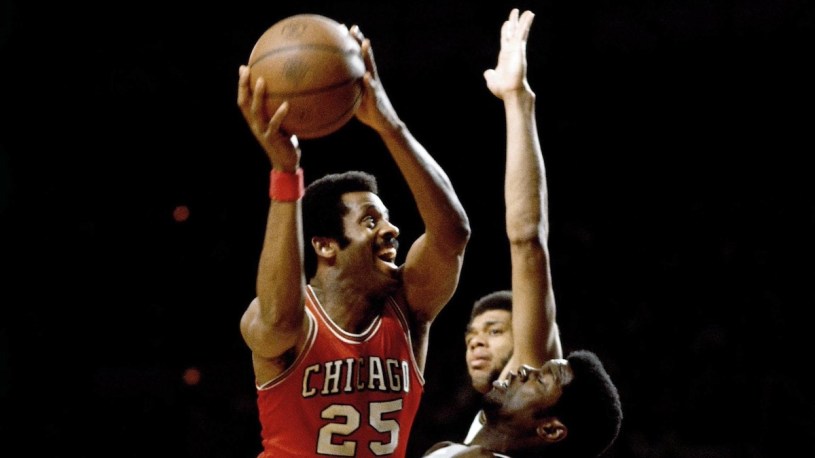
This NBA Tuesday miniseries looking at the best players in each team’s history continues today as we head to the Windy City—and you know what that means. The Chicago Bulls dominated the 1990s like no team had dominated the league since the Boston Celtics in the late 1950s and early 1960s. This produced a few stars, of course, but who else will be on this list? That is the true conundrum, of course, always and forever.
No. 10: Jerry Sloan, SG/SF—48.1 WS (1966-1976)
Perhaps better known for his later coaching with the Utah Jazz, Sloan toiled away in relative anonymity with the Bulls for his whole career, save his first season. Yet he was a two-time All Star (1967, 1969) who made it to the postseason 8 times over his 10 years in the Windy City. His key strength was defense, as he made the All-Defensive Team 6 times, while averaging 17.7 ppg and 7.7 rpg as a shooting guard (mostly).
No. 9: Bob Love, SF/PF—48.2 WS (1968-1976)
He made 3 straight All-Star teams in his prime (1971-1973), as Love managed 21.3 ppg and 6.8 rpg during his 9 seasons with the Bulls. He also went to the playoffs 6 times with the team, upping his stat line to 22.9 ppg and 7.5 rpg over 47 postseason games. His best season came in 1970-1971 as he produced 9.9 WS for a team that finished with a 51-31 record before losing to the Los Angeles Lakers in the conference semifinals.
No. 8: Jimmy Butler, SF—49.3 WS (2011-2017)
Playoff Jimmy started his career with the Bulls before moving on to other cities in the league; he was an All Star in his final three Chicago seasons (2015-2017). His growth and maturity since leaving his first team stem from his origins, where he put up a mere 15.6 ppg, 4.8 rpg, 3.1 apg, and 1.5 spg in the inital 6 seasons of his career. And yes, he was better in the playoffs here: 16.8 ppg, 5.2 rpg, and 1.6 spg. It was a shame he left.
No. 7: Joakim Noah, C—57.3 WS (2007-2016)
In 9 seasons with Chicago, Sticks acquitted himself just fine: 2 All-Star designations and almost a double double every night (9.3 ppg, 9.4 rpg). He also tossed in 3.0 apg and 1.4 bpg, as well. He won the 2014 DPOY vote, too, although we disagree with that choice. Noah did top the NBA in DWS (6.6) that season, which was his best overall, too (11.2 WS). He started 60 postseason games with the Bulls, posting 11.0 rpg and 9.7 ppg.
No. 6: Luol Deng, SF—58.4 WS (2004-2013)
He made the All-Star team his last two full seasons with the team (2012-2013) as Deng posted 16.1 ppg, 6.4 rpg, 2.5 apg, and 1.0 spg over 637 regular-season games in Chicago. He also topped the NBA in minutes per game in both of those years, too. In the playoffs, Deng improved to 16.7 ppg, and 7.0 rpg over 48 postseason games with the Bulls. However, 2006-2007 was his best season (11.3 WS) in terms of overall value. Strange.
No. 5: Horace Grant, PF—62.4 WS (1987-1994)
A member of the organization’s first 3 league championships (1991-1993), Grant only made the All-Star team once, in his final season with the Bulls (1994). He scored a career-high 15.1 ppg that season, too, as a famous teammate of his (see below) took that season off to go play minor-league baseball. Overall in his time in Chicago, he posted 12.6 ppg, 8.6 rpg, 2.4 apg, 1.1 spg, and 1.1 bpg to provide excellent team support.
No. 4: Artis Gilmore, C—66.5 WS (1976-1982, 1987)
The A-Train had a very successful ABA career before joining the Bulls, where he proceeded to make 4 All-Star teams (1978, 1979, 1981, 1982) on his way to the Hall of Fame. Overall, in 7 seasons with Chicago, Gilmore posted 19.3 ppg, 11.1 rpg, 2.5 apg, and 2.1 bpg. This includes a late-career, 24-game stint when he was 38 years old. Sadly, the sad-sack Bulls could only make the postseason twice while he was in town.
No. 3: Chet Walker, SF—67.0 WS (1969-1975)
Chicago got the Jet for the final 6 seasons of his 13-year Hall of Fame career, and Walker didn’t disappoint: he was a 4-time All Star (1970. 1971, 1973, 1974), and he still managed 20.6 ppg in 474 regular-season games. Walker added 6.1 rpg and 2.3 apg as well. The Bulls made the playoffs every season he was with the team, although that totaled up to just 47 games over the 6 postseasons. We hardly can fault Walker for that, right?
No. 2: Scottie Pippen, SF—99.7 WS (1987-1998)
He was a 7-time All-Star selection during his time with the Bulls, which also featured 6 NBA titles in an 8-year span. Of course, Pippen always will be remembered as someone else’s sidekick, a guy who couldn’t lead the team in the absence of His Majesty (below). His overall numbers with Chicago? 17.7 ppg, 6.7 rpg, 5.3 apg, and 2.1 spg over 856 regular-season games. Pippen was better in the playoffs, but only when … yeah. Truth.
No. 1: Michael Jordan, SG—204.5 WS (1984-1993, 1995-1998)
We doubt we will see this again during this miniseries: the top guy more than doubling up the next-best dude. But what can we say here that hasn’t already been stated, repeatedly? Jordan is probably the best player in the history of the league: his 31.5 ppg, 6.3 rpg, 5.3 apg, and 2.3 spg with the Bulls alone don’t even begin to tell the whole story. We gave him 7 MVP awards in our analyses; that should be enough proof.

