
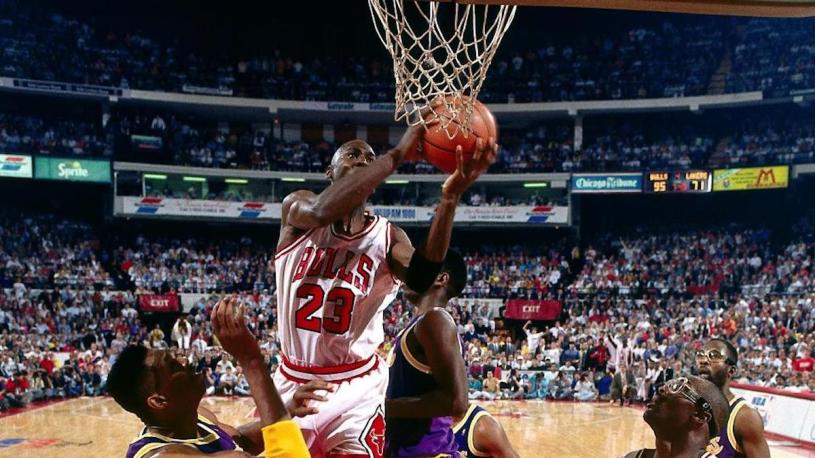
The current NBA Tuesday miniseries drifts a little west today to the Windy City, where we take on the Chicago Bulls—and you know what that means. From 1966 to 2023, this franchise has been to the postseason 37 times, winning 9 division titles and 6 NBA championships—all in the 1990s with Michael Jordan at the helm. The question is now which five teams will make this list. Read on to find out … enjoy!
No. 5: 1971-72 Chicago Bulls
Surprise, surprise, surprise … this team edged out the 1993 and 1998 championship squads. With a 57-25 record, these Bulls finished second in the Midwest Division behind the defending title team, the Milwaukee Bucks. Chicago was No. 6 on offense, No. 1 on defense, and No. 3 overall in the SRS rankings. But rough luck meant the Bulls had to face to 69-win Los Angeles Lakers, record setters at the time and eventual champs.
Small forward Chet Walker (14.5 WS), center Clifford Ray (8.7), and point guard Norm Van Lier (8.1) led this group, although power forward Bob Love (7.5), C Tom Boerwinkle (7.4), and shooting guard Jerry Sloan (7.2) made this a deep and talented team. But the Lakers were too good, for everyone: They outscored the Bulls by 10.0 ppg, and the closest contests in a four-game sweep were Games 2 and 3 (seven points).
No. 4: 1990-91 Chicago Bulls
This was the first team in organization history to win the NBA title, and Chicago did it with a 61-21 record that clinched a Central Division title. The Bulls were No. 7 on offense, No. 4 on defense, and No. 1 in the overall SRS rankings. They dropped just two games on their way to the championship: one against Philadelphia in the conference semifinals and one in the Finals against the Lakers. Air Jordan reigned.
Jordan (20.3 WS) was the MVP, of course, but SF Scottie Pippen (11.2) and PF Horace Grant (10.3) were pretty darn impressive as well. The Bulls only used 12 players all season, so it was a healthy roster, too. Sweeping the two-time defending champion Detroit Pistons in the Eastern Conference Finals was huge, of course, but dropping the Team of the ’80s in the Finals was just as symbolic … passing of the torch, indeed.
No. 3: 1991-92 Chicago Bulls
The Bulls’ second title team was even better than the first: They won 67 games to win the Central Division again, thanks to the No. 5 offense, the No. 3 defense, and the No. 1 SRS ranking overall. But the playoffs were rougher for this group, after the opening-round sweep of the Miami Heat. Chicago was pushed to 7 games by the New York Knicks, 6 games by the Cleveland Cavaliers, and 6 games by the Portland Trail Blazers.
Jordan (17.7 WS) won the MVP again, while Grant (14.1) and Pippen (12.7) were even better than they’d been the year prior. Overall, though, 10 players posted at least 2.3 WS to make this a much more well-rounded roster. The Bulls won Game 7 against N.Y. by 29 points, and against the Cavs, Chicago closed out Game 6 on the road by 5 points. In the Finals, the Game 5 road win by 13 points was the big turning point for the Bulls.
No. 2: 1996-97 Chicago Bulls
The fifth of Chicago’s title teams ranks second on this list, with a 69-13 record and another Central crown. These Bulls were No. 1 on offense, No. 6 on defense, and No. 1 overall in the SRS rankings. Chicago swept the Washington Bullets in the first round, and then it topped the Atlanta Hawks and the Miami Heat, respectively, in 5 games each to advance to the Finals against the Utah Jazz—a series that went 6 games.
The cast of characters for Act II of the Bulls dynasty was slightly different: Jordan (18.3 WS) and Pippen (13.1) were supported ably by four other players with at least 5.7 WS. His Airness should have been the MVP, even though he didn’t win the vote. The Finals against voted MVP Karl Malone was personal for Jordan, we suspect: the Chicago star outscored his rival by 8.5 ppg while outshooting him from the floor, too. Burn.
No. 1: 1995-96 Chicago Bulls
Many people think this is the best team of all time, for winning 72 games and the NBA title. Jordan’s return from his first “retirement” resulted in a then-record 72 wins, a Central title, the No. 1 offense, the No. 3 defense, and the No. 1 overall SRS ranking. In the playoffs, the Bulls rolled through the Eastern Conference, losing just one game to the Knicks in the semis, before beating Seattle in a weird six-game Finals series.
Jordan (20.4 WS) was the MVP; duh. Atop the value charts with him? Pippen (12.3), SF Toni Kukoč (10.1), and PG Steve Kerr (8.3). Chicago swept Miami in the first round and swept Orlando in the Eastern Conference Finals—a year after Orlando had reached the NBA Finals. The Bulls went up 3-0 on the SuperSonics easily (plus-14.3 ppg) before cruising to a 6-game series victory back home in front of the fans.
 Daily McPlay: (mostly) Historical Sports Analysis with TENACITY & VERVE