
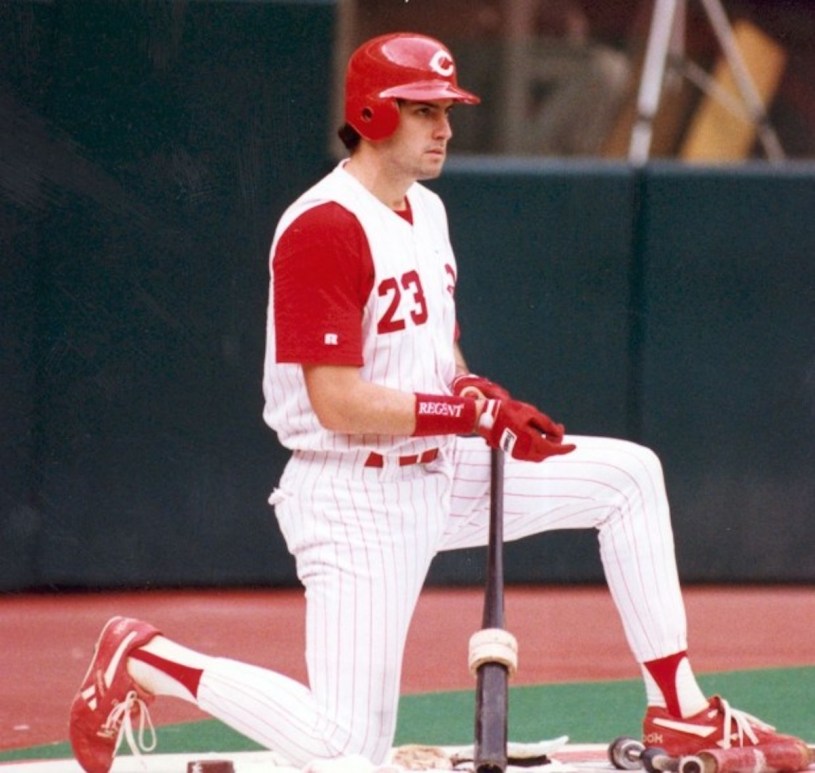
This is our first MLB Monday entry for the 2026 regular season, although we’re going back in time, as usual. We look today at one of those .300-plus lifetime hitters who will never sniff Cooperstown without a ticket: (mostly) first baseman Hal Morris, who played for four teams in a 13-season career, primarily with the Cincinnati Reds. He also played a little left field and rarely right field. His lifetime .304 batting average was directly the result of being platooned as a left-handed hitter for most of his career.
His splits? Morris hit .320 in 3,055 ABs against right-handed pitchers and just .252 in only 943 ABs against lefties. His OPS marks are even more drastic: .846 (113 OPS+) against righties and .626 (59 OPS+) against southpaws. It makes you wonder why he ever got any ABs against the LHPs on the mound, but situations be situations, so that is a sunk thought as Morris turns 60 later this week (Thursday, to be exact). Ir doesn’t seem that long ago that he was hitting .311 in his final 40 MLB games back at age 35.
But time flies in baseball and life, doesn’t it? Morris first arrived in the majors as a member of the New York Yankees during the 1988 season, getting two hits in 20 ABs while striking out nine times across 15 games. He played in an additional 15 games the following season, hitting .278 and drawing a single walk in 19 plate appearances. The New York front office didn’t think enough of him at that point to keep him, so they flipped him to the Cincinnati Reds before his age-25 season (1990) for pitcher Tim Leary.
Leary had posted 17 wins and a 2.91 ERA in 1988 for the World Series champion Los Angeles Dodgers, but he had regressed in 1989 and been traded midseason to the Reds. In the Bronx, he would go on to lose an MLB-worst 19 games in 1990 as well, while Morris hit .340 in Cincinnati to finish third in the NL ROTY vote—as the Reds won the World Series. He only played in 107 games as a platoon hitter, and his 1.8 WAR was just 12th best on the roster, but clearly Morris was a significant contributor there.
[That trade was just one of many reasons the Yankees finished 67-95 with the worst record in the American League, while also going 0-12 against the pennant-winning Oakland Athletics and scoring just 12 runs in those 12 games. Good times, eh? But, we digress …]
Morris would never post a higher batting average in his career than he did in 1990, but in 10 seasons with the Reds, he did hit .305 overall in 1,049 games and help Cincinnati reach the postseason in 1995, too. He posted a career-best 3.8 WAR in 1991 and delivered a .318 BA that season, in addition 14 home runs and 59 RBI. While never a big power hitter, Morris was a good contact hitter who struck out only 548 times in MLB career while walking 356 times. It was all about putting the bat on the ball for him.
His other .300-plus seasons with Cincinnati were 1993 (.317), 1994 (.335), and 1996 (.313). In an odd transactional note, the Reds let him walk after the 1997 season, when Morris hit just .276 while making $3.1M that season. He signed with the Kansas City Royals for $1.4M, hit .309 with just one HR in 127 games, and was suddenly a free agent again. Cincy brought him back for the 1999 season at a cut-rate $450K salary, and Morris put up a punchless .284 BA at age 34. His power gone, he had little value left.
It’s an odd career trend that after the 1996 season when he was 31, Morris hit just 5 HRs in his final four seasons, after hitting 71 HRs from 1990-1996. Again, he wasn’t a power hitter, but what HR potential he had possessed earlier in his career abandoned him pretty abruptly. The Reds hung on to him through the middle of the 2000 season before the Detroit Tigers purchased his contract off waivers after the All-Star break. That’s where Morris finished his career with a final 40-game push that looked good on paper.
He never made an All-Star team. He never won a Gold Glove (his defense was mediocre with a minus-5.4 dWAR mark overall for his career). He earned MVP votes just once in his career (1994). His 13.4 career WAR doesn’t put him in any exclusive company. But Morris did make almost $15M in his MLB lifetime, and he has a World Series ring, as well. Most baseball fans would trade their existing lives for that kind of professional baseball experience, and again, he did finish with a .304 lifetime BA: impressive.
So, on that note, happy early 60th, Mr. Morris. We wish you the best.
 Daily McPlay: (mostly) Historical Sports Analysis with TENACITY & VERVE