
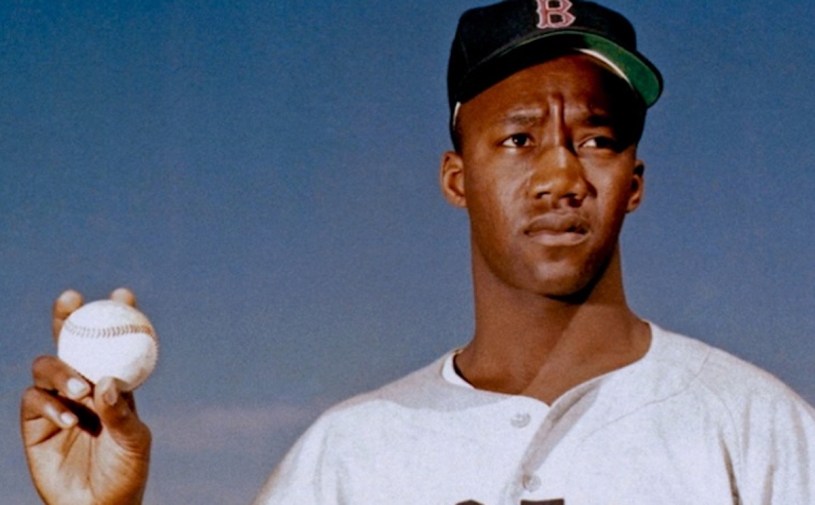
Welcome back to Friday Funday! When we started covering MLB for CBS and its various affiliates back in 2009, we were living in San Leandro, CA, a suburb of Oakland where our grandparents had lived in their retirement years. We actually were located exactly 6.66 miles from the infamous Coliseum, which was an amusing fact, as we also saw our first-ever MLB game there in 1974 (as noted elsewhere) with those same grandparents, who lived in nearby Alameda at that time. Oh, the East Bay memories!
When former MLB player Pumpsie Green died in San Leandro many years later (2019), we had no idea he was from the Bay Area. It made us proud to learn he had been raised in El Cerrito, attended community college in San Pablo, and had spent his latter years very near to where our grandparents and we ourselves had once lived. Green wasn’t a star, and he was known best for the wrong reasons; however, he was a slightly above-average player who perhaps deserved a better fate than the one MLB gave him.
His full story is here, but we want to do our own analysis of his career situation right here. Elijah Jerry Green made his MLB debut with the Boston Red Sox on July 21, 1959, making the team the last one in the majors to integrate its roster. Considering Jackie Robinson had debuted for the Brooklyn Dodgers in 1947, and Larry Doby had done the same later that summer for the Cleveland Indians, it’s pretty sad that Boston took so long to include a Black player on its team. We know why, sadly, but we’re moving on.
Our focus here today is the talent of Pumpsie Green, who earned his nickname from his mother at an early age for reasons he never knew. He signed with the independent Oakland Oaks of the Pacific Coast League out of college in 1951, although he never played for them, instead suiting up for lower-level farm teams—including the Stockton Ports (1955). Later, after the Red Sox had purchased his contract in February 1956, he played for the San Francisco Seals in 1958, ironically. He made it to Boston by 1959.
As an age-25 rookie, he found himself playing second base and shortstop near the likes of Hall of Famer Ted Williams, eventual two-time batting champion Pete Runnels, frequent All Star and Gold Glove winner Frank Malzone, and 1958 AL MVP vote winner Jackie Jensen. That was quite a collection of teammates, for sure, but Green did just fine in the 50 games he played, earning 1.0 WAR for a team that somehow finished under .500 on the year. His .350 OBP and 0.5 dWAR were the highlights.
Green was never a regular starter in his MLB career, but he did play in a career-best 133 games during the 1960 season. The results were less than stellar, in terms of his 0.2 WAR, .688 OPS, and a negative-0.3 dWAR effort in the field. However, he did improve his batting average from his rookie year, while maintaining a .350 OBP due to 44 walks. His eye at the plate was good, as he finished career with more walks than strikeouts, despite that lifetime .246 BA. The Red Sox stuck with him, and it paid off.
In 1961, he posted his best statistical season at age 27, which makes sense, despite playing in only 88 games, which does not make sense. His 1.9 WAR mark was seventh best on a 76-win team adjusting to life after Williams retired while also breaking in rookie Carl Yastrzemski (who posted minus-0.3 WAR at age 21). Green’s .801 OPS was a career high at the time, and his defense rebounded to the 0.5-dWAR level. His six home runs and 27 RBI were the best numbers of his MLB tenure in those categories.
Through three seasons (totaling 271 games) at this point, Green had posted 3.1 WAR, and perhaps he was poised to break out big in his prime. Alas, it never happened that way; his 1962 season was a disappointment (-0.5 WAR in 56 games), and Boston traded him to the New York Mets in December 1962. His new team was coming off a horrible expansion debut, winning just 40 games in 1962. Perhaps there would be opportunity for Green in the Big Apple with such a mediocre team, but he played in only 17 games.
And even though those handful of games produced an .835 OPS as he played third base for the first time in the majors, it would be the end of his MLB career. The final numbers: 2.9 WAR, prorated to 1.4 WAR for every 162 games he played. The 95 OPS+ mark shows the weakness of his bat, despite a career .357 OBP. He also was a slightly positive defender overall at the three infield positions he manned during his five-season journey in the majors. Green never got to play in the World Series, either, of course.
The questions always linger now, though, why the Red Sox took so long to integrate, and why the Boston organization decided on Green to break its internal color line, about 13 years after the front office took a pass on Jackie Robinson. Those are questions for someone else to answer today, but for us, we’re disappointed in ourselves for never realizing Green was a local persona we missed a chance to discover during our time covering MLB for CBS way back when. He would have been a fascinating interview, truly.
On a personal level, we love the fact he was married for 62 years to his wife, Marie. Maybe that is his best statistic in the end, eh?
 Daily McPlay: (mostly) Historical Sports Analysis with TENACITY & VERVE