
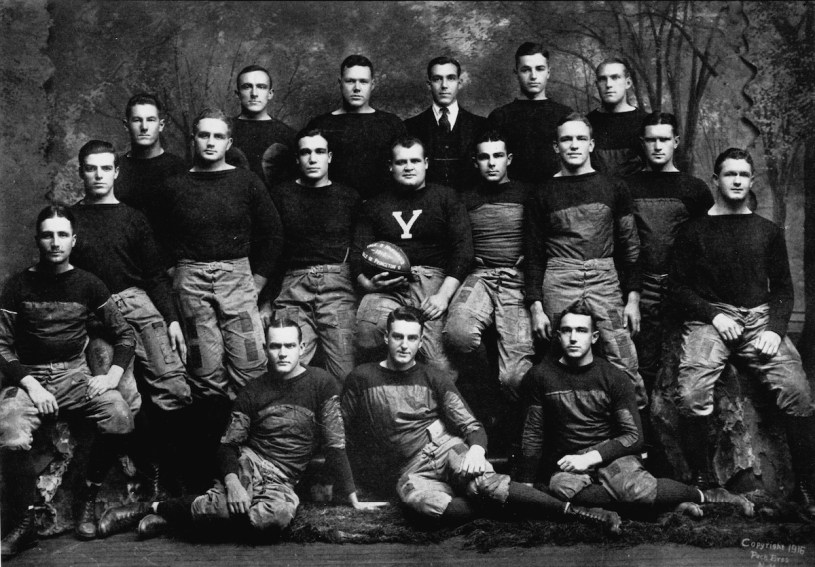
As this MNC Wednesday prequel miniseries goes back deeper and deeper in time, it gets a little more rough trying to decipher numbers in a spreadsheet. Yet in the absence of reliable objectivity in the qualitative records, it’s still our best bet. Take this season today: its notoriety is well known, and that clouds a lot of judgment in the human mind, trying to rectify the quantitative. Our eyes are telling us one thing, and our brains are informing us of something quite different. This is the delight and joy of sports, perhaps.
The 1916 MNC: Pittsburgh (Helms, NCF); Yale (DMP)
The experts have crowned the Pittsburgh Panthers (8-0, No. 2 SRS, No. 26 SOS) as the de facto mythical national champion for this campaign. But they played only five major-college opponents during the season, leaving that SOS open for attack. And of course, there is the elephant in the room here: the No. 1 team in the SRS. That would be the Georgia Tech Yellow Jackets (8-0-1, No. 1 SRS, No. 8 SOS). Yet even this team played two small-college teams on its way to the best sabermetric rating of the bunch.
One other team to highlight is the Yale Bulldogs (8-1, No. 3 SRS, No. 2 SOS), for these guys are right up in the discussion, too, with those mathematical realities. From where we stand almost 110 years later, the Panthers seem to have a weak case for the title crown. And, of course, this is the infamous GPI squad that ran up the score on little Cumberland Bulldogs, by a 222-0 score. In an ethical and moral sense, that should have disqualified the Yellow Jackets from all consideration, even if that is a subjective take.
As kids we read about this game, like it should have been taken seriously; as adults now with a lifetime of athletic and sporting experience, it’s clear now how tacky and wrong this whole incident was, even if it helped put Georgia Tech atop the sabermetric rankings. For example, here is something we never knew about in childhood: “Cumberland had disbanded its football program the previous year but was still obligated to play this game against Georgia Tech.” Obligated? Makes GPI seem like real robber barons.
But we digress: thank goodness for Yale, eh? Those Bulldogs have the best combined profile, and in conjunction with the Yellow Jackets’ tie and the Yale loss in relation to SOS ratings being a wash there. Pittsburgh’s SOS really does take it out of the running in our minds; the Panthers also played only two road games, although they both were against major-college opponents. Also, in that comparative-score avenue, Pitt only beat small-school Carnegie Mellon by a 14-6 margin, when Yale downed them, 25-0. So?
Yes, if you can only beat a small school by eight points at home, you may not be MNC-worthy material. Meanwhile, the Bulldogs lost at home by a 21-6 margin to No. 9 Brown, while the Yellow Jackets were tied at home by No. 20 Washington & Lee. The Generals posted a 5-2-2 mark, so they were no great shakes. But Yale really did lay a home egg against the Bears, too. Neither of these record blemishes look good, cosmetically, so we have to retreat to the math—which favors the Bulldogs, overall, in reality.
The one area where Georgia Tech has the edge is in that SRS rating, giving GPI a mere 0.7-point edge on a neutral field. Oddly, both team played only one road game, which is kind of weak sauce. The Bulldogs beat No. 17 Princeton, 10-0, while the Yellow Jackets traveled to No. 37 Georgia and posted a 21-0 victory. Pretty much another non-differentiating piece of evidence. In the end, we feel the 3/2 combination rankings for Yale outdo the 1/8 marks for Georgia Tech. Feel free to disagree with us, of course.
For now, this is the Bulldogs’ second MNC designation, the other coming in 1923. That was another season where Yale has been overlooked in favor of two more “popular” schools, yet objectively and sabermetrically, that should not have been the case at all.
 Daily McPlay: (mostly) Historical Sports Analysis with TENACITY & VERVE