
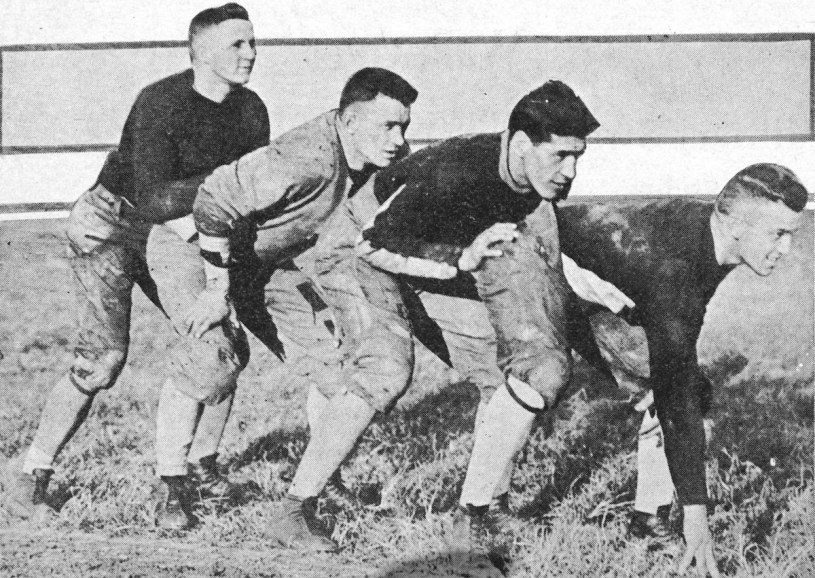
The historically deep(er) MNC Wednesday prequel miniseries makes another appearance today, to explore the mythical national championship in an era where most of us can hardly imagine what life was like for the average sports fan in America. The United States entered World War I on April 6, 1917, deploying over five million people into military activity in one form or another. College student athletes were not exempt, of course, so this is another season where there are some wonky results to assess/sort.
The 1917 MNC: Georgia Tech (Helms, NCF); Georgia Tech (DMP)
Five of the Top 10 teams in the SRS rankings resided in the Western Conference, the precursor to the modern-day B1G. But it was the Ramblin’ Wreck from Georgia Tech that emerged with the MNC in retrospective analysis. And of course, per our rules, only one of the Western Conference schools can emerge as a primary contender in these examinations. Yet due to wartime conditions, uneven league slates were abundant: for example, Michigan played just a single conference game, and it wasn’t against Ohio State.
[Shocker, right? Maybe not, considering the Wolverines like to duck the Buckeyes. But we digress.]
Ironically, Michigan played the most games (10) of any team in the Western, but with its 0-1 league mark, the school is not in this conversation. Ohio State finished 8-0-1 with a 4-0 record in conference play to claim the crown. Therefore, the Buckeyes get our Western “autobid” to the overall MNC discussion. Overall, we’ve narrowed it down, as well, to just five teams under consideration here, all of them in the Top 7 for the SRS rankings. Without further adieu, these are the lucky schools:
- Georgia Tech (9-0): No. 1 SRS, No. 9 SOS (out of 88)
- Ohio State (8-0-1): No. 3 SRS, No. 17 SOS
- Pittsburgh (10-0): No. 4 SRS, No. 27 SOS
- Navy (7-1): No. 5 SRS, No. 35 SOS
- Texas A&M (8-0): No. 7 SRS, No. 23 SOS
That’s it. Again, due to wartime challenges and restrictions, excessive travel was not an option in adjusting schedules on the fly. Coincidentally and/or situationally, the Yellow Jackets played a full slate of major-college teams, contributing to their superior SOS rating. In addition? They did play only one road game, and Georgia Tech outscored its opponents by an insane 491-17 margin. This wasn’t even the season of the infamous Cumberland game, either (that was 1916, so maybe it will come up later).
Interestingly, though, all that data only gives the Yellow Jackets a slight edge over the No. 2 SRS team, Minnesota, which lost a conference game to No. 8 Wisconsin on the road by three points, and therefore is not a part of this conversation. That is the lucky stroke for the Ramblin’ Wreck here, for sure. If the Golden Gophers had won that game, maybe this whole analysis would be different. Alas, we know it’s sometimes better to be lucky than good, so we see Georgia Tech’s dominance here in plain terms.
The Buckeyes only played five major-college opponents, but playing one of them on the road (Auburn, no less) to a scoreless tie ended up hurting Ohio State in this analysis. To its credit, though, the team did play three road games against real competition, so there was no stacking of the schedule here against regional patsies, which is sort of what the Yellow Jackets did, despite that SOS. Yet, either way, the Buckeyes cannot compete with the Georgia Tech sabermetric profile. And neither can the Pittsburgh Panthers.
While this team did go undefeated, four of its games came against small-school competition. The only two road games were against Pennsylvania and West Virginia. We applaud the Panthers for their excellent season, but they’re not overtaking GPI, either. And while transitive scores are not a valid form of comparison, objectively, they do inform us somewhat, so Navy’s loss to the Mountaineers tells us just what the numbers above do: the Midshipmen were a notch below Pittsburgh in this 1917 hierarchy.
That leaves us with the Aggies and their undefeated season: no one scored on TAMU all season long, which is amazing, and the schedule featured 75 percent major-college opponents, too. The Aggies went on the road against Baylor and Rice, but they only scored a total of 24 points themselves in their final three games. Perhaps if they had scored a lot more points in a “run-up-the-score” mindset, we’d be talking about A&M here with seriousness. Alas, the margin of victory factors into the sabermetrics.
So, in the end, we can confirm Georgia Tech’s MNC designation, under the unique conditions of this season. This is the first time since our 1922 analysis that we have agreed with the so-called experts; additionally, this is the Yellow Jackets’ second MNC in our estimation, as we also confirmed their 1928 championship in our analyses. Congratulations to the Ramblin’ Wreck—although this nickname was not in existence at this time … we don’t care. It’s still too cool not to use any time we want.
 Daily McPlay: (mostly) Historical Sports Analysis with TENACITY & VERVE