
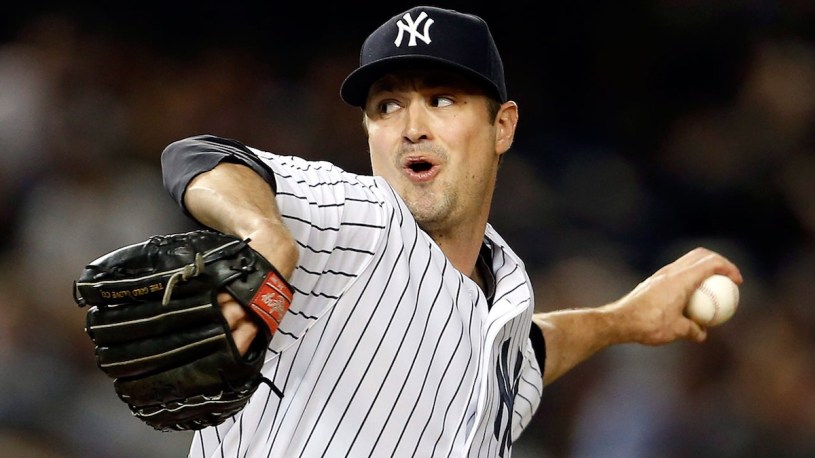
Our Friday Funday pieces recently have had a theme, which we don’t need to revisit today. Thus, today we go off in another direction with our MLB profile: southpaw Andrew Miller. He spent 16 years pitching in the majors, for seven different franchises, which is weird to think about considering he had his 15 minutes of fame as seemingly everyone’s bullpen answer du jour. Yet his overall career ERA (4.03) is uninspiring, and he only made two All-Star teams. But his prime seasons really were something else.
Originally drafted in the third round by the Tampa Bay Devil Rays in 2003 out of high school, Miller passed on that opportunity and went to play college baseball at the University of North Carolina. As a six-foot-seven lefty, he always was an imposing presence on the mound, reminiscent of Randy Johnson. At just 200 pounds, he was relatively wispy, but the Detroit Tigers made him their first-round pick in 2006, and Miller went on to make his MLB debut later that year as Detroit reached the World Series.
But Miller didn’t pitch in that postseason; in fact, it wasn’t until three teams later in 2014 that he finally threw a meaningful pitch in October. His career didn’t really go as planned with the Tigers, as before he’d even thrown 75 innings in the majors (to the tune of a 5.69 ERA, no less), the Detroit front office flipped him to the Florida Marlins in exchange for some guys named Miguel Cabrera and Dontrelle Willis. The fact he was a key cog in that trade, despite no MLB success yet, speaks volumes about perceived upside.
Yet over the next three seasons with the Marlins, he was even worse than he was with the Tigers, posting a 5.89 ERA in 220 IP. So, through parts of five years in the major leagues, at this point (2010 was his age-25 campaign), Miller had not even thrown 300 total innings, and his ERA was 5.84 across 79 appearances—which included 54 starts. He had made almost $6.5M so far in the majors, and the return on that investment was mediocre at best (his WHIP was over 1.700, for example). Miller was a real bust.
Despite his career minus-2.8 WAR at that point, however, guess who decided to take a gamble on potential? The Boston Red Sox traded for Miller’s rights after the 2010 season, where he had delivered an 8.54 ERA in just nine appearances. Loyal readers here know what we have deduced about this era of Red Sox baseball, so maybe it’s not a surprise they took on a reclamation project like Miller. Alas, he still was young, so we make no judgments, but Boston “fixed” whatever was wrong with Miller, to great success.
The 2011 season was again mediocre for him (5.54 ERA in 64 IP), but by his age-27 season in 2012, Miller finally had command of his pitches and had mastered his craft (3.35 ERA in 40-plus IP). Perhaps coincidentally, or not, he never made another MLB start after the 2011 season, so his greatest successes came as a relief pitcher. Boston gets credit for making him a full-time bullpen resident, for sure, as the team went on to win the World Series in 2013 when Miller had his best season (2.64 ERA in 30-plus IP).
Alas, he was injured right before the 2013 All-Star break and did not return for the postseason success. And then with Boston sinking into last place the following year (2014), the Red Sox front office flipped Miller—who was pitching very well—to the contending Baltimore Orioles with his contract expiring at the end of the year. With the Orioles, he was dynamite (1.35 ERA in 20 appearances) as Baltimore won the American League East Division and advanced to the AL Championship Series. This was huge.
Miller’s total 2014 statistical profile—1.8 WAR, plus a 2.02 ERA in 73 appearances—represented his best year ever, at age 29, and his prime seasons were in full swing. Naturally, there was a bidding war for his services when he became a free agent that winter, and of course, it was the New York Yankees who won the day with a four-year, $36M contract. That was quite a raise for Miller, who made just $1.9M in the 2014 season under his Boston contract. And with that new money came a lot of new expectations, too.
The Yankees wanted him to close, for the first time in his career, as he had only one save prior to the 2015 season. Yet Miller acquitted himself well, posting 36 saves along with a 2.04 ERA in 60 appearances to earn Cy Young votes, a new achievement for him. Yet New York lost the AL Wild-Card Game to the Houston Astros, and in 2016, the team traded him to Cleveland as the Yankees faded from contention. With the Indians, Miller reached the World Series and played a vital role in helping his team.
He went 2-0 with one save in October 2016, posting a 1.40 ERA in 10 appearances in the postseason as Cleveland lost in Game 7 of the World Series to the Chicago Cubs. But Miller’s legacy was cemented here: he won the ALCS MVP vote, which we agreed with in our own analysis. His success continued into his age-32 season (2017), as he posted a 1.44 ERA in 57 games with Cleveland. The team once again made the playoffs, but they lost the AL Division Series matchup to New York, interestingly so.
Thus, Miller’s prime years (age 27-32) added up to the following: 2.01 ERA in 332 IP with a 26-15 record, 60 saves, and 11.9 WAR. His WHIP was under 0.900 from 2014-2017, collectively, while his K/9 rate was between 13.6 and 14.9 from 2013-2017. This is what most baseball fans remember: the relief dominance he provided in his prime for winning teams goiong deep into October. Even though he never pitched in the World Series for the winner, Miller certainly enabled these teams to get there.
His decline began in 2018, in his final year with the Cleveland franchise. His 4.24 ERA and 1.382 WHIP certainly did not warrant a $9M annual salary anymore, and he hit free agency again after that age-33 campaign. The St. Louis Cardinals offered him a three-year contract worth close to $35M, for some insane reason, but Miller never regained his prime-years form. His 4.45 ERA in 2019 in 73 appearances generated negative WAR, and even though his 2020 season resulted in a 2.77 ERA, he pitched just 13 IP.
In 2021 at age 36, he put up a 4.75 ERA in just 36 IP, resulting in his retirement after that year. So, for their near-$35M investment, the Cardinals got a 4.34 ERA in 129 games across 103-plus IP. It pays well to be a southpaw, evidently. Maybe that’s not fair to say, but St. Louis really didn’t do its homework before that deal, and it’s no wonder the franchise hasn’t made it to the NLCS since 2019 after dominating the National League earlier this century with 10 NLCS appearances from 2000-2019. Some deals hurt deep.
One final reality for Miller is his postseason track record: he pitched in seven straight Octobers, from 2014-2020, for four different teams (Baltimore, New York, Cleveland, and St. Louis), and in those 29 playoff appearances amounting to 38 2/3 IP total, his ERA was 0.93 along with a 0.853 WHIP and a 12.6 K/9 rate. He was everything advertised during his prime and in these postseason moments on television when the announcers sang his praises and celebrated his talents. His whole career wasn’t all roses, however.
Yet, he probably made around $83M overall as a MLB pitcher; he had an outstanding prime stretch in his career; and his postseason prowess is worthy of a lot of adulation. We assume the 2013 Red Sox gave him a championship ring, even though he didn’t pitch in that playoff run due to injury, so all in all, we can’t imagine Miller has anything to complain about in his retirement. From a fan’s perspective, those postseasons (2014-2020) were fun to watch when he came in and inevitably shut down the batters.
[Editor’s Note: Miller’s career WAR mark of 7.7 doesn’t perhaps do him justice, but just like his career ERA and WHIP (1.345), it doesn’t reflect his dominant stretch in the middle of his MLB tenure. That’s the context we provide here: during his peak, there was no one better than Miller, even if the beginning and end of his career were far from stellar. There’s always a story within to read.]
 Daily McPlay: (mostly) Historical Sports Analysis with TENACITY & VERVE