
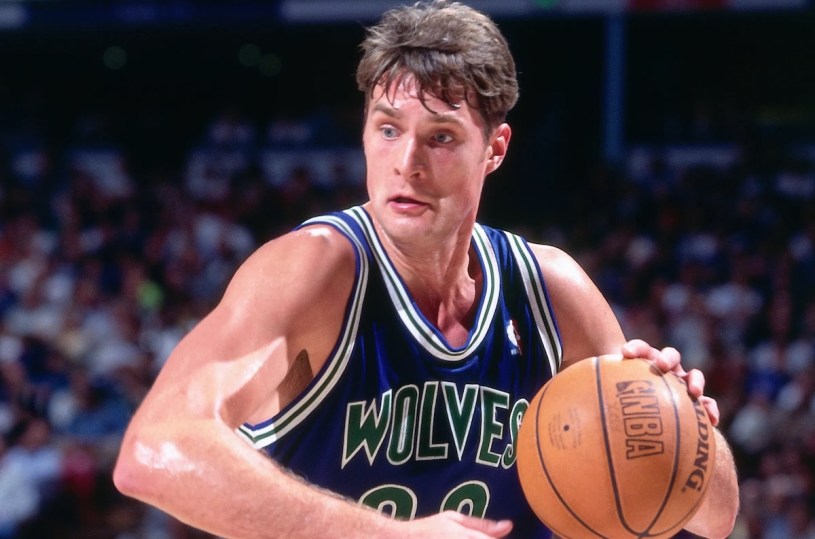
Everyone hates Duke when it comes to college basketball and March Madness: the reasons are myriad. Even just a quick Internet search (search term “Duke basketball cheating scandals”) reveals the following summation: “Duke University has faced multiple allegations of cheating and misconduct in its basketball program over the years. These scandals have raised questions about the integrity of the program and its recruitment practices.” Even if we cannot trust the AI summary, there’s enough smoke here, really.
Saturday Smugness takes on one of the most-hated (albeit not by us) Duke players ever: Christian Laettner. He was the only collegiate member of the 1992 Olympic basketball Dream Team, and his college career is legendary—capped, really, by his perfect game in the NCAA Regional Final that spring against Kentucky, where Laettner was a perfect 10-for-10 from the floor and a perfect 10-for-10 from the line, while scoring 31 points and hitting the last-second, game-winning shot that cemented his legacy.
[It really was an amazing game to watch live for those us who had the fortune to do so at the time. Trust us; YouTube isn’t enough.]
We have nothing but mad respect for this guy’s college career: the list of accolades is ridiculous, including the reality that he reached the Final Four in every season of his four-year stay at Duke (1989-1992), and in his last three seasons, the Blue Devils played in the championship game—the first school to do so since UCLA from 1971-1973, although Kentucky replicated this feat from 1996-1998. Duke lost the 1990 title game before coming back to win the 1991 and 1992 championships. It was incredible.
His individual achievements are also stunning:we’re not going to list them here, but you can follow the link at the start of this sentence and read for yourself. The statistics don’t tell the whole story, as his Duke teams were pretty loaded, even when he was a freshman, so he didn’t have to “dominate” on his own. But as the consummate team leader and star, he was an excellent “coach on the floor”—getting better every season of his career, culminating in greatness, legend, and the No. 3 overall pick in the NBA Draft.
And that’s where we focus our analysis today: his pro career, while solid, was not spectacular, and it’s an interesting example of how even the greatest of college careers may not translate to NBA stardom. Laettner won the Olympic gold in 1992 and played in the NBA for 13 seasons, making a single All-Star team in 1997 while with the Atlanta Hawks, his second professional team after the Minnesota Timberwolves took him third overall, initially, before the Barcelona Summer Games. His career was pretty plain.
He never topped the NBA in any significant statistical category, and he garnered zero votes for the 1993 NBA Rookie of the Year Award, despite posing 18.2 points, 8.7 rebounds, 2.8 assists, 1.3 steals, and 1.0 blocks per game in his first pro season. Upon reflection now, that’s a pretty amazing stat line. But the T’Wolves won just 19 games that year despite Laettner teaming with small forward Chuck Person (the 1987 ROTY) and shooting guard Doug West (19.3 ppg). Ironically, the team just couldn’t score a lot.
Laettner only lasted three-plus years in Minnesota before the organization flipped him to the Atlanta Hawks. In 276 regular-season games with the Timberwolves, he averaged 17.2 ppg, 8.1 rpg, and 3.2 apg, while putting up more than one block and one steal a game as well. Yet since the team overall was so bad, his 6.2 Win Shares in his third season there (1994-1995) was his best one, and that sabermetric measurement really didn’t capture enough of his overall game. Clearly, the Minnesota brass was disappointed.
Yet the team never gave Laettner much of a supporting cast, and unlike his draft-class peer Shaquille O’Neal who got to play with Penny Hardaway in Orlando, the T’Wolves had never made the postseason before as a 1989 expansion team and would not until 1997 and weren’t a high-functioning organization (yet). In his two-plus seasons with the Hawks, though, Laettner hit his NBA peak, getting to the NBA playoffs all three years he finished with the team (1996-1998). His All-Star nod came in 1997 as well.
That was his best season by far: 11.6 WS, 18.1 ppg, 8.8 rpg, and 2.7 apg for a playoff team. It also was his career-high season for minutes played, as Laettner was on the court for 38.3 minutes per contest. At age 27, this should have represented the start of his career peak. Yet it didn’t quite work out that way, even though he had a solid follow-up campaign in 1998 with 7.5 WS. However, he “lost” his starting position, going from 82 games started/played in his All-Star year to just 74 games and 49 starts the next year.
He then was traded for a second time (of six total times in his career) to the Detroit Pistons, and his career arc just cratered. Laettner played in just 98 games across two seasons in Motown (11.5 ppg, 6.2 rpg) before being traded to the Dallas Mavericks before the start of the 2000-2001 campaign. At age 31 now, his Dallas stint was short lived (just 53 games) as the Mavs flipped him to the Washington Wizards, where he spent the next three-plus seasons (8.0 ppg, 5.8 rpg), winding down his NBA existence.
Ironically, in Summer 2004, he was traded back to Dallas for about two months before being moved again, this time to the Golden State Warriors; he never played a game for Golden State and was waived about two weeks after that transaction. He then signed with the Miami Heat and spent his last NBA season in South Beach, FL, to the tune of 5.3 ppg and 2.7 rpg in 49 games. Overall, as a result of this sharp decline, his career marks look very middling: 12.8 ppg, 6.7 rpg, 2.6 apg, and 1.1 spg. They look depressing.
The receipts say he earned over $61M in his career, so it’s hard to feel sorry for Laettner: his college career is legendary, and his NBA career was lucrative, if nothing else. As we have noted in many baseball-player commentaries, most sports fans would give up a kidney to have lived his life. We never understood the hatred for him at the time in the early 1990s, although we assumed in our early 20s that it was just jealousy. We look back now and just wonder why his pro career didn’t come close to matching Duke.
Maybe it was the coaching; maybe it was the supporting cast. Generally, though, he was a great college player among his contemporaries, and then his skills/talents just didn’t translate well to pro ball where every team had dominant college players on its roster. That is often the case when the talent pool is more concentrated; many amazing amateur players in all four major sports have great careers before going professional, and that success doesn’t always follow them forward. Such is life; it’s rough out there.
 Daily McPlay: (mostly) Historical Sports Analysis with TENACITY & VERVE