
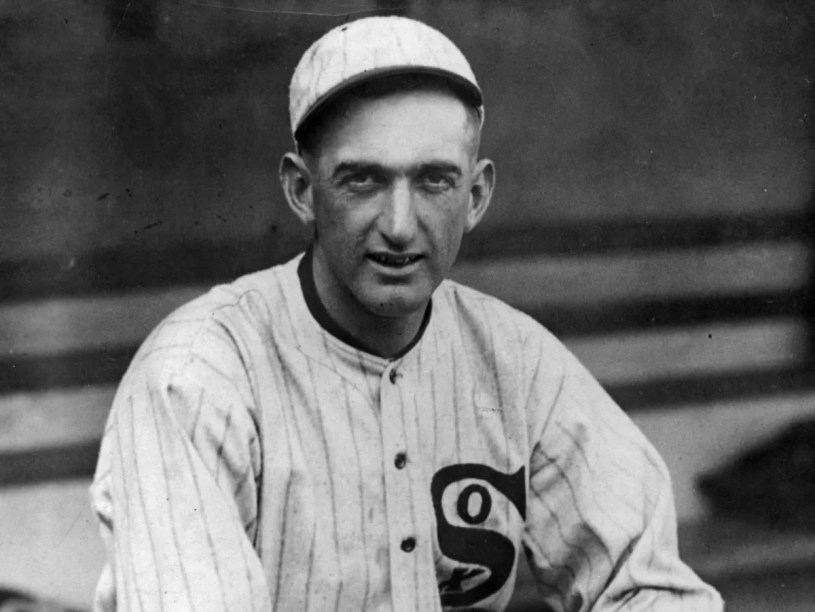
We are going to try to do a regular MLB Monday piece once again, now that the baseball season is ramping up for Opening Day in a month. Today, we’re continuing the theme of some earlier columns: our sabermetric look at the 1919 Chicago “Black Sox” and the more-recent glance at the 1971 Baltimore Orioles with their four different 20-win starters. Connect the dots between these two analytic explorations, and you get … drumroll, please … the 1920 Chicago Pale Hose.
That’s right: the team everyone usually forgets about because of the 1919 World Series and the subsequent mythologized show trial of the Black Sox—immortalized in the film Eight Men Out, among other media. While the 1919 team posted a .629 winning percentage, the 1920 team followed it up with a .623 winning rate, good enough for 96 victories despite the fact that it played with the specter of the legal proceedings hanging over it all year long. Alas, the Sox finished second.
[Another reason they’ve been forgotten is the fact the American League was won by the Cleveland Indians after they lost their starting shortstop to the only “on-field” fatality in the history of MLB: Ray Chapman was beaned by New York pitcher Carl Mays on August 16 and died from his injuries a day later. Interestingly, the White Sox were tied atop the AL with Cleveland at the start of play that day, but they would lose the pennant by two games in the end. But we disgress …]
One should be able to say there is no shame in losing the pennant by two games when you post 96 victories, yet for whatever reasons, the 1920 White Sox have all but disappeared from history—save this one tidbit: they were the first team of the modern era (the twentieth century, basically) to have four starting pitchers win at least 20 games apiece. Red Faber (23), Lefty Williams (22), Eddie Cicotte (21), and Dickie Kerr (21) combined for 87 wins and 17.8 WAR on the year.
That collective WAR mark seems kind of low, but the top three players on the team were position guys: second baseman Eddie Collins (7.9 WAR), left fielder Joe Jackson (7.5), and center fielder Happy Felsch (5.6) had pretty good seasons, too. Of course, this would be the final MLB season for Williams, Cicotte, and Jackson, among others, due to the fallout from the Black Sox scandal. However, we have given our 1921 and 1922 AL Cy Young nods to Faber ourselves, so there’s that.
What about the rest of the White Sox pitchers? The Big Four made all but 15 starts for the team, with swingman Roy Wilkinson making 12 starts and winning seven games overall. The other three starts were made by two random pitchers on the staff who totaled just 24 1/3 innings between them. Overall, Faber, Williams, Cicotte, and Kerr posted a 3.38 ERA in 1,175 IP, which undercuts the team’s overall 3.59 ERA. Faber was the best of the bunch with 23 wins and a 2.99 ERA.
Meanwhile, Williams really struggled, which is no surprise perhaps considering all we know about the strain of the scandal on him, emotionally and mentally. His 3.91 ERA was the worst of the quartet, and he allowed an AL-worst 15 home runs during the season—not to mention a league-high 130 earned runs. The fact he won 22 games, against 14 losses, speaks more to the run support he received from his teammates when on the mound. They had his back, for sure.
However, the White Sox were consistent: they posted identical 48-29 records in the first and second halves, and they finished 26-16 in one-run games, as well. We gave Manager Kid Gleason the AL MOTY nod, too, in 1920, as he navigated the challenges of the season with a deft hand. The reality is that the Sox were still tied for the AL pennant on the morning of September 11, but in a three-team race with the Indians and the Yankees, Chicago’s 12-6 closing run wasn’t enough.
That’s a testament to the quality of the Cleveland club and its resiliency to overcome the tragic loss of Chapman in August. One cannot argue the White Sox folded under pressure; in fact, after a 13-16 record in May, the Pale Hose went 76-40 the rest of the way (.655), coming together as a team to fight back from the 6.5-game deficit they faced at the start of June. They rode their four horses as hard as they could, really, and the team went 14-5 in extra-inning games as well.
It’s really hard to find many flaws with the 1920 White Sox, in truth. They hit .295 as a team; Jackson topped the AL one final time in triples (20) while hitting .382 and having his best overall season in a Chicago uniform at age 32. Five of the regular starters hit over .300, including first baseman Shano Collins (.303) and third baseman Buck Weaver (.331)—not exactly dominant career batsmen. Right field was the only true hole in the lineup, overall, and that could have cost them.
Nemo Leibold (minus-1.1 WAR in 108 games) and Amos Strunk (0.1 WAR in 53 games) were pretty bad, and perhaps Gleason could have given reserve Eddie Murphy (0.3 WAR in 58 games) more playing time in right. It may not have made a difference, and this where the argument could be made that the team missed former 1B Chick Gandil, who never played in the majors again after the 1919 Series. He had contributed 1.5 WAR in 1919, and his absence hurt the White Sox.
While he wasn’t a great player, he was a good one—and Shano Collins had to move from a reserve OF spot to play first base, when maybe he could have played RF instead. Yet Leibold had been a better producer in 1919, too, when he added 2.7 WAR to the team’s success. So, the combination of Gandil moving on and Leibold dropping off a cliff in production is possibly what ended up costing Chicago a chance at a second straight AL pennant. Overall, though, this was a wasted era.
From 1915-1920, the White Sox posted a .594 winning percentage, finished in the Top 3 among AL teams five times in six years, won two pennants, and the 1917 World Series. They were not an official dynasty, of course, but that’s a pretty impressive stretch of play, and to end up with just one MLB championship out of it had to feel like a disappointment at the time. This was the Shoeless Joe Era of Chicago baseball, too, and it would be another 85 years until the next crown.
 Daily McPlay: (mostly) Historical Sports Analysis with TENACITY & VERVE
Wow, well done! Thanks for the intense analysis of the ’20 Sox. I’m a huge Sox fan and didn’t know most of this.
Reid
LikeLiked by 1 person