
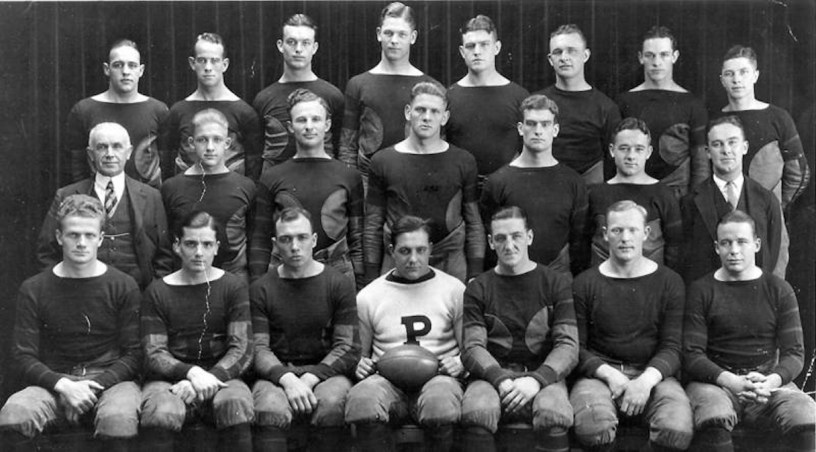
Our MNC Wednesday prequel miniseries moves back another year in time today , looking at retroactive mythical national championship selections. Once again, like our last look at the 1923 season, we have a tie with one of the selectors—and the second selector choosing a third team, to boot. This is fun for us, really, as it gives us a chance to do our own assessment to determine a singular winner of the retro MNC. Oh, the joy of being sport historians and journalists, right?
The 1922 MNC: California (NCF-tie), Princeton (NCF-tie), and Cornell (Helms); Princeton (DMP)
Let’s start with the SRS rankings, where NCF co-champ California (No. 6), NCF co-champ Princeton (No. 8); and Helms champ Cornell (No. 3) all fit into the Top 8 list. Obviously, we don’t just go by straight sabermetrics, although it is a good place to start. Clearly, however, there are many other teams to look at here, besides these three “charmed” teams! They were all undefeated, so that’s probably why the “official” selectors above chose them. We know better than that, though.
So, here is the full Top 8 in the SRS rankings:
- No. 1 Nebraska: 7-1, No. 21 SOS (out of 109)
- No. 2 Vanderbilt: 8-0-1, No. 22 SOS
- No. 3 Cornell: 8-0, No. 67 SOS
- No. 4 Centre: 8-2, No. 19 SOS
- No. 5 Michigan: 6-0-1, No. 24 SOS
- No. 6 California: 9-0, No. 89 SOS
- No. 7 Iowa: 7-0, No. 30 SOS
- No. 8 Princeton: 8-0, No. 4 SOS
This helps clear a lot up right away: Cornell is out with that mediocre SOS rating, while Centre is eliminated due to the two losses, while teams with comparable SOS ratings had zero losses. Michigan gets discarded due to its tie with the Commodores, who had a superior SOS rating, even if just by a little. California? Don’t make us laugh. What the heck was the NCF thinking, giving the Golden Bears half an MNC with that unholy weakness of schedule? That just defies logic!
Can we keep Iowa in with its SOS and perfect record? Yes, but only until we get to Princeton, of course, as the Tigers get precedence over the Hawkeyes with their own clean slate—and the most impressive SOS rating of the bunch. This begs the question of why Princeton is “ranked” so low sabermetrically? Well, it’s about margin of victory, and the Tigers didn’t dominate their schedule the same way the Cornhuskers and the Commodores did. More on this in a moment, of course.
After all that, we’re down to those three teams, in the end: Nebraska, Vanderbilt, and Princeton—the latter being the only one that has won a share of this MNC from the “experts” above. The Cornhuskers loss was on the road to No. 19 Syracuse by three points in the middle of a three-game road trip which also included Oklahoma and Kansas. But a loss is a loss, and Nebraska doesn’t have the SOS to overcome its loss against either Vandy’s tie or Princeton’s perfect record. Hmmm.
Why are the Huskers No. 1 in the SRS? MOV, as they outscored their opponents 278-26, overall. Yet it all goes by the wayside here, because other teams have superior numbers. Nebraska shouldn’t have lost to Syracuse, as they would have been a 6.5-point favorite on a neutral field … or even a 3.5-point favorite on the road. What’s the point of beating up a lot of teams if you end up losing narrowly to one of the better teams you played all year? The 1983 Cornhuskers know this.
So, Nebraska is out. What about Vanderbilt now? The Commodores gave up just 16 points all season, but that scoreless tie against the Wolverines at home costs them here, since Princeton’s record is blemish free against a much better schedule. However, even if Vandy had beaten Michigan, the overall slate would still pale in comparison to what the Tigers did: go undefeated against the No. 4 SOS in the country. In the end, margin of victory doesn’t matter here, because reality does.
On a neutral field, the Commodores would have been 1.5-point favorites over Princeton, and that’s still kind of a toss-up matchup. We have to merge the sabermetrics with the realities of what did actually happen, and the Tigers won five games by single-digit margins against a significantly better schedule: no ties, either. In the end, without meaning to sound repetitive, Princeton was perfect in the win column against a top-notch schedule, and no other team can say that.
This is the Tigers’ only MNC in our analyses (so far), of course, but they do join Yale (1923) and Cornell (1939) as the only Ivy League schools to win one. That in itself is impressive aplenty. Congrats to Princeton, a team that should be the outright champion of 1922. Of course, the Tigers didn’t play Cornell this season, as both were still independents at the time. That’s the breaks, right? Princeton would have been a one-point underdog on a neutral field, for what it is worth.
 Daily McPlay: (mostly) Historical Sports Analysis with TENACITY & VERVE