
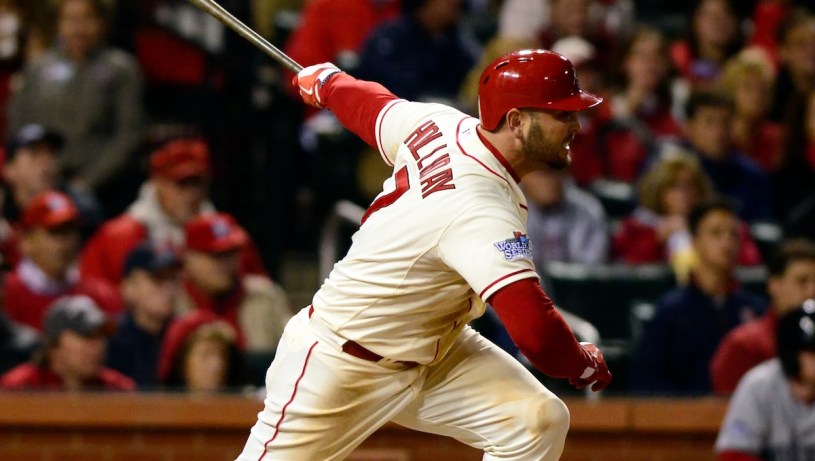
We are back with another Friday Funday column exploring a professional athlete possibly forgotten. Of course, they’re never truly forgotten, but you know what we mean. We’ve mentioned the soft spot in our hearts before for the Colorado Rockies, and today—on an observed federal holiday, for some—we take on longtime MLB left fielder Matt Holliday (see what we did there?). In his career, he played for Colorado, Oakland, St. Louis, and New York (A), compiling 44.4 WAR.
That mark places him 37th overall at his position in history—not quite great enough for the Hall of Fame yet certainly good enough to be remembered for his seven All-Star nods, an NL Championship Series vote win, and the 2011 World Series title. However, despite stellar postseasons in 2007 and 2011, Holliday only hit .245 overall across 77 playoff games with a pedestrian .723 OPS … a far cry from his regular-season numbers (.299 BA, .889 OPS). And yes, that BA isn’t a typo.
The dude blew it by hitting a combined .258 from 2014-2018 over the final five seasons of his MLB career, in 469 games with the Cardinals (2014-2016), the Yankees (2017), and the Rockies (2018). That kept him from finishing his career as a .300 hitter, for all he had to do was not play in 2017-2018, and he would have finished with a .303 career average. We dare say the $13M he made with New York in 2017 as a free agent was not worth it, but maybe that’s just us talking theoretical.
And that’s the sad part here: Holliday isn’t a .300 career hitter as a result of that last big paycheck.
He broke into the majors with Colorado in 2004 at age 24, finishing fifth in the NL ROTY vote after hitting .290 with an .837 OPS in 121 games. By 2006, he was an All Star, and in 2007, he won the NL batting title as the Rockies had a miraculous run to the World Series that was ended by the cheating Boston Red Sox. Collectively, in his first five seasons, Holliday hit .319 with a .936 OPS, but he managed just 18.5 WAR combined in those years due to some atrocious defense.
The minus-4.2 dWAR with the Rockies may not have mattered in the grand scheme of the universe, but Holliday’s offense had priced him out of the Colorado organization’s plans. The team traded him before his free-agent walk year to the Athletics for some serious return (outfielder Carlos González and closer Huston Street). Alas, CarGo would go on to make three All-Star teams himself over a decade with the Rockies; Street had won the AL ROTY in 2005 for the Athletics.
Alas, that 2009 season was amid a rebuilding cycle for Oakland, and the A’s flipped Holliday themselves to the Cardinals after 93 games after he hit .286 with an .831 OPS in the hitter-unfriendly confines of the Coliseum. Upon joining his new team in St. Louis, Holliday hit .353 the rest of the way (63 games) with a 1.023 OPS. It is a testimony to his hitting ability that he put up those solid numbers with a garbage A’s team on its way to a 75-win season. Holliday really could hit, obvi.
[By the way, Oakland’s return for Holliday in that trade? Clayton Mortensen, Shane Peterson, and Brett Wallace.]
In seven-plus seasons with the Cardinals, he posted 23.0 WAR, a .293 BA, and an .874 OPS. He helped St. Louis reach two World Series, although he again was a victim of the cheatin’ Red Sox in the 2013 Fall Classic. However, his overall game dropped off a shelf in his age-35 campaign (2015), when he somehow was named to the All-Star roster despite hitting just four home runs in 73 games. When his OPS dropped under .800 for a single season for the first time ever in 2015?
The Cardinals decided not to re-sign him after the 2016 season. That was the right move, after he contributed just 1.1 WAR in 183 games across the prior two years. He was looking at his age-37 season as a washed-up, former All Star, really, so why the Yankees decided to throw $13M at him is beyond comprehension. And again, even though Holliday secured a lot more cash from the transaction, he destroyed his statistical profile and deprived himself of a landmark-noted career.
His .231 BA with New York, on the heels of hitting .246 in his final year with the Cardinals, demonstrated he was all but done. He managed to reunite with a sad-sack Rockies organization in 2018 for 25 games in late summer, where he actually did hit .283 to almost get back to .300 for his career, but a final career batting average (.299) is painful to see. If he had just hung ’em up after 2016 … although again, maybe that isn’t practical or reasonable for a guy like Holliday to do.
We have the benefit of hindsight—even if he had to know his skills were gone—and of being on the sidelines, for maybe he had financial troubles and needed the final big pay day that the Yankees were offering. We would understand either reality, of course, both the drive to prove one’s self one last time and the lure of a lot of money. Heck, if someone offered us $13M for one year’s work, yes, we would jump at that chance (assuming it didn’t violate any ethics, laws, or morals).
As it is, Holliday still had a wonderful career to reflect upon, even if he didn’t finish as a .300 hitter in the stat column. He made about $160M total (so it would be a shame if he had really needed that last pay day, eh?), and he won a ring. What more could a 21st-century ball player ask for these days? Not much. Throw in the seven All-Star appearances, and he had a dream career for 99 percent of the guys in history who have ever put on an MLB uniform. Yes, we’d give our left testicle.
 Daily McPlay: (mostly) Historical Sports Analysis with TENACITY & VERVE