
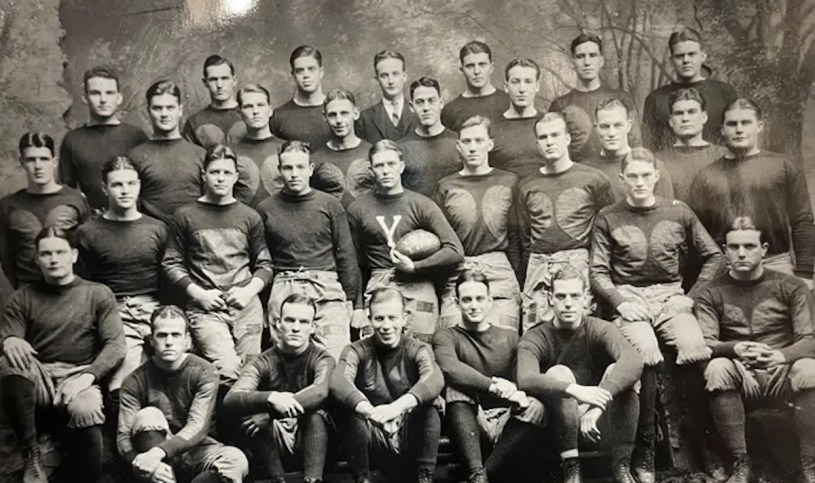
This MNC Wednesday prequel miniseries takes on the banner year of 1923 today. It is an interesting year as our two retroactive mythical national championship selectors combined to pick two champions. We, of course, will choose one of them, because no one likes ties, in reality. As usual, what we have is the math to pick a winner here, and while the math sometimes works out just the way it should, there are other times where the sabermetrics fail us miserably. So … yeah.
The 1923 MNC: Illinois (Helms, NCF-tie) & Michigan (NCF-tie); Yale (DMP)
We have five unbeaten, untied teams to consider here, plus another team that didn’t lose despite being tied once. So, that’s six team right off the top to evaluate. Let’s start with the No. 1 team in the SRS: Yale (8-0). The Bulldogs actually finished four-plus points clear of the field in sabermetric value, based on the No. 16 SOS against seven major colleges—with the eighth opponent being Bucknell. This Yale squad tossed five shutouts as well, so we’re surprised ourselves.
Next up: Illinois, the No. 2 team in the SRS. The Fighting Illini (8-0) also only faced one “small” school, which was nearby Butler. Overall, Illinois faced the No. 12 SOS, so that’s slightly better than the Bulldogs above, but the Illini’s plus-116 scoring margin pales in comparison to what Yale did (plus-192). The schedules are close enough to make that scoring-differential edge hard to ignore—hence the four-point edge for a neutral-field prediction. We’ll come back to this one.
Now, the Cornell Big Red finished third in the SRS, yet its 8-0 record came against a soft schedule: the No. 84 SOS out of 109 schools. This is what happens when you play four small schools, making half your schedule full of the cupcakes. We respect Cornell’s plus-287 point differential, but facing teams like Susquehanna really water down that accomplishment. In good conscience, we cannot take the Big Red seriously in this analysis. We are sure you understand consistency here.
Michigan’s SOS was also weak in comparison to that of Yale and Illinois: the Wolverines’ 8-0 record has less value since it came against only five major-college teams. The SOS ranking (34th) isn’t bad, but it’s not a Top 20 schedule, either. Popular perception at the time, and even in retrospect, is based on the 12 total points allowed on the season, but against that schedule, it certainly was a lot easier to do that. On a neutral field, Michigan would have been six-point dogs to Yale.
Meanwhile, the Colorado Buffaloes went 9-0 against eight major-college teams, finishing seventh in the SRS—two spots behind Michigan—mostly because the SOS is still weak. Facing just the No. 62 schedule, the Buffs just don’t rate here. And that’s okay, because neither do the Texas Longhorns (8-0-1) with their No. 69 SOS rating. Again, none of these teams can hold a candle to our undefeated teams at the top of the table that played Top 20 schedules, making this job easier.
[By the way, this season’s Rose Bowl featured SRS No. 17 Washington against No. 28 Navy, so the matchup was not all that interesting to the national scene.]
This really just comes down to Yale or Illinois, and the Illini just can’t match the Bulldogs’ domination as reflected in the SRS where the top team has a four-point edge on the second-ranked team. It’s interesting that Helms and the NCF forced the Illini to “share” a faux title with the Wolverines, too, while completely overlooking Yale in the process. We obviously won’t make that same mistake, with modernized data, so this MNC goes to the Bulldogs, without a doubt.
It is Yale’s first and only championship so far in our analyses, so congratulations are in order. We love a newbie!
 Daily McPlay: (mostly) Historical Sports Analysis with TENACITY & VERVE