
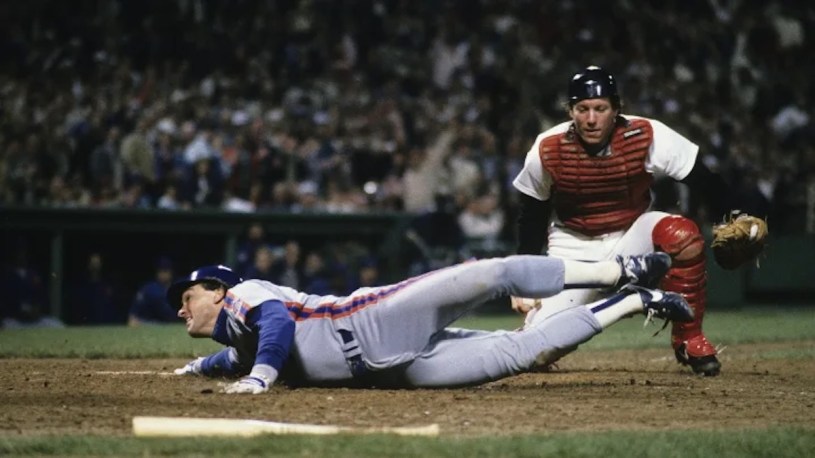
Today on MLB Monday, we are getting back to what we love to do most: write a short-form piece on a random professional baseball player from the past, analyzing their career and trying to put into historical context. Today, we’re looking at longtime Boston Red Sox catcher Rich Gedman—the guy who was charged with a passed ball in Game Six of the 1986 World Series that ended up costing his team a championship.
While first baseman Bill Buckner took a lot of heat for the Game Six implosion, Gedman also was involved in a lot of analysis after the fact, along with relief pitcher Calvin Schiraldi. It was a perfect storm of several little things going awry in the right combination and order that led to the Red Sox blowing a two-run lead in extra innings, needing just one strike to clinch their first World Series title since 1918: bad luck.
We’re not here to recap that; we’re here to look at Gedman’s career as a whole: a two-time All Star (1985-1986), the three best years of his 13-season tenure in MLB were 1984-1986 in Boston, as he compiled 12.0 WAR in that span. He was never better before or after, as his total WAR ended up in single digits (9.6), sadly. His best year—1985—saw him post 5.4 WAR and receive both All-Star and MVP-vote recognition at age 25.
Yet what happened in October 1986 changed his career trajectory, as from 1987-1992, he managed to post negative value with the Red Sox (1987-1990), the Houston Astros (1990), and the St. Louis Cardinals (1991-1992). After that three-year run where he was arguably the best catcher in the American League, Gedman would decline and “earn” negative-2.2 WAR in the final six years of his career, losing his prime to fate.
But let’s go back to the beginning first …
Gedman made it to the majors for just nine games in 1980, and in 1981, he finished second in the AL ROTY vote, contributing 0.8 WAR to the Boston cause. As an age-21 rookie catcher, he hit .288 in 62 games and posted a 110 OPS+ mark. He regressed the next two seasons across 173 games combined, with minus-0.7 WAR overall. Nothing about his game or numbers seemed to suggest he would break out anytime soon.
However, the Red Sox kept faith, and that was rewarded in 1984 with 3.3 WAR, including 1.3 dWAR which tracks well behind the plate for any team. His strong arm helped him lead the AL in throwing out runners three consecutive years (1984-1986), which was his best defensive attribute, although he did lead the league in passed balls (1986) once, too. Overall, in his three-season peak, he allowed 33 passed balls. Duly noted.
His bat was strong, too, though, as across 1984-1986, Gedman totaled 58 home runs after hitting just 11 dingers in his first 244 games. His .846 OPS and 126 OPS+ marks in 1985 were career bests at age 25, and the future seemed limitless for him at that point. Some minor regression in 1986 may have been expected, but it still was a very good season for him: 3.3 WAR, 2.2 dWAR, 16 HRs, 65 RBI, and 54 base stealers nabbed clean.
A 49.5-percent rate for throwing out runners in 1986 was a career high. Yet again, though, there were those 14 passed balls in the regular season. As Gedman played 134 games that year, that means he committed a passed-ball blunder every 9.5 games or so. In the 1986 playoffs, he went the first 12 games without a transgression, and his luck ran out in the 13th game of the postseason. We will let that sink in your brain …
Regardless of the events in Game Six, the Red Sox organization knew Gedman had been a significant contributor to the team’s success—sort of. He became a free agent after the 1986 season, but that was the era of owner collusion, and he surprisingly went unsigned throughout the winter. That makes no sense for a young guy coming off his three prior seasons of production, but even the Boston management partook.
Eventually, however, the team re-signed him on May 1, 1987, the first day free agents could re-sign with their former teams. After making $650K in 1986, the Red Sox signed him to a four-year deal worth almost $3.8M. For whatever reason, though, Gedman had one of his worst seasons in 1987. It may have been the psychological effects of both the World Series and the lack of interest in his services as a free agent, really.
Either way, he hit just .205 in 52 games with just one HR. His defense was still above average (0.4 dWAR), but this not what anyone would have expected as he entered the “peak years” of his career. It was a disaster for Gedman; he was a little better in 1988 with a 1.0 WAR mark, and he hit .357 in the 1988 postseason, but his overall impact and production was still a far cry from his high-point seasons of 1984-1986. It got uglier.
At age 29 in 1989, Gedman had his worst season since 1982, posting negative-0.6 WAR, and his time in Boston seemed to be over. With the late start to the 1990 season due to the labor lockout, he played just 10 games with the Red Sox before being traded to the Houston organization for basically nothing. The Astros thought they could get something decent out of him with the Boston franchise paying for it, realistically.
But his 40 games for Houston were even worse than his 10 games with Boston, and by the end of 1990, he was once again a free agent. The St. Louis organization signed him to a low-rate deal (two years, $350K total), a far cry from the salary he had been earning beforehand. His 89 games with the Cardinals over the next two seasons as a backup yielded negative-1.8 WAR combined, and the writing was on the wall for him.
The Oakland Athletics inked him to a minor-league deal before spring training in 1993 but nothing ever came of it. Gedman’s career was done and done, with the clear demarcation line between 1986 and 1987 showing a premature—and drastic—decline in his production. He had been an All Star, and then he experienced tragedy and trauma on a grand scale in front of a national television audience … game over.
Professional athletes are human, too, and they have the same flaws and psyches as the rest of us, for sure.
 Daily McPlay: (mostly) Historical Sports Analysis with TENACITY & VERVE