
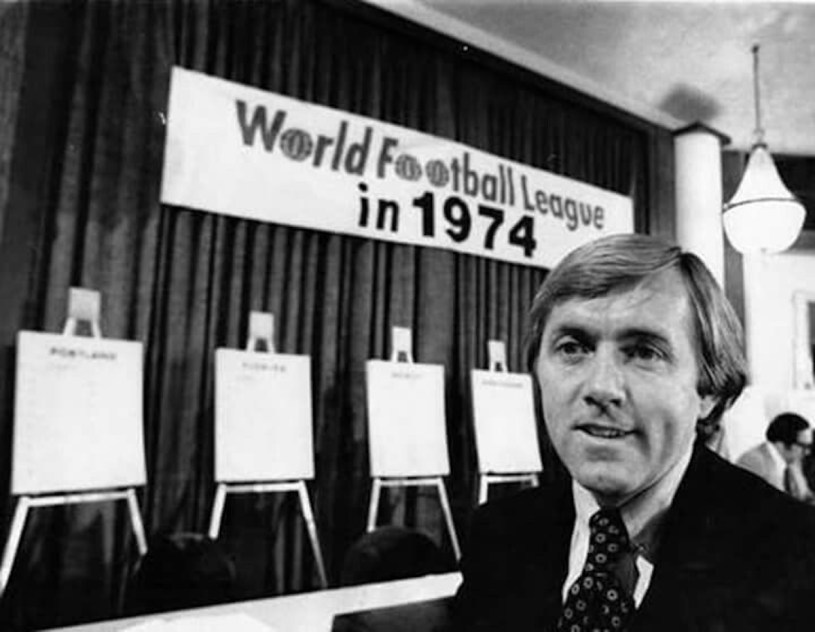
Tuesday Teasings returns this week to look at that strange anomaly of the 1970s: the World Football League. Other than a passing reference in one of our WHA pieces, we have spent no time on this phenomenon of the sporting past. Well, that ends today. There are a few websites out there dedicated to this niche topic, and the Wikipedia page itself is pretty interesting. We won’t just recap that here, of course, but it’s a starter kit.
What to make of the WFL? For starters, it didn’t last very long: the league played its full season in 1974 and then folded before the 1975 season could be completed. Some very famous names from the NFL’s Hall of Fame found their way to the WFL, too, making it much like the Federal League of the 1910s in baseball or the WHA of the 1970s in hockey. However, the fact the WFL couldn’t survive its second season says a lot.
Even the United States Football League made it for three seasons in the 1980s before an idiot named Donald J. Trump ran it into the ground by 1986. The WFL was started by the same guy who had the brainstorms for the ABA and the WHA, actually, so the blueprints were there. Plus, we all know the AAFC and the AFL did alright in merging with the NFL. The possibilities seemed very probable for WFL success.
Alas, it was not to be: perhaps the biggest issue in 1974 was the schedule, which called for a 20-game season—way longer than any other football season in existence, then or now, really. But worse, it all was supposed to happen in a 19-week period, meaning there would be times when a team would play twice in the same week. With a mid-July start date and a mid-November end date, too, there would be too much NFL overlap.
Financing was problematic, and stadium use was a challenge, too. These are things the USFL learned from the WFL’s mistakes (at least until Trump got over-involved; everything he touches dies, remember?) by setting up shop in the spring, without direct competition from the established league. Overall, the WFL failed for a lot of logistical and organizational reasons, too, and we will leave it at that. What about players?
A lot of NFL players jumped early, and some players signed future contracts, too. This was a weird situation, for sure, in terms of contract. Consider Ken Stabler, the Oakland Raiders star quarterback: he had played at Alabama in college, and he wanted to play pro ball closer to home. He signed a future deal with the Birmingham Americans to start the 1977 season after his Raiders contract expired, but it never happened.
Yet the Miami Dolphins lost three star players to the WFL after the 1974 season: Larry Csonka, Jim Kiick, and Paul Warfield. The list of players to move or planning to move to the new league is pretty long and astounding. The potential to devastate the NFL was there, even if the financing was not. In the end, without a real TV contract, there was no chance for the upstart WFL to survive. It always comes down to money, eh?
The only deal the league was with something called TVS Television Network, which is just as much a mystery to 1970s kids without cable as it is to readers today. It’s weird to think this TV network existed for almost 25 years (through 1993, actually) without many people even knowing what it was or that it existed. We know how the NFL butters its bread these days, so you can imagine how starved the WFL was for cash.
Thus, the Americans remain the only official champion of the WFL (1974), after beating the Florida Blazers in the World Bowl by a 22-21 score. There’s some video proof this event actually took place, as well, in the Americans home stadium (Legion Field). Perhaps what we find most entertaining today, though, is the names of the defunct teams in this league. They are fun, crazy, and memorable in some specific cases.
Take the Birmingham Vulcans, for example, who replaced the Americans for the second WFL season after the league champs folded due to financial reasons (imagine that kind of fiasco today!). We’re amazed no new expansion team in any sports league has taken on that nickname. Some of the team mascots have been adopted elsewhere, though: the Jacksonville Sharks, for example, demonstrate this, as do other teams.
One team name we don’t need to see is the Shreveport Steamer, even though its franchise predecessor (the Houston Texans) now exists in the NFL. The WFL’s Charlotte Hornets found their way to the NBA, twice of course, and there are other interesting team names that have resurfaced in the WNBA, among other places. Creativity isn’t everything, however; in this modern sports world, even in the 1970s, it still was about money.
As for Gary Davidson, the man behind the ABA, the WHA, and the WFL? He’s still alive at age 91. When the day comes he passes along from this lifetime, you can say you knew enough about him to warrant his inevitable recognition. He was pretty impressive, in terms of coming up with these leagues to rival the established one, but in this case, the third time was definitely not the charm. Alas, you can’t win ’em all.
Editor’s Note: only three franchises existed in the WFL that were west of the Mississippi River, like it was 1950s MLB or something. The Southern California Sun and the Hawaiians participated in both the 1974 and 1975 season, while the Portland Storm (1974) and the Portland Thunder (1975) also took part in the WFL’s short lifespan. Maybe that was part of the problem, as that’s not enough Best Coast excitement, is it? Nope.
 Daily McPlay: (mostly) Historical Sports Analysis with TENACITY & VERVE