
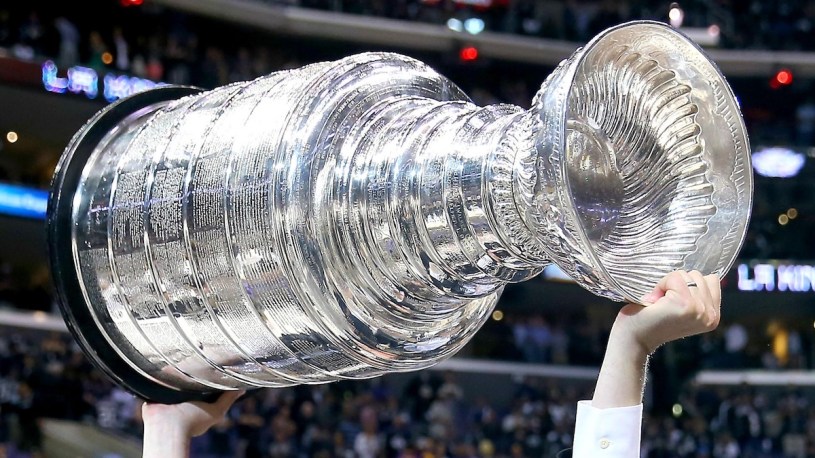
Last week on Wednesday Wizengamot, we discussed the definitive parameters for using the term “dynasty” in sports commentary. Today, we present the list of “official” National Hockey League dynasties as we see it here on The Daily McPlay. You don’t have to agree with us; that’s fine. We have outlined our definition(s), based on the actual meaning of language, and we use that as the basis for this list. Enjoy it at your own risk!
[Editor’s Note: We’re starting with the Original Six era, since the NHL was a bit of a mess before that. This keeps alignment with our Awards Analysis miniseries, as well, for structural framework’s sake. Thank you.]
1945–1951 Toronto Maple Leafs: The first real dynasty of the Original Six era, the Leafs won five titles in a seven-year stretch, interrupted only by Montréal in 1946 and Detroit in 1950. Toronto pulled off a three-peat run from 1947–1949 as well. With just six teams in the league, though, it was easier to do then, for sure.
1950–1955 Detroit Red Wings: They pulled off four titles in six year, not quite matching the Leafs for sustained success but coming very close. Toronto in 1951 and Montréal in 1953 were the only blips on the streak of titles here. The Red Wings won back-to-back titles in 1954 and 1955 to qualify for this list.
1956–1960 Montréal Canadiens: This is the gold standard for NHL dominance, as the Habs won five consecutive titles to establish a record that has never been matched—and rarely even approached. In 1961, it was the Chicago Black Hawks who won the title, putting a stop to the greatest stretch of success in history.
1962–1967 Toronto Maple Leafs: With four titles in a six-year span, the Maple Leafs closed out the Original Six era in style. They won three straight Stanley Cups from 1962-1964 before the Canadiens started another little dynastic run of their own (see below). Sadly, Toronto never has won an NHL title since this.
1965–1973 Montréal Canadiens: This represents the longest stretch of official dynastic success in league history, as Montréal hoisted Lord Stanley’s chalice six times in an eight-season span. They won consecutive titles in 1965-1966 and again in 1968–1969 as the latter championships kicked off the Expansion Era in style.
1974–1975 Philadelphia Flyers: The infamous Broad Street Bullies became the first expansion team to pull off the dynastic feat of back-to-back titles with their mid-decade stretch of success. Philadelphia almost made it three straight, but they ran into another Montréal dynasty in the 1976 Cup Finals (see below). Doh!
1976–1979 Montréal Canadiens: Forget the new kids on the block, right? The Canadiens had to re-assert their mastery of the sport to close out the 1970s. Strung together, from 1956-1979, Les Habs won 15 championships in a 24-season span, establishing themselves as the New York Yankees of the hockey world.
1980–1983 New York Islanders: Other than Montréal itself, this is the closest any team has come to matching the five-straight titles record. The Islanders had a chance to match the five-peat effort, but they lost in the 1984 Cup Finals to the next dynasty on the list. Isn’t that often the way it goes? Out with the old …
1984–1990 Edmonton Oilers: In with the new! After the WHA-NHL merger, this team dominated much of the decade with its high-flying offensive attack. The Oilers won five titles in seven years, including repeat championships in 1984-1985 and 1987–1988, while changing the game drastically from the 1970s version.
1991–1992 Pittsburgh Penguins: With more expansion happening, this started the current era, really, of minimal dynasties, as everything got much harder in terms of sustaining success. But the Pens capitalized on the style of play that served Edmonton so well in the prior handful of seasons: score a lot and score often.
1997–2002 Detroit Red Wings: With consecutive Cups in 1997 and 1998 to break a decades-long title drought, the Red Wings brought meaning back to the identity of Hockeytown. The dynasty might have started in 1996, when Detroit set a new record for wins in a season, but the playoffs had become gauntlets.
2016–2017 Pittsburgh Penguins: The Pens returned with a new cast of offensive stars to take consecutive championships, and they had some pretty good defensive guys, too. The team missed some golden opportunities between 2010-2015 to make this a much more dominant dynasty, but they did alright overall.
2020–2021 Tampa Bay Lightning: Interestingly enough, this dynasty could have been more, too, as the Lightning lost in both the 2015 and 2022 Cup Finals. The first title was during the Covid year, as well, when the league shut down for months between the end of the regular season and the postseason. Tough feat!
2024–2025 Florida Panthers: A second dynasty from the Sunshine State also stopped a second dynasty opportunity for the Edmonton Oilers, as the Panthers took them down in both Finals matchups. Who ever would have guess that no teams from California would have dynasties before these last two happened?!
There you have it; that’s our list. You can see the dynasties get “shorter” in more recent years with expansion and playoff-format changes, making harder to repeat at all in the first place—let alone pile on extensive title runs. Really in the last 35 years, the only long-term dynasty was the Red Wings’ one noted above, although one could argue it began earlier (1993) and ended later (2009). But there was little continuity there.
So, this is what we leave you with in the end: 14 dynasties. Hope it works for you as well as it works for us.
 Daily McPlay: (mostly) Historical Sports Analysis with TENACITY & VERVE