
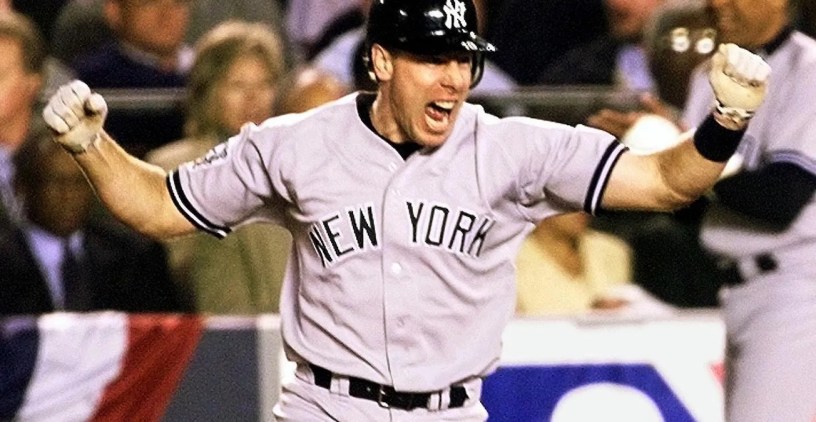
Our Friday Funday column returns today to examine the interestingly odd career of former MLB third baseman Scott Brosius. He was a nondescript player in Oakland with the Athletics for the first five seasons of his career (1991-1995), before having a random breakout year in 1996 at age 29 before regressing the following season to having his worst season ever. Yet, somehow, he still ended up winning three rings …
That’s right: most people remember Brosius as the guy the New York Yankees pegged to replace Wade Boggs at third base before the 1998 season. He posted 2.9 dWAR at the hot corner across four years with the Yankees (1998-2001), all of which ended up with AL pennants and World Series appearances. He only posted a .696 OPS in 58 playoff games during that successful New York run. Oddly, he then retired suddenly.
So, what do we make of Brosius’ career?
We’re so glad someone asked! Brosius was no one in Oakland for five seasons, compiling just 2.2 WAR overall while playing all over the diamond for the A’s: second, third, left, right, center, short, and first. Seriously, he played all those positions from 1991-1995. Then suddenly, everything came together for him in Year Six, as he settled into starting at third: .304 average, .909 OPS, 2.0 dWAR, etc. This was a different guy.
Why?
Hating to go here, we point out a few things about the 1996 A’s: this was the first full season in the majors for one Jason Giambi, known PED user, and it was the final full season in Oakland for Mark McGwire, who would be traded in 1997 to the St. Louis Cardinals. McGwire had fine tuned his PED use by this point, overcoming the injuries that had plagued him for the three prior years, and suddenly Brosius was “good”?!
That’s too much coincidence for us, really. Brosius made just $970K in 1996 and then saw his salary leap in arbitration to $2.55M before 1997—he regressed tremendously and had the worst season of his career as his average dropped more than 100 points, and his OPS decline more than 300 points. That is a tremendous roller coaster ride for Brosius, from 1995-1997: 0.6, 5.3, -0.1 WAR marks and .794, .909, .596 OPS marks.
All things considered, there’s only one explanation that makes sense for an average player at age 28 in 1995 to experience this kind of volatility: PED use, followed by discontinued PED use. We’ve seen this before where a player tries out the juice and decides they don’t like the way it makes then feel (or they feel they’ve secured enough guaranteed money to stop). Brosius may rep both, really, when we look at his specific sitch.
He was guaranteed $5.2M in 1997 and 1998 combined, so perhaps figured he didn’t need any PEDs after his 1996 season. But when he cratered in 1997, the A’s dumped him on the Yankees for Kenny Rogers, who the New York front office wanted to unload after two years of mediocrity in the Bronx (5.11 ERA for $10M combined). We don’t know how much of Rogers’ salary the Bronx Bombers picked up, but it was a win win.
In New York during the 1998 season, surrounded by talent everywhere and maybe a better coaching staff, Brosius thrived once again: 5.3 WAR, .300 average, .836 OPS. The Yankees won the World Series, and they re-signed their All-Star third baseman to a three-year, $15.75M deal. Brosius would lose his bat potency in his final three years, compiling just 2.3 oWAR, but he did win a Gold Glove in 1999 to balance it all out.
By stabilizing the defense (2.9 dWAR combined) in his four seasons in the Bronx, some could argue anything Brosius added on offense was a plus for this roster that was loaded with offensive stars. He won three rings, almost won a fourth, and then walked off into the sunset, quite wealthy ($22.5M career earnings), all things considered, for a guy who posted just 2.2 WAR for every 162 games he played. Nice.
We should note, too, that he did win the World Series MVP vote in 1998, despite his overall below-average career in October. We did not agree with that vote, but he did represent well enough that postseason. Yet overall, like his entire career, the postseason was an interestingly inconsistent ride for Brosius. We always like him as a player in Oakland for his grit, and we smiled when he won so many rings in New York. Alas …
Looking at it now, it’s pretty clear how he probably achieved that anomalous 1996 season to open the door to his lasting New York legacy, and that makes us sad. They say baseball is a game designed to break your heart, and as we get older/wiser, we look back at some things quite differently than when we lived through them. We’re not afraid to do this, because statistical patterns do not lie; we want facts and truth … even if.
 Daily McPlay: (mostly) Historical Sports Analysis with TENACITY & VERVE