
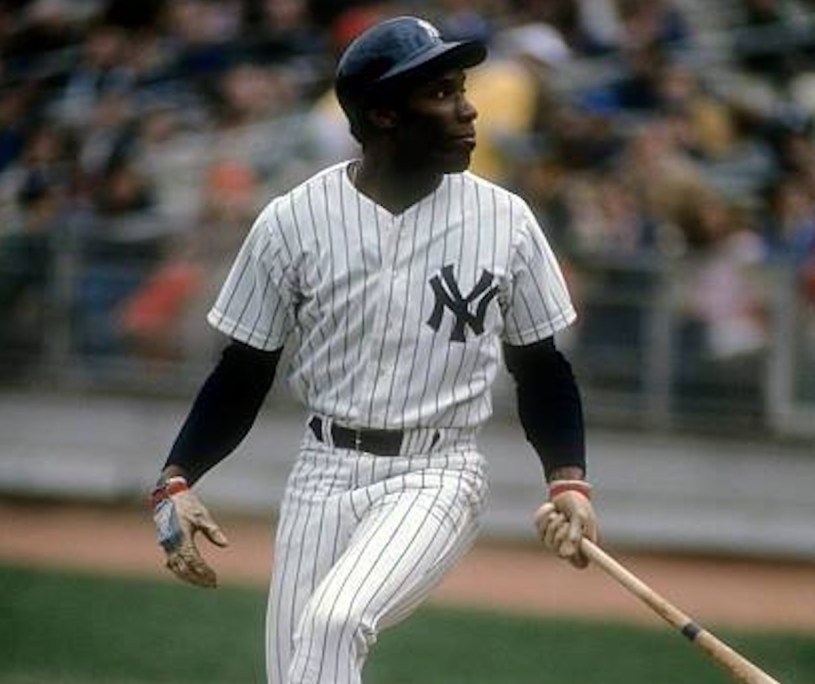
We are back on Friday Funday with another random look at an MLB player from the past. This time, it’s three-time All Star and one-time All-Star Game MVP Bobby Bonds. With 57.9 career WAR, there’s a borderline argument to be made that he belongs in the Hall of Fame, as the 24th-best right fielder in history. There are certainly less-qualified players than this Bonds in Cooperstown, and that’s a fact.
In many ways, Bonds was a revelation in the sport when he came up as a rookie in 1968 with the San Francisco Giants, in terms of raw ability—power and speed. The sport itself was evolving to embrace the stolen base more in the 1960s as an offensive weapon, and even though players like Mickey Mantle and Willie Mays had the same tool combinations as Bonds, they weren’t encouraged to use them fully, really.
He played in just 81 games as a rookie, but in his first full season (1969), Bonds’ tool set was on full display: 32 home runs and 45 stolen bases in 49 attempts. He posted 6.2 WAR, which somehow only got him 30th place in the MVP balloting as the Giants won 90 games and finished second in the newly formed National League West. The downside was the negative reaction to his leading the majors with 187 strikeouts, sadly.
That was another revelation Bonds brought to the sport, that you could still be productive despite a high K total as a hitter. His .824 OPS produced a 131 OPS+ as he patrolled right field in Candlestick Park to the tune of a negative-0.1 dWAR mark, hardly damning. There was an unwillingness for baseball traditionalists—sportswriters among them—to “reward” a guy who whiffed so much, even with only nine GDPs on his slate.
Think about that: yes, he struck out a lot, but he only was doubled up nine times all year. Today, we understand that the strikeout is the lesser of evils when you come to the plate with either runners on base or runners in scoring position. Back then, though, the high number of strikeouts may have turned “experts” against Bonds, despite his prodigious talents. In our perspective today, Bonds was an MVP finalist by 1971.
Even before that, though, he hit .302 in 1970 but struck out 189 times—not enough to diminish his .879 OPS and 135 OPS+ marks. Yet, there were no MVP votes for Bonds as the Giants dropped to 86 wins. However, as we noted above, his 1971 season was his best yet: 6.7 WAR, his first All-Star nod, and a fourth-place finish in the MVP balloting … thanks to a 145 OPS+ mark and only 137 strikeouts as the Giants won the NL West.
His best season would come in 1973, however, as he posted 7.8 WAR and again made the All-Star squad with a career-high .900 OPS. But the San Francisco roster as a whole was in decline, finishing third, which hurt Bonds’ MVP chances (third in balloting). We had him second in our analysis, thanks to a near-historic season with 39 HRs and 43 SBs. He did lead the majors in Ks again (148), but he clearly was getting better.
However, that was his age-27 season, and instead of being the start of his peak years, it really was his actual pinnacle. After a .798 OPS in 1974, the Giants traded Bonds to the New York Yankees, who were starting to ramp up the roster in the early Steinbrenner years. Alas, a 30-30 season with 5.0 WAR and an .888 OPS wasn’t enough for King George, so New York flipped Bonds after just one year to the California Angels.
Now in his 30s, he had one average season (1976) in Anaheim and one great season with the Angels (1977) before he was on the move again: traded to the Chicago White Sox, where he didn’t last more than two months into the 1978 season before being flipped to the Texas Rangers. In his age-32 season with these two teams combined, he posted 31 HRs, 43 SBs, and an .834 OPS for a 133 OPS+ mark—still very good, overall.
So, what was the deal? There are many reasons and theories explored elsewhere, but the reality is his productivity just “wasn’t enough” for whichever team employed him at this point. And that does not make sense to us at all, as his 4.4 WAR mark in 1978 suggests. But the die was cast, rightfully or not: he spent the 1979, 1980, and 1981 seasons with three different teams before retiring at the age of 35 at the end of 1981.
Bonds still managed to contribute 3.5 WAR to the 1979 Cleveland Indians, although his production for the St. Louis Cardinals in 1980 (-0.4 WAR) and the Chicago Cubs in 1981 (0.1 WAR) clearly demonstrated his physical tools had eroded, naturally. He was never a truly stellar glove man, but he did manage to win three Gold Glove votes, which we have discussed elsewhere. It just seems whatever he did do was never enough.
Which is a shame, because he did do so many positive things on the diamond: 332 HRs, 461 SBs, .an 824 OPS, and a 129 OPS+ overall. Sadly, his only postseason appearance came in three games during the 1971 NL Championship Series against the Pirates, which the Giants lost; his performance was unremarkable, with just two hits in eight ABs and no HRs or SBs. He walked twice and struck out four times in a losing sweep.
His legacy is mixed, although with time, we come back to our opening statement: he’s a borderline Cooperstown candidate, and it seems like few people really want to acknowledge that achievement. It is ironic to point out that his .888 OPS in New York remains his “best” mark in terms of a franchise stay, but it wasn’t enough for Steinbrenner, and that just seemed to compound the down reputation Bonds had then.
Fuckin’ Steinbrenner, yo (excuse our Frenchlish).
 Daily McPlay: (mostly) Historical Sports Analysis with TENACITY & VERVE