
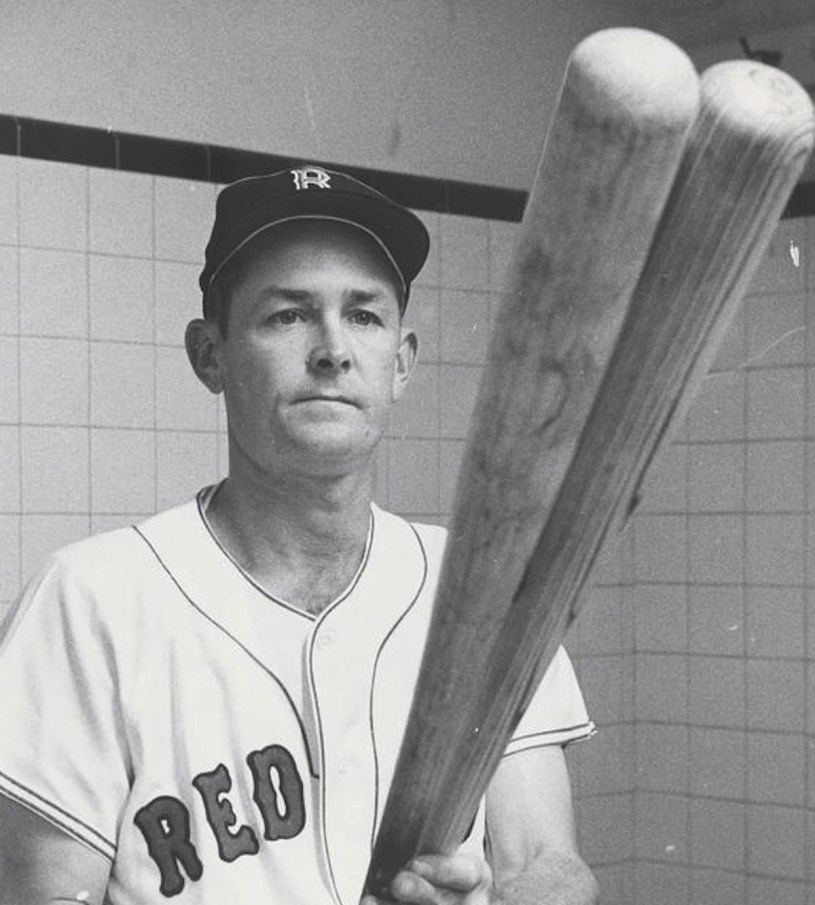
It’s time for MLB Monday again: today we look at longtime MLB infielder Pete Runnels, who won two American League batting titles (1960, 1962) while playing for the Boston Red Sox. The first batting title came in his age-32 season after Runnels spent his first seven seasons with the Washington Senators (1951-1957). He made five All-Star teams in his Boston years (1958-1962), while hitting .320 overall with the Red Sox.
However, Runnels finished with a .291 career average, as he was not able to hit as well with the Senators or the Houston Colt .45s (1963-1964), where he finished his career. After hitting .326 at age 34 in his final year with Boston, he was traded to expansion Houston where he hit just .246 in 146 games before being released in the middle of the 1964 season. Did Runnels suddenly forget how to hit? It’s a very good question, really.
We will return to that later.
His .274 average with the Senators was probably his real level of production, and his surprise years in Boston came playing in Fenway Park while also getting some hitting lessons from Ted Williams, we suspect. While he peaking in Washington with a .310 average in 1956, he also bottomed out there with a .230 average in 1957. At age 29, his career might have been over at that point, if not for the Red Sox reaching out.
With little power (49 career home runs) or speed (37 career stolen bases), Runnels was a contact hitter who mostly hit a lot of singles. His career SLG (.378) was just three points higher than his career OBP (.375). He drew 844 career walks while only striking out 627 times. His eye at the plate definitely improved with his move to Boston and tutelage by Williams: his .408 OBP in Boston was 53 points higher than with the Sens.
Of his 29.9 career WAR, over 20 of that came with the Red Sox. He was a slightly below average fielder at first, second, and shortstop (negative-1.8 dWAR overall), emphasizing once again his primary value as a contact hitter who got on base. He actually got caught stealing more times (51) than he was successful, too, so his baserunning was not a strength. Of his 1,854 career hits, almost 79 percent of them were singles.
As for those All-Star nods, they came in three different seasons (1959-1960, 1962), including twice when there were two ASGs per season (1959-1960). His .753 lifetime OPS equates to a 107 OPS+ career mark, showing Runnels to be above average in offensive production. When we think of five-time All Stars, we don’t think of guys with those OPS numbers, for sure, regardless of eras in which they played, so … yeah.
As for why he suddenly lost his ability to hit after winning the 1962 AL batting title, it’s historically attributed to changing leagues after 12 seasons in the junior circuit—and obviously the ballpark and team effects, too. We don’t have an issue with either of those explanations, and we’d just factor in the obvious one, too: age. Runnels just hit his physical breaking point, and it meant the end of his career as a solid hitter.
Did we mention he’s not in Cooperstown? We probably did not need to do so.
 Daily McPlay: (mostly) Historical Sports Analysis with TENACITY & VERVE