
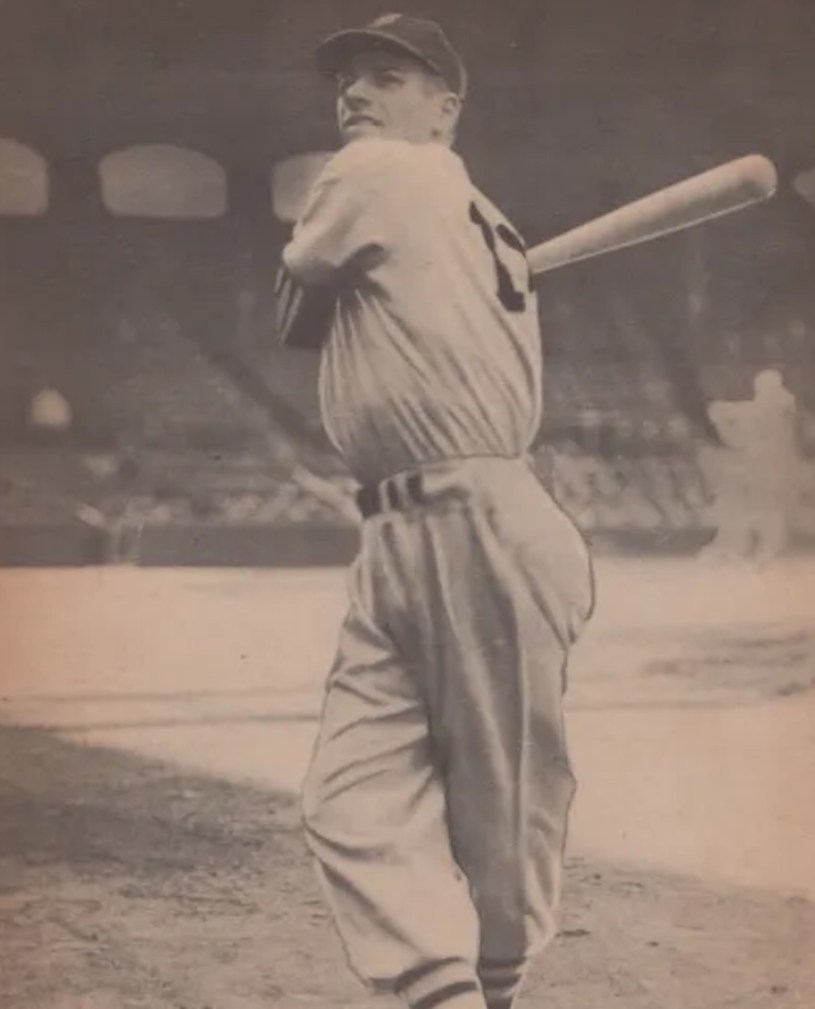
Our Friday Funday entry today takes on two-time Boston Red Sox All Star Billy Goodman, whose career stretched from 1947 to 1962—and features many interesting tidbits. He was a lifetime .300 hitter, as well, exactly, another one of those who is not in the Hall of Fame despite playing for a long time. His 27.0 WAR mark falls very short of Cooperstown standards, yet he collected 1,671 hits overall in a mere 1,623 games.
Goodman’s issue was that he rarely played in all the games in a singular season, never appearing in even 150 games in a season, ever. His career splits show he got most of his game action against right-handed pitchers (4,402 ABs) while not being used anywhere near as much against southpaws (1,144 ABs). His batting averages against each reflect the differences in outcome: .308 BA against righties, .262 otherwise.
The .112 gap in his respective OPS marks also illustrate Goodman’s utilization and the reasons for it. Still, after a cup of coffee in Boston during the 1947 season, he hit .310 with an 801 OPS in his rookie year of 1948, when the Red Sox ended up losing the AL pennant in a playoff against Cleveland. His 1.8 WAR contribution certainly helped his team get that far, even though he only played in 127 games and hit a single home run.
His plate discipline was evident from the start of his career, however, as he drew 74 walks in 1948 while striking out just 44 times in posting a .414 OBP. His career numbers better that pace, actually: 669 BBs and 329 Ks. He was an All Star in 1949 with Boston and again in 1953, as his 10-plus seasons with the Red Sox produced a .306 BA and a .773 OPS—but only a 101 OPS+ as he mostly played second base defensively.
Yet while with Boston from 1947-1957, he also played every position except center field and catcher at one time or another to the overall tune of a 1.7 aggregate dWAR mark as a Red Sox player. His overall 21.8 WAR in a decade of play is not overwhelmingly good, obviously, even if the batting average and OBP (.386) were very good. Goodman had little speed on the base paths, stealing just 37 bases and getting caught 30 times.
However, at age 31 in 1957, the Red Sox traded him to the Baltimore Orioles, where he played in 73 games and hit .308 for the rest of that season. That wasn’t enough to impress his new club, though, as the Os immediately flipped him to the Chicago White Sox in December 1957. On the South Side of the Windy City, Goodman stayed for four seasons (1958-1961), while playing in 291 games and hitting .274 in the process.
His usage declines every year with the Pale Hose, going from 471 ABs in 1958 to just 51 ABs in 1961, and Goodman’s final years in the majors came with the expansion Houston Colt .45s in 1962. This was his only time in the National League, and he was in his age-36 season. He put up just a .598 OPS in 161 ABs, and that was it for his MLB career—which, of course, included the 1950 American League batting title with Boston.
Goodman hit .354 that year with the Red Sox as a utility player, appearing in just 110 games at a variety of positions: left, third, first, second, and short. His 485 plate appearances were enough to qualify for the batting crown, of course, and his batting average was a bit of an outlier, as he never hit better than .313 in any other season of his career. But he drew 52 walks and only struck out 25 times, so he was very effective.
From 1948-1954, the peak years of his career, he earned MVP votes six times, including five years in a row from 1950 to 1954. Yet he never reached the postseason with Boston, despite playing on some very good teams. His only postseason came in 1959 with the White Sox, and he hit just .231 with no walks and five strikeouts, surprisingly, in the World Series against the Los Angeles Dodgers. But at least he got there.
In the end, it’s an interesting career to analyze from afar now, considering the batting title, the batting average, and the plate discipline we don’t often see anymore in MLB. Goodman also was a unique player in the field, of course, being a jack of many trades with the glove—and effective enough to do so, while also providing positive value at the plate, too. Most of us fans would love to have this guy’s career in the game.
Today, it would make us multimillionaires.
 Daily McPlay: (mostly) Historical Sports Analysis with TENACITY & VERVE