
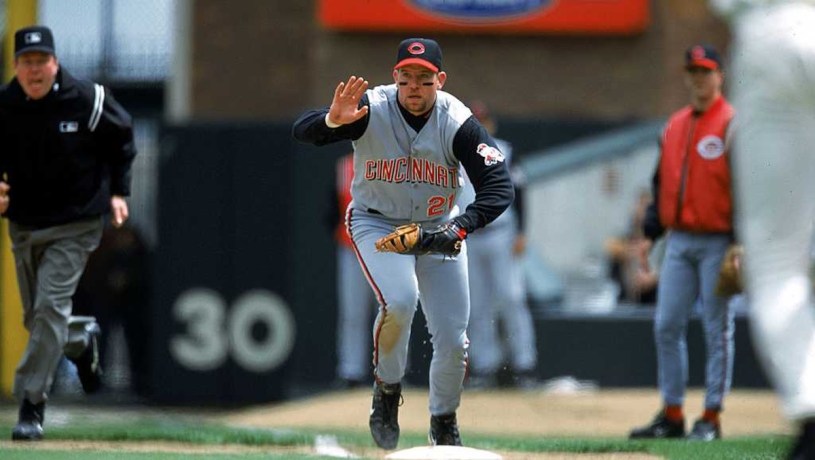
The Friday Funday column returns today with a look at former MLB first baseman Sean Casey, also known as “The Mayor” during his 12-year career that amounted to just 16.5 WAR despite his lifetime .302 batting average and three All-Star nods. Yeah, we don’t get it, either, and that’s why we’re checking it out today the way we like to analyze the careers of random baseball players from the past. So, without further adieu …
First off, his negative-7.0 dWAR means he probably was born to be a designated hitter, really, yet he only played 271 games in the American League during a career that spanned from 1997-2008. With 1,134 games logged in the National League, Casey had to play … somewhere … in the field for the vast majority of his career, and he only managed to play first. Not once did he get shoved into right field or left field, either.
With that out of the way, we want to emphasize his talent as a contact hitter with middling power and no speed. For every 162 games played, Casey walked 55 times while striking out just 67 times—while stroking 15 home runs and stealing two bases. Put that line together with his .302 average, and you get a very respectable .814 OPS overall. That equated to a 109 OPS+ mark for his career, so he was a good hitter, really.
His best stretch came from 1999-2005, all with the Cincinnati Reds. He made the 1999, 2001, and 2004 NL All-Star teams during that era, compiling 16.0 WAR in those seven seasons overall. The other seasons in his career—his brief debut in 1998 with Cleveland and his swan song seasons with Pittsburgh (2006), Detroit (2006-2007), and Boston (2008)—didn’t amount to much, obviously, although he did well with the Tigers.
He actually hit .432 in the 2006 postseason for Detroit, helping the team reach its first World Series since 1984. After hitting a mere .245 in 53 games with them after being traded by the Pirates, this was a great contribution to the Tigers’ postseason series wins over the New York Yankees and the Oakland Athletics. Of course, Detroit’s luck ran out in the Fall Classic against the St. Louis Cardinals, so Casey never won a ring.
The All-Star designations really are his legacy, since he never topped the league in any positive statistical category. His career-best .332 average in 1999 earned him some MVP votes, however. His top power numbers (.539 SLG) came in that same season (25 HRs), and it was one of two seasons (2004) where he drove in 99 runs—never making it to triple digits. In truth, his 1999 and 2004 seasons are very oddly similar.
Maybe those should be considered the bookends of a short prime that just didn’t keep into his 30s, meaning his peak years came a bit earlier than one might expect, historically. For a second round pick out of college, though, maybe it’s not so strange. He earned more than $41M across his career, so he clearly did the right thing for himself in life. We will note he still hit .322 in his final season with the Red Sox at age 33, however.
Yet that came in just 199 ABs, and with zero HRs that year, his WAR was right at 0.0 despite the impressive batting average. In nine “full” seasons, Casey hit over .300 five times, so he was more consistent with the average than he was with the power, which dipped oddly between 2001-2003 when so many of his peers were juicing. He hit just 33 HRs in those years, even though he topped 20 HRs in 1999, 2000, and 2004.
Alas, his slowness of foot did cause him to “lead” the NL in GDPs once (27 at age 30 in 2005). Perhaps that’s why Cincinnati traded its three-time All Star to the Pittsburgh after that season. Again, Casey made the most of his opportunities with the other teams in the homestretch of his career, for sure, and we salute him for that. His nickname came from chatting up opposing players at first and for charity work: a great legacy.
 Daily McPlay: (mostly) Historical Sports Analysis with TENACITY & VERVE