
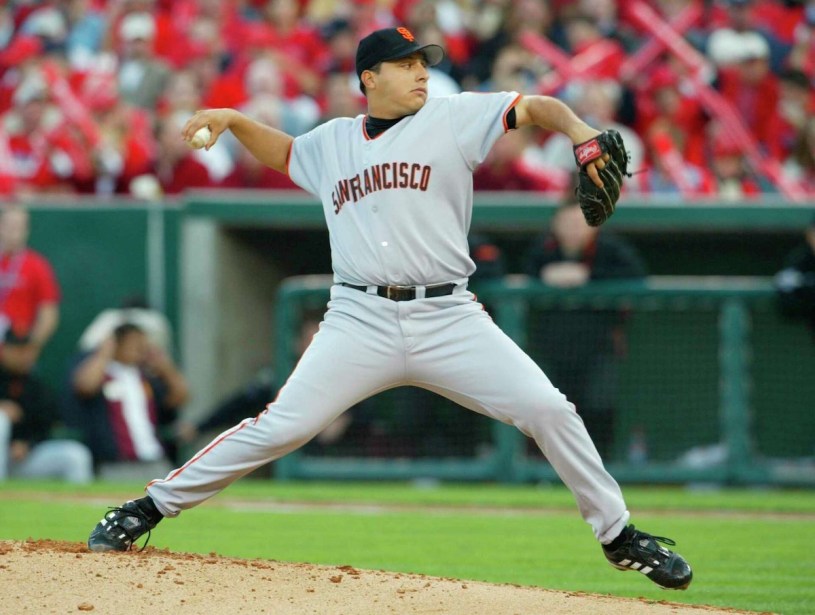
We are taking a different tack here on Thursday Thorns this week, as we look back at the 2001 San Francisco Giants, a team knee-deep in PED use as chronicled before in this space. We all know Barry Bonds was on multiple performance-enhancing drugs (thanks to test results that were uncovered), as were other Giants teammates as exposed in the BALCO scandal and subsequent trials in court. So, how did the team fare?
Amazingly, despite Bonds hitting a “record” 73 home runs, the Giants won only 90 games and missed the postseason. The team actually outperformed in Pythagorean projections, too, winning four more games than it should have, based on run-scoring differential analysis. Yet somehow, the Arizona Diamondbacks won 92 games after posting a 10-9 record against the Giants and went on to miraculously win the Series.
How did a team that cheated so brazenly fail to qualify for October baseball? Good question. The top four players totaled 27.3 WAR, but the twelfth-best player on the roster managed just 1.2 WAR, so there was a huge drop in production from the top of the roster to the middle territory. In fact, six position-player starters compiled just 4.3 WAR, with the three best hitters carrying the offense to its max potential:
- Bonds, LF: 11.9 WAR
- Rich Aurilia, SS: 6.7
- Jeff Kent, 2B: 5.2
The bench was pretty barren, too, with 28.6 WAR total from position players. The top three posted 23.8 WAR alone, so the rest of the position players (a whopping 21 guys) did next to nothing. That’s an incredible disparity, which proves the old adage about depth, really. As for the pitching staff, it wasn’t much better, in reality. Six of the Top 12 WAR earners were pitchers, and they combined for 13.4 WAR together … just meh.
Considering starter Russ Ortiz alone posted 4.5 WAR, the other five guys didn’t do a lot, individually. The top innings eater—the eternally overrated Liván Hernández—actually managed negative-0.9 WAR on the season, so you can see the second reason why this club missed the postseason, giving so many innings to such a bad pitcher. In fact, if not for a solid bullpen trio that posted 5.5 WAR combined, this staff was rough.
Overall, the pitching contributed just 10.8 WAR to the team’s finish, and that was spread out among 18 pitchers. Generally, each of them, on average, was barely above replacement level, so the Giants took a hit—no pun intended—with that kind of talentless roster. With a run-scoring differential of just plus-51, the offense was top heavy, the pitching was barely passable, and … well, that’s why the team missed October.
Also, despite finishing four games ahead of the Los Angeles Dodgers in the NL West Division, San Francisco lost the season series to its hated rival by going just 8-11 against them. The Giants also lost the season series to the Diamondbacks, so that did not help much, either. Going just 10-9 against the 73-win Colorado Rockies also hurt San Francisco’s chances of reaching the postseason, as that was a lot of missed chances.
What may have hurt the most was the 26-27 start for the team through the end of May. From June 1 on, the Giants went 64-45, which is great—but the whole division sort of lacked so much that S.F. went from five games out on the morning of June 1 to two games out by the time the season was over. Sadly for the Orange & Black, the Arizona team played just well enough across the same period (61-48) to hold on to the lead.
In the end, cheating didn’t help this incarnation of the San Francisco Giants, playing their second season in The House that Steroids Built. The team managed a 28-22 record in one-run games, which was a nice positive, and it also posted a 26-22 record in blowout games. On the surface, this team may seemed well equipped for October, but the lack of depth on offense and a very average pitching staff lost it that chance.
A fast start where the Giants spent 24 days in first place through May 15 was not sustainable, as San Francisco was never atop the division again after that date. Playing from behind all the time is hard work, and it took its toll on this group—not to mention, we assume, the media grind of Bonds’ HR-record chase … and all the negative publicity that came along with the “eventually” correct assumption that he was juicing.
 Daily McPlay: (mostly) Historical Sports Analysis with TENACITY & VERVE