
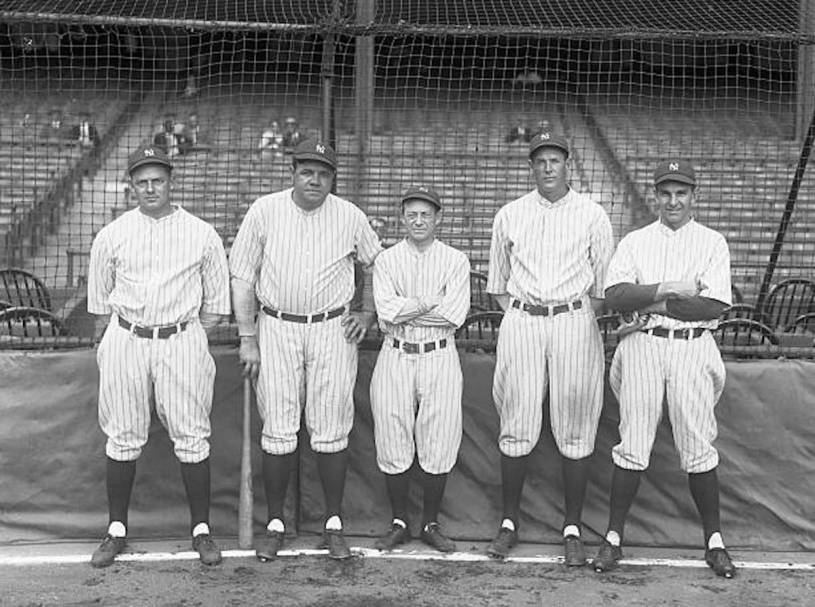
Once again, Friday Funday explores the career of a random MLB player in the past: Bob Meusel. He is one of those unique players who hit over .300 for his career yet is not in the Hall of Fame. A Californian from birth (San José) to death (Downey), he spent a decade playing for the New York Yankees (1920-1929) and one season with the Cincinnati Reds (1930). Meusel played in six World Series, winning three of them overall.
In his first MLB season, he played third base, left field, right field, and first base. After that, he mostly stuck to the outfield, as a regular RF starter initially (1921-1922) and then moving to LF to accommodate teammate Babe Ruth (1923-1929); you may have heard of him. In 1925 in his age-28 season, he actually led the American League in both home runs (33) and RBI (134) while hitting .290 overall. Meusel was solid.
However, he was never a strong fielder, as his negative-4.9 dWAR demonstrates, and he never posted a season WAR mark higher than 4.2 overall. His career 28.4 WAR probably is the reason he is not in Cooperstown, as it’s very low in comparison to the players at his position(s) generally in the Hall. Overall, he rates out to being a Top 100 right fielder in baseball history, based on the sabermetrics and whatnot.
But we like his profile, anyway: he hit .309 in 1,407 regular-season games, and his lifetome .852 OPS also equates to a 118 OPS+ mark. He was way above average, basically, and as a contact hitter, he only struck out 619 times. However, he walked even less: just 375 free passes in 11 seasons. We don’t have numbers of how man double plays he ground into, but perhaps that was a large number with his level of contact hitting.
He also had a strong arm in the outfield, according to eyewitnesses, even if his range was not stellar (he was a tall man for the time at 6-foot-3). The same frame, though, made him inconsistent on the basepaths as he stole 143 bases while getting thrown out 109 times. Today, most managers wouldn’t even let a guy with that failure rate take a chance at stealing. Yet times were different in the 1920s, and the game itself was, too.
Meusel was not a strong postseason hitter, however: his .225 average in those six World Series (34 games) is rough, as is his .632 playoff OPS. However, in the legendary Murderers’ Row lineup, he didn’t need to be a star. He only hit one HR in World Series play, and his 17 RBI were not even really a good output for the number of games he played in. His best Fall Classic came in 1922 when he hit .300 in a losing effort. Oh well.
Yet with championship teams in 1923, 1927, and 1928, Meusel was a key member of one of the most feared lineups in MLB history. Even if he wasn’t a Hall of Fame player, his .309 average in the middle of a stretch involving Lou Gehrig, Ruth, and others was significant: trying to pitch around this group was next to impossible. He often hit fifth in the order, so pitchers ran the risk of avoiding Gehrig and Ruth to get to him.
That resulted in 1,009 RBI in the 1920s, the fourth most in the majors. He also hit for the cycle three times, being the second player ever to pull off that feat in triplicate. So, we know Meusel could hit, and so could his brother, strangely enough: Irish Meusel hit .310 in his MLB career across 10-plus seasons with four different teams, including World Series champions in 1921 and 1922. Must have run in the family, perhaps.
[Editor’s Note: we will take on the elder Meusel brother in one of these columns down the line. We promise.]
 Daily McPlay: (mostly) Historical Sports Analysis with TENACITY & VERVE