
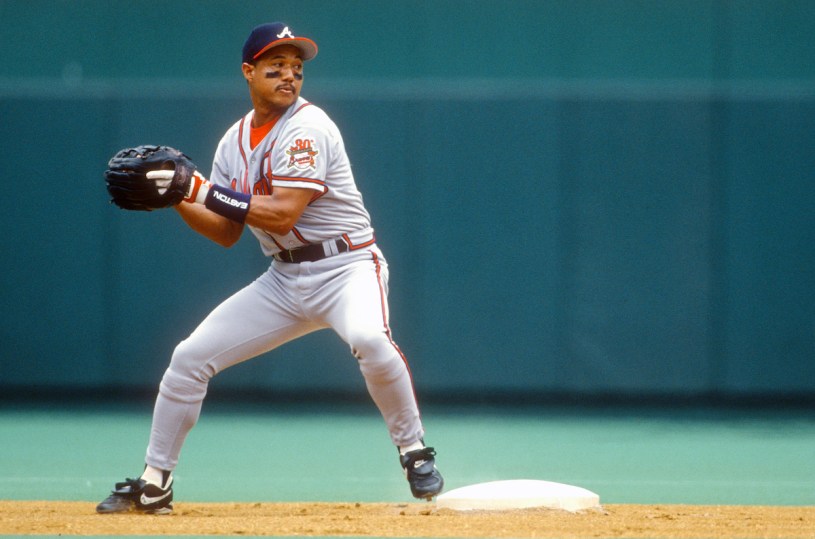
We are taking a break this week from the Gold Gloves analysis on MLB Monday and doing another fun exploration of a random major leaguer from the past: Rafael Belliard. Why? Well … mostly because he finished his career with a composite negative-0.1 WAR. We find that fascinating for a guy who stuck around in the show for 17 seasons—which is just effing incredible considering he was entirely replaceable, really.
Now, those were not all full seasons, as Belliard only played in 1,155 regular-season games. Still, he only played for two franchises: the Pittsburgh Pirates (1982-1990) and the Atlanta Braves (1991-1998). In that time, he compiled 8.7 dWAR, with a season high of 353 ABs in 1991 with the NL West champions (we still find it funny that Atlanta was in the “West” division when it literally is on the East Coast). He was sticky.
He never won a Gold Glove, although he did post five seasons of 1.0-plus dWAR (1986, 1988, 1991, 1993, 1995). Belliard played on a whopping eight division winners, even though he only saw action in five different postseasons, all with the Braves (1991-1993, 1995-1996). He played in four World Series, all with Atlanta, and won a championship ring in 1995 with them. However, his 46 OPS+ is an embarrassment.
How did a guy such a weak bat stick around so long? Good question. His defense was above average, but it wasn’t outstanding. He really only spent two seasons as a prohibitive “starter” as a result: 1991 and 1992, totaling 638 ABs—which is what a “normal” starter would accrue in a single season, of course. Belliard certainly was never a star, or even close to it, but he made a career out of being a serviceable team player.
It is interesting to note that before 1990, he won his arbitration case, getting a $380K contract after the Pirates offered just $225K, the same he’d made in 1989. In that last season of the ’80s, though, Belliard put up a .493 OPS and a 0.5 dWAR mark. We’re not sure how and why he won his arbitration hearing, but the Pittsburgh front office certainly was never going to re-sign him when he became eligible for free agency.
His 1990 season, the last one with the Pirates, did result in the team’s first playoff spot since 1979, but again, Belliard put up just a .543 OPS as the team used him even less than they did during the 1989 campaign. As a free agent, he clearly scored, as the Braves stepped in and gave him a $1M offer for 1991 and 1992, and then Atlanta increased that to $1.6M deal for two years (1993-1994) as he was suddenly part of a winning combo.
As he aged and his playing time diminished, the Braves lowered his base salaries to a combined $1.6M over his final four seasons, but Atlanta kept winning with him on the roster. When the Braves did not make it to the World Series in 1997 or 1998 (after making it in 1991, 1992, 1995, and 1996), perhaps they thought it was time to cut bait on the age-36 middle infielder. At that point, Belliard had served his purpose and was done.
It’s incredible to think his career even happened, really, as the sport wasn’t in its sabermetric “Moneyball” phase yet, and he represents that old-school concept of the integral team player who does all the little things that contribute to winning. Belliard lived a charmed life, considering his undrafted status and inability to hit the ball with any sort of actual success for 17 years in the major leagues. His glove? Solid.
That was enough, however, to win a World Series ring and make some pretty decent money for the era.
 Daily McPlay: (mostly) Historical Sports Analysis with TENACITY & VERVE