
This NHL Saturday miniseries on the Original Six awards ends today; looks like we made it. In 1933, the NHL had nine teams remaining amid the Great Depression, and by 1942, the league was down to seven teams in the middle of the World War II. When the New York/Brooklyn Americans franchise ceased operations, the NHL was left with just six teams—and would stay that size until the 1967-1968 season.
1943 Hart: Bill Cowley, C, Boston (original, confirmed)
Only two forwards appeared in the overall Point Shares Top 10 for the league: Boston Bruins center Bill Cowley (6.3) and Chicago Black Hawks left wing Doug Bentley (6.3). Cowley won the Hart vote, and we chose Bentley as our 1944 Hart winner. So, who do we choose for this first season of Original Six play? Well, the Black Hawks missed the playoffs by a point, while the Bruins finished eight points ahead of them. Easy.
We will confirm Cowley’s vote win, as Chicago still would have missed the postseason without Bentley, thereby diminishing his actual value. Cowley topped the league with 45 assists in a 50-game season, so he was a key reason Boston took second place in the regular season. He had a “chronically bad knee” which we suspect kept him out of active military duty, yet he also won the Hart vote in 1941, which we won’t analyze.
1943 Norris: Flash Hollet, Boston
We gave him our 1945 Norris, and we give him this one as well: Bruins veteran blue liner Flash Hollet. He is not in the Hall of Fame, although he was a two-time All Star and two-time Cup winner with Boston (1939, 1941). In this season, he topped all NHL skaters in Point Shares (7.8) while finishing 1.3 Point Shares ahead of the next-best defenseman. He would be traded midseason next to finish his career with the Red Wings.
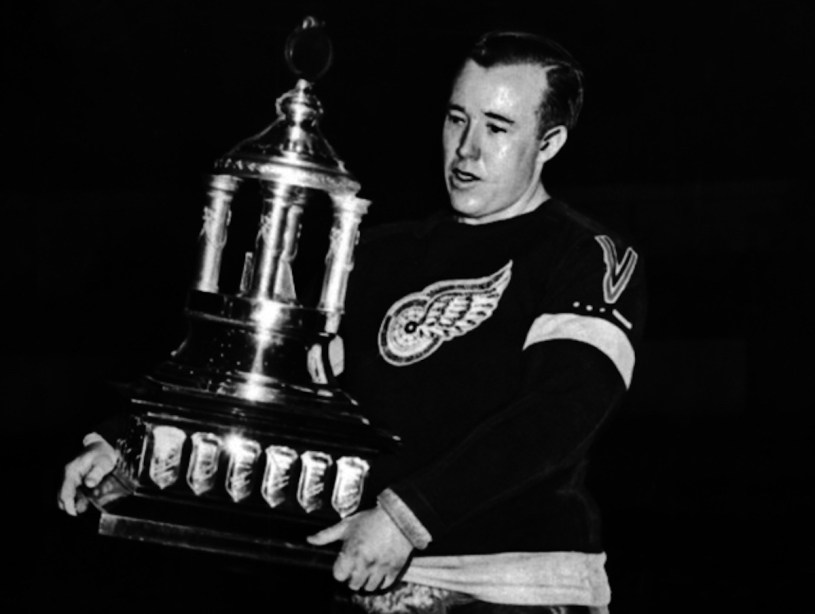
1943 Vezina: Johnny Mowers, Detroit (original, confirmed)
The standings were very bunched, with the top four teams within 11 points of each other, which makes this analysis more interesting than we expected. Detroit finished first, thanks to its Triple Crown-winning goaltender Johnny Mowers (12.8 PS), who won the Vezina. But we’d also like to give a shoutout to Toronto Maple Leafs legend Turk Broda (10.0), for his outstanding season, as well. Yet Triple Crowns cannot fail.
Interestingly enough, Mowers topped the NHL in losses (25) during the 1941-1942 season before recovering to lead the league in wins (25) during this campaign. Oddly as well, after the completion of this season, he joined the Canadian army and did not play again until 1947 when he went 0-6-1 in his final NHL stint(s).
1943 Calder: Gaye Stewart, LW, Toronto (original, confirmed)
Maple Leafs LW Gaye Stewart (4.0 PS) was the voted Calder winner, as well as the top PS-earning rookie. So we can confirm this vote win, easily, as the “second-best” first-year player—Montréal Canadiens D Glen Harmon, who would win our Norris in 1949—came in with just 2.6 Point Shares. It could be argued that fourth-place Montréal would have lost its playoff berth without Harmon, but the PS mark is too low, really.
As for Stewart, this was his age-19 season, and he joined the Royal Canadian Navy for two years after this campaign before returning to NHL action in his age-22 season in 1945-1946—when he topped the league in goals scored. The next time a Toronto skater achieved this feat was in the 2020-2021 season. He also holds the distinction of being the first player to win a Stanley Cup (1942) before winning the Calder Trophy.
1943 Conn Smythe: Mowers
The Detroit Red Wings capped of their regular-season, first-place finish with a Stanley Cup championship, beating Toronto in the semis (six games) and the Bruins in the Finals (four games). Two skaters stood out—LW Carl Liscombe (14 points) and LW Sid Abel (13 points)—while Mowers posted two shutouts and a sub-2.00 GAA mark. We go with the goaltender here, as the two skaters had each other to rely on and support.
 Daily McPlay: (mostly) Historical Sports Analysis with TENACITY & VERVE